Caldo de Pollo and Butterfly Dreams: Co-Labor as Pedagogical Art at the Borderlands of Feminist and Trans Nepantlera Practices
Adetty Pérez de Miles
Caldo de Pollo
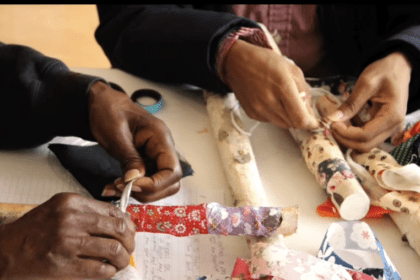
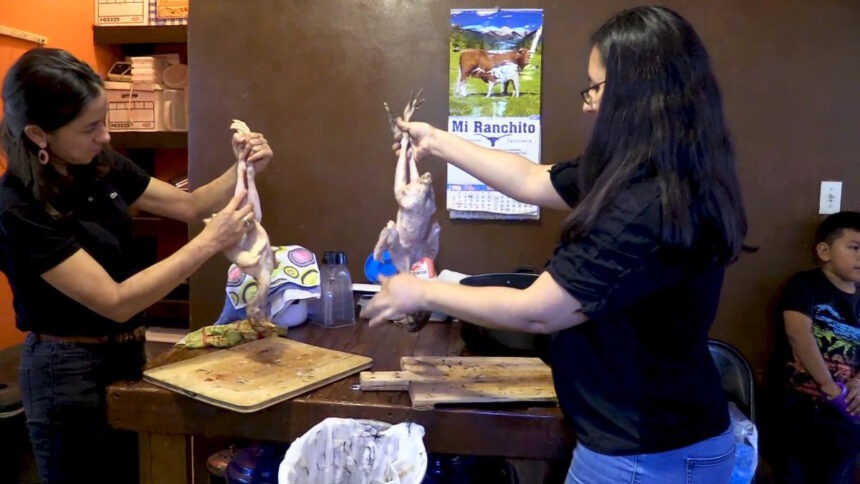
Bodies lean in, movements practiced and careful—the weight of the chicken in the hands, alive, warm, resisting. Wings beat against forearms; feathers rustle sharply in the open air. There is a short burst of sound, then quiet. A pot is already warming. Water hums low before boiling. As the chicken is broken down, rhythms emerge—knives tap bone, a practiced voice, steady and gentle—gives clear instruction. Someone salts the water. Garlic is crushed under the blade—sharp and bright—followed by onion and coriander seeds.
The broth takes time. Steam lifts slowly, carrying a scent that gathers people closer. Vegetables are cut by hand—carrots, green beans—each addition harvested from the garden. When it is ready, the caldo is ladled generously. The broth is clear and deeply aromatic, slicked with a thin layer of fat that catches the light. Heat spreads through the spoon before it reaches the mouth. It tastes patient, earned through time. People eat together, sitting, bowls cradled, bodies relaxed. What was once held, cleaned, cut, and tended moves inside the body, binding labor to care and marking the time spent together through nourishment.
Jenea Sánchez and Gabriela Muñoz have worked with the women’s collective DouglaPrieta Trabajan (DPT) in Agua Prieta, Sonora, Mexico, since 2015, developing a series of projects that span video installations, printmaking, performance, sculpture, and socially engaged art.[1] The opening scene frames Caldo de Pollo (Chicken Soup) (2020) as an art action embedded in shared labor.[2] The labor gathered around this pot of soup also points beyond the scene itself. What unfolds through the preparation and sharing of food raises broader questions about how people learn to sustain one another through co-labor, reciprocity, and collective responsibility, and how such practices become visible, valued, or overlooked. These questions emerge differently across two artistic constellations: first through Sánchez’s collaborations with the DouglaPrieta women’s collective, and later through Jay Lynn Gomez’s engagement with domestic labor, service economies, and gender transition, unfolding questions on how socially engaged art and pedagogy are shaped through borderlands feminist and trans nepantlera practices.
In Caldo de Pollo, these relations and knowledges circulate through embodied attunement—hands that steady, voices that guide, inherited practices shared, and time that must be waited on. Here, food‑centered practice becomes a site where pedagogy is organized through co‑labor and reciprocity, teaching less through information‑transfer than by holding participants together in relations of interdependence and careful responsibility for one another. Such relations echo feminist accounts of care as collective labor. In this sense, the shared work enacts a form of relational knowing as participants come to know with and from one another through embodied engagement.[3] Although Sánchez’s long-term collaboration with the DouglaPrieta collective foregrounds relational knowing through shared labor and embodied attunement, the video installation also raises broader questions about how such forms of labor and knowledge become visible—or remain unevenly visible—within exhibition and institutional frameworks, locating learning instead in the everyday practice of making caldo de pollo.
The stakes of this relational mode of co-labor become sharper when set beside other works that foreground animal harvesting, such as Postcommodity’s four-channel video installation Gallup Motel Butchering (2011), which stages butchering as a visual and spatial encounter with labor, land, and witnessing. In Postcommodity’s piece, a Diné (Navajo) woman butchers a sheep in a motel bathtub on Diné land, the act recorded from multiple angles and projected large in a small gallery so that viewers feel closely surrounded by the images and sounds. The installation’s “fast edits and multiple supersized screens” have been read as making the butchering intensely present—a “profound act” of cultural empowerment that, in this reading, is nearly overwhelmed by its own visual amplification.[4] Notwithstanding this critique, L’Hirondelle Hill et al. place the work in relation to Indigenous economies of hunting and harvesting, as well as to shared processes of learning how to prepare animals together, and to ongoing questions about how Indigenous women’s labor and relations become, or fail to become, legible to others.[5] Extending this line of inquiry, I argue that similar questions emerge for mestiza women’s labor and relations, particularly within borderlands contexts where visibility is unevenly structured and continually negotiated.
Set against these debates about mediation and visibility, Caldo de Pollo responds by re-situating legibility within practice, where what can be seen, recognized, or valued is negotiated through shared labor rather than through representation alone, building a quieter but no less confronting pedagogy. In this sense, Caldo de Pollo situates borderlands foodwork within an already collective space, where bodily skill and mutual reliance are inseparable, inviting participants and viewers to inhabit an ongoing feminist project of sustaining one another through small‑scale animal harvesting and permaculture gardens that support everyday nourishment and modest income.[6]
The video documents not only the making of soup but a redistribution of conventional pedagogical roles within socially engaged art. Artistic expertise and discursive fluency recede as domestic and communal knowledge comes forward as the primary site of teaching and learning. Drawing on Gloria Anzaldúa, the kitchen is a space of conocimiento, where borderlands subjects come to know themselves and each other through practices of care, endurance, and shared risk, rather than through institutional display.
Anzaldúa describes conocimiento as a multi‑stage, embodied process in which subjects move through rupture, critical self‑reflection, and re‑connection in order to remake their relations to self and world.[7] In Caldo de Pollo, this process unfolds not through solitary introspection, but through shared work in the garden and kitchen. Cutting, boiling, waiting, and eating together become occasions for reorienting perception, responsibility, and attachment under borderlands conditions of uneven access to food, water, and shelter; precarious work; and militarized crossings, where interdependence is not optional but necessary for survival.
Attending to these embodied scenes of conocimiento also requires attention to the material infrastructures that sustain them. On the ground, DouglaPrieta’s gardens, chicken coops, and shared kitchens make palpable the economic and ecological interdependence on which this pedagogy rests: seeds are saved and exchanged, surplus produce is sold or redistributed, and soil and water are tended collectively rather than as private property. These practices take shape within a maquiladora economy marked by low wages, unstable housing, and failing public infrastructure, where formal employment rarely guarantees food security or stable living conditions for women and their families. What might otherwise be framed as domestic labor most often coded as “women’s work” becomes coordinated labor that generates food security and environmental stewardship, repositioning cooking and cultivation as feminist economic practices. Focusing on how caldo is made and shared foregrounds pedagogy as co‑labor that exceeds any single artwork or workshop and extends into how co-labor between Sánchez and DouglaPrieta is negotiated across institutional partnerships, funding structures, and cross‑border visibility without allowing the collaboration to become extractive. Rather than offering an account of a conventionally framed “successful” collaboration, the next section examines how co‑labor is negotiated across artistic, community, and curatorial roles that remain structurally unequal, interdependent, and entangled.
Long Horizons of Reciprocal Co‑Labor in Socially Engaged Art
The partnership with DouglaPrieta Trabajan (DPT) began when the collective approached Sánchez to create a mural, a commission that unfolded over time and required sustained presence and ongoing engagement. From the outset, the collaboration was not organized as a single art project but as a reciprocal engagement, where learning emerged through trust and building shared working rhythms across different types of knowledges, temporalities, and responsibilities across the Mexico‑U.S. border.
This long horizon sharply distinguishes Sánchez’s work from itinerant models of social practice that treat community as a stage to be activated and then left behind. As Miwon Kwon, Grant Kester, and Gregory Sholette have argued, such project‑based or site‑specific engagements often reproduce the very asymmetries they purport to challenge, with artists foraying into unfamiliar places to generate culturally legible “participation,” conditions that, as Kester argues, foster a “de‑politicized conviviality,” and entail minimal accountability to local realities.[8] It must be acknowledged, however, that socially engaged artists often operate within the constraints of unpaid, precarious, and underfunded labor central to socially engaged arts funding and commissions.[9] As Sholette observes, such practices often rely on an un- or semi‑employed “reserve army” of cultural workers whose surplus labor effectively subsidizes the system from below;[10] together, these dynamics complicate, rather than resolve, the critiques of social practice.[11]
Sánchez’s work with DouglaPrieta Trabajan (DPT) explicitly refuses this extractive logic. The collaboration rests on returning—on listening again, adjusting expectations again, and renegotiating roles again. It proceeds through long‑term reciprocity and shared decision‑making on determining what kinds of visibility, funding, and institutional partnerships are feasible or useful. For example, Sánchez and the collective have declined short‑term invitations that would have required scripted community “participation” without addressing local priorities, choosing instead to pursue collaborations that support the gardens and workshops the collective identify as essential.[12]
Within this ongoing relation, Caldo de Pollo (2021), a video installation about making chicken soup, marks a significant inflection in this dynamic. Rather than organizing an art action in which participants contribute to a pre-designed artistic structure, Sánchez and Muñoz step into the position of learners.
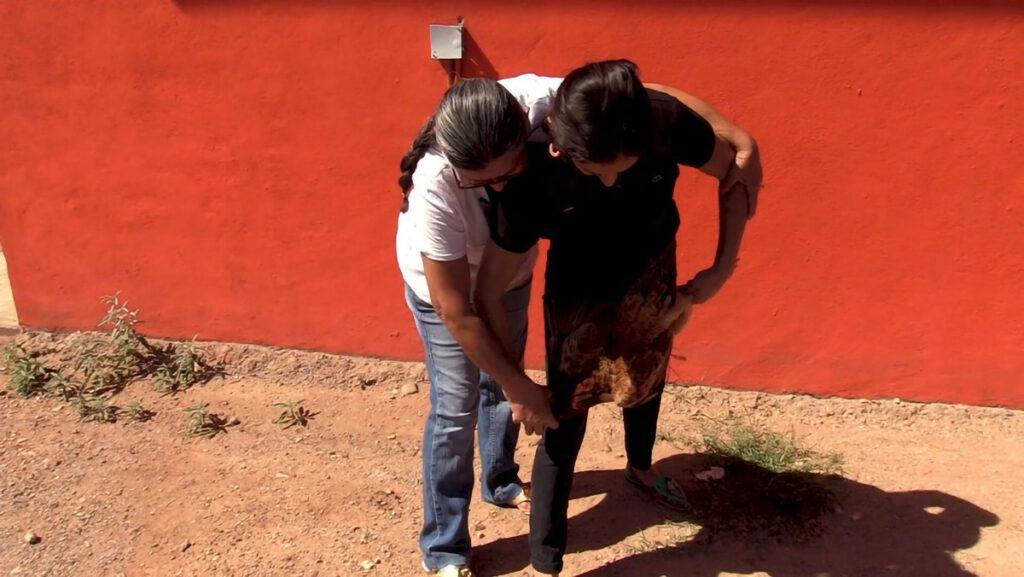
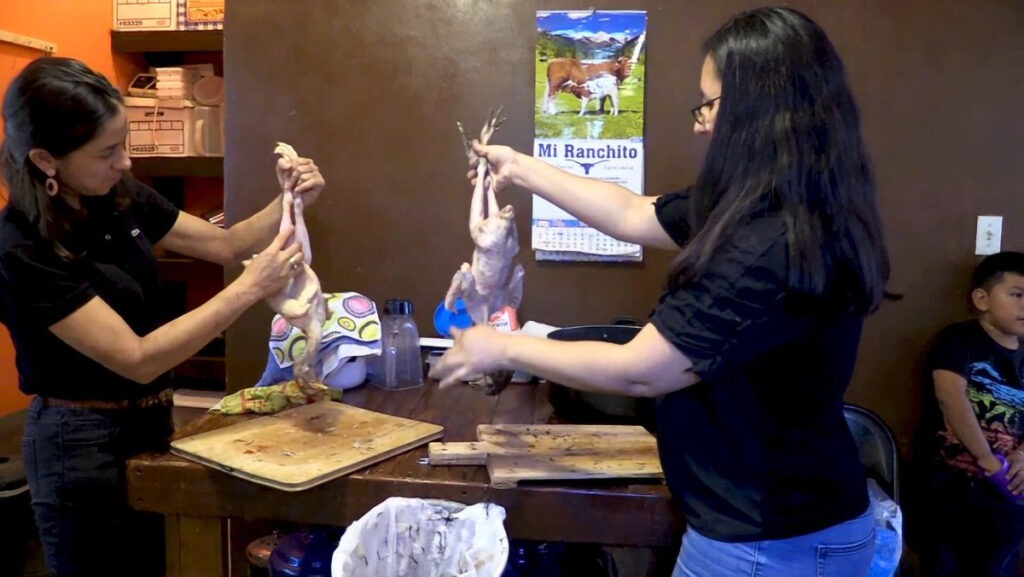
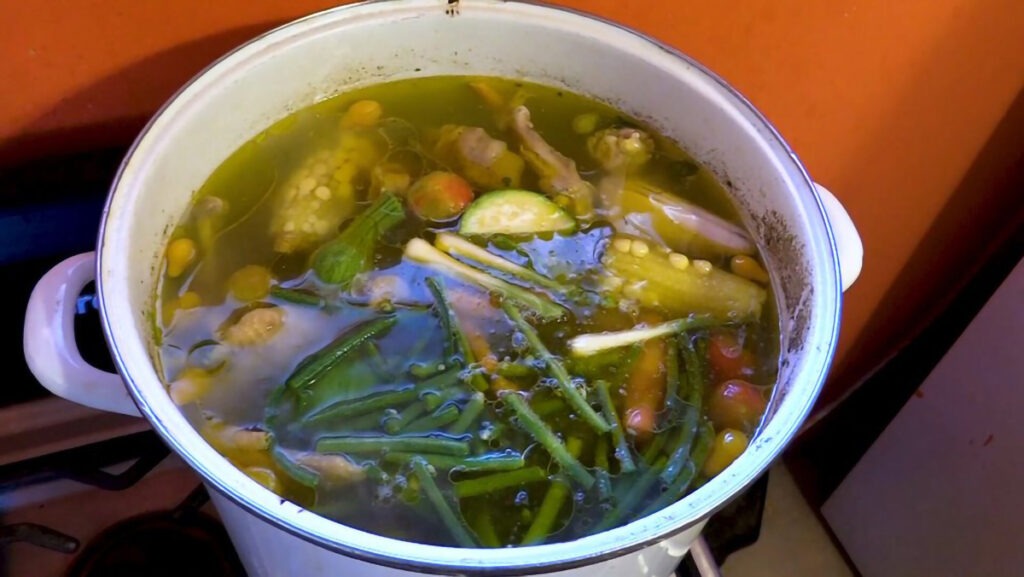
The work centers the collective’s expertise in raising, humanely killing, butchering, and cooking the chicken; it foregrounds the embodied knowledges that sustain households and gardens under conditions of economic precarity and anchors the collaboration in everyday practices of food sovereignty that underwrite DouglaPrieta’s feminist economic projects. In this sense, these practices are not only oriented toward sustaining life under constrained conditions, but toward maintaining collective control over how food is produced, shared, and valued; situating ecological care, economic survival, and social interdependence as inseparable dimensions of a locally grounded food system.[13] Although these practices foreground co-labor through shared material and pedagogical infrastructures, they also extend into forms of visual representation through which questions of authorship, visibility, and legibility are further negotiated.
Reconfiguring Legibility and Authorship with DouglaPrieta Trabajan
The relationship between M. Jenea Sánchez and the DouglaPrieta collective is long-standing, shaped through sustained collaboration. Their work engages directly with the concerns raised in Izabel Galliera and Noni Brynjolson’s Pedagogical Art in Activist and Curatorial Practices, particularly its emphasis on pedagogy as a distributed and relational practice.[14] Here, art pedagogy does not reside in the transmission of knowledge but in the structuring of relations: how labor is shared, how decisions are made, and how visibility is negotiated across participants. In this way, the collaboration foregrounds reciprocity, accountability, and non-extractive modes of working, with learning unfolding through shared labor and the redistribution of resources.
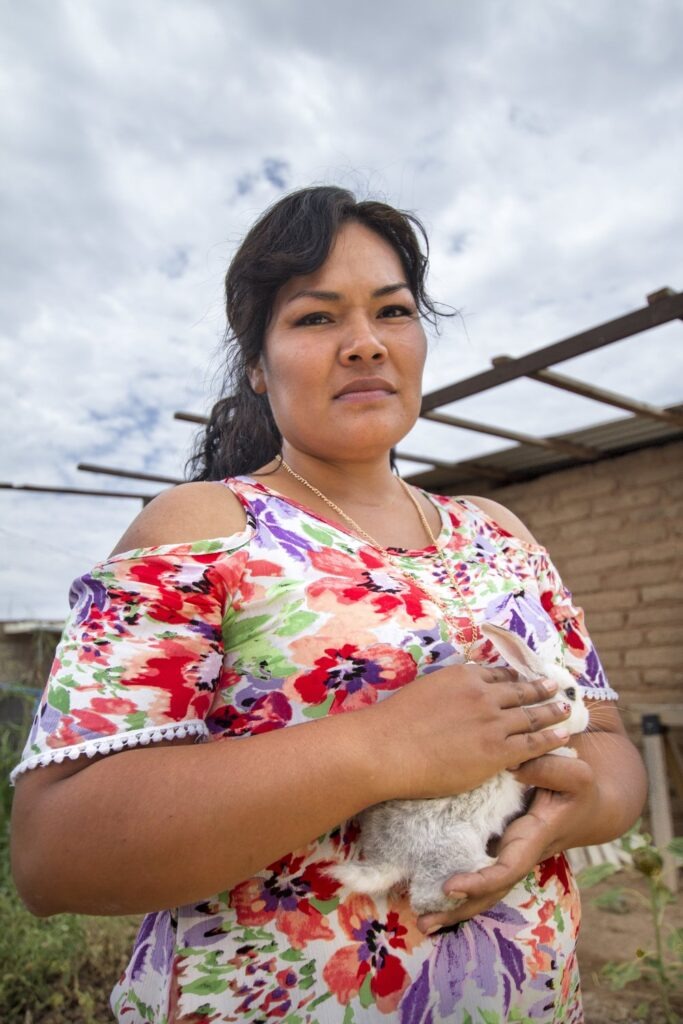
Within this sustained collaboration, Sánchez invited members of the collective to participate in photographic portraiture, producing images grounded in the women’s everyday practices of gardening and collective work. The images are thus circulated within Sánchez’s exhibitions and publications, situating the women’s everyday lives and work within institutional art contexts, spaces that often render such labor invisible or merely representational. However, these portraits did not simply represent the collective; they instead initiated an ongoing negotiation over how representation itself would be authored, tested, shared, and re-mapped. The portraits make possible a form of presence within these spaces, but they also crystallize a familiar tension: they render the women’s lives legible to art audiences while leaving the terms of that legibility centered on the artist’s authorship and aesthetic decisions. Over time, the terms through which this legibility took shape began to shift.
Members of the DouglaPrieta Trabajan (DPT) collective expressed interest in acquiring digital photography skills, ultimately producing their own self-portraits.[15] Read alongside Sánchez’s images, these self-portraits articulate distinct modes of self-representation shaped by the women’s own perspectives and priorities. They do not function merely to confirm or contest Sánchez’s portraits; instead, they actively reconfigure the terms under which authorship and legibility are produced. The coexistence of these bodies of work foregrounds subjectivity itself as an arena of co-labor and negotiation, in which art pedagogy operates not only through learning how to make images but through shifts in legibility—when to claim visibility, when to refuse it, and how to redirect the terms under which one is seen. Questions about who frames whom, for which publics, and toward what ends are not resolved but remain in tension, as the terms of legibility continue to be negotiated.
Pedagogies of Co‑Labor: Authorship, Curation, and Institutional Power
This negotiation extends to questions of authorship and co-labor within institutional settings. As a scholar of socially engaged art and as the curator of a forthcoming exhibition of Sánchez’s work at The Wittliff Collections,[16] my access to resources and decision‑making is conditioned by institutional power, even as I work within these spaces to foreground the priorities of socially committed art practices. This position underscores that co‑labor, as theorized and enacted here, is never purely horizontal, but is shaped by uneven access to visibility, funding, and institutional authority that must be negotiated rather than denied. To this end, I advocated for the inclusion of the collective’s self-portraits as artworks in their own right, and for forms of compensation that recognized their contributions within the same framework of artistic labor, participating in negotiations with the Wittliff to support the recognition of individual compensation for members of the DouglaPrieta collective as image-makers. This commitment materialized most visibly in the acquisition of self-portraits by members of the DPT collective alongside Sánchez’s photographic work, supporting the women’s positioning as contributors to an institutional archive rather than subjects of representation. In this context, the repositioning of authorship through co-labor within institutional frameworks can function as a pedagogical strategy: it works to reorient institutions and audiences to encounter the work as collective, redistributing recognition and value beyond the singular figure of the artist.
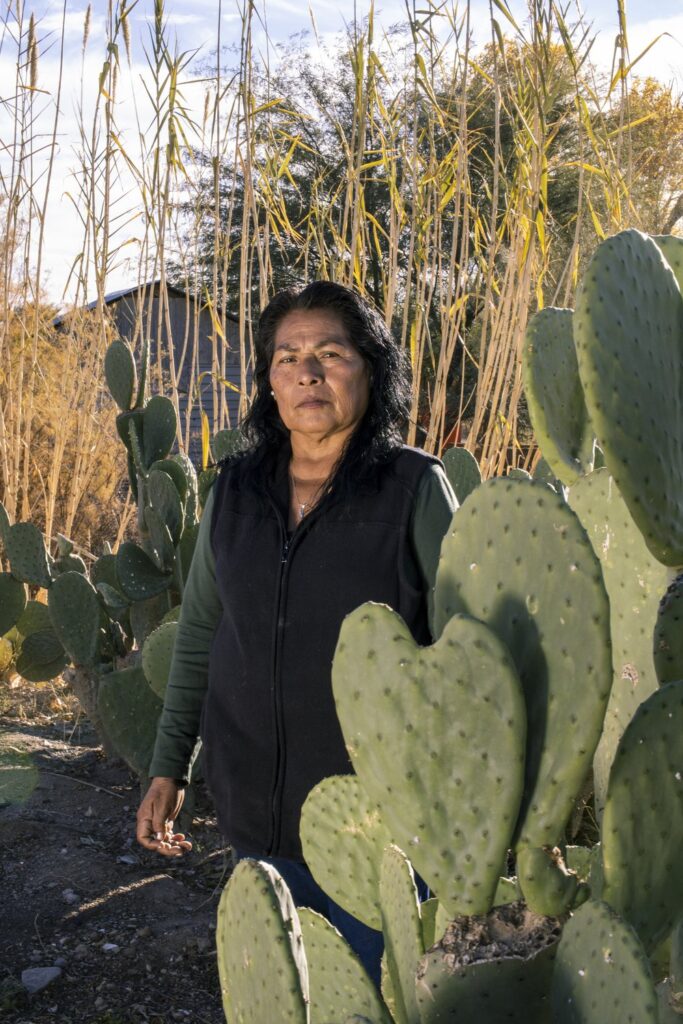
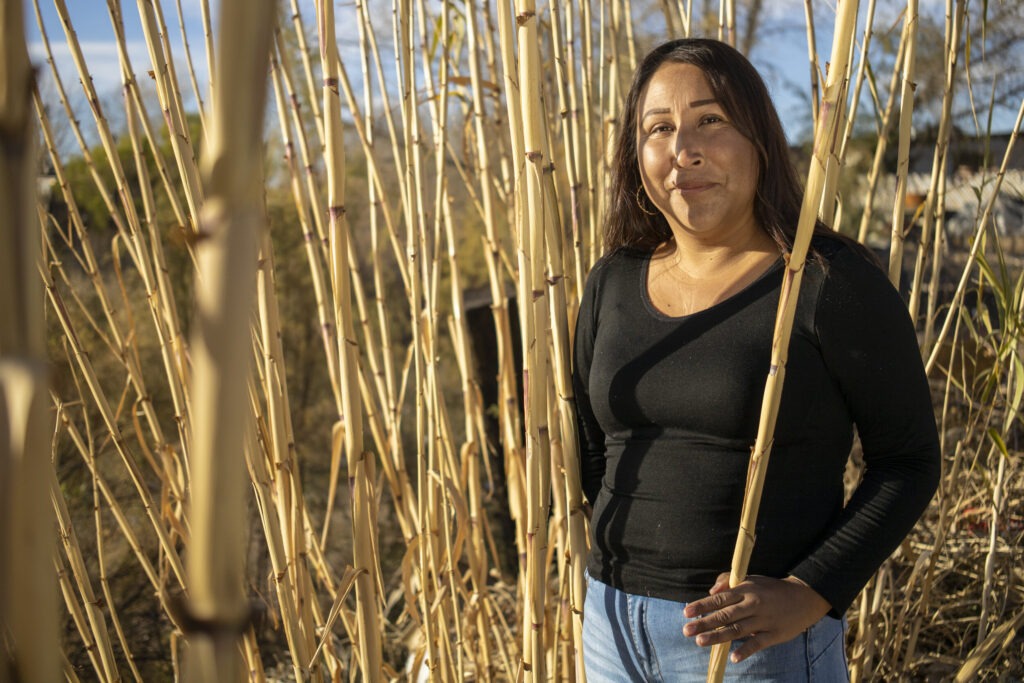
In earlier writing, I proposed that socially engaged art can counter the hypervisualization of border violence by foregrounding everyday resilience—by showing how people cultivate life and kinship within borderlands marked by precarious immigration enforcement and unstable economic conditions.[17] The DouglaPrieta self-portraits extend this argument by centering border life as shaped by the collective’s own labor, survival practices, and self-representation, underscoring the women’s agency in how their lives and work are made visible and complicating any simple reading of resilience. In this sense, they reconfigure how pedagogical art circulates and teaches through co-labor, curatorial and activist practices, not simply as a site of representation or collaboration but as a process that structures relations, authorship, and value. The work no longer moves through institutions solely under the artist’s name or the curator’s framing; it circulates in forms that embed the women’s own ways of seeing, narrating, and evaluating their labor and enters institutional and pedagogical structures that are themselves shaped through these curatorial and collaborative practices.
Further reversals followed. In a move that unsettles conventional models of participation in social practice, the DouglaPrieta collective invited Sánchez and her collaborator Gabriela Muñoz to serve as grant writers on their behalf—an inversion of the more familiar artist invitation to “participate” in artist-led projects. Muñoz undertook this labor, securing funding that enabled the collective to compensate themselves for the first time.[18] Here, pedagogy operates not as instruction but as infrastructural co‑labor: learning unfolds alongside the redistribution of resources, rather than in advance of or separate from it. This aligns with Galliera and Brynjolson’s (2025), broader concern with how pedagogical art intervenes in the material conditions that structure collaboration.[19]
Across these moments, Sánchez’s work with the DouglaPrieta collective demonstrates how pedagogical art in the borderlands is enacted through co‑labor, redistribution, and ongoing negotiation, with curatorial labor functioning as a central site through which these relations are structured and sustained. Rather than staging participation, the collaboration reorganizes authorship, visibility, and institutional access, foregrounding pedagogy as a practice of living and working together under conditions of asymmetry and constraint. Taken together, then, Sánchez’s photographs and the DouglaPrieta’s self‑portraits do not just “represent” a feminist borderlands practice; they help build and maintain the infrastructures—gardens, kitchens, workshops, archives, and exhibitions—through which that practice endures. They demonstrate that co‑labor in socially engaged art is not exhausted by participation. It is an ongoing negotiation over who gets to teach, who gets to appear, how money and visibility move, and how the work of sustaining life in the borderlands is understood, valued, collected, archived, and remembered. Together, these interactions point toward forms of practice in which pedagogy is not only enacted through co‑labor and institutional negotiation. Pedagogy is also carried through the ways images and narratives are arranged, circulated, encountered, made legible, and deployed.
The following section turns to Jay Lynn Gomez’s art practice to examine how these dynamics unfold through domestic labor, service economies, and processes of gender transition. If Sánchez’s collaborations with DouglaPrieta foreground the collective labor of sustaining life together, Gomez’s work draws attention to forms of labor and becoming that are often rendered peripheral, extending the discussion of pedagogy, legibility, and world-making into a different but related terrain, opening another avenue for considering how socially engaged art and pedagogy are shaped through borderlands feminist and trans nepantlera practices.
Trans Movidas in Butterfly Dreams
Jay Lynn Gomez first became known for her cardboard cut‑outs of life‑size figures of maintenance workers, painted in acrylic on discarded cardboard boxes and installed in wealthy Los Angeles neighborhoods: gardeners in Beverly Hills and cleaners at Grand Central Market.[20]
In her Magazine series, she paints brown‑skinned nannies and housekeepers into glossy spreads torn from luxury home and design magazines, their matte brushstrokes sitting visibly on top of the printed pages so that the act of alteration and the labor it acknowledges remain in plain view.[21] As a Mexican‑descent artist and former nanny, Gomez uses this work to emphasize the unseen childcare workers, cleaners, and gardeners who sustain the American economy. She extends this intervention into the art institution itself by drawing attention to the labor that also underpins canonical works that she appropriates and reworks, from her paintings after David Hockney to her mixed media Artworld Interactions series after Jeff Koons, insisting that this labor register within the art institution and its economies of visibility rather than remain at the edges of legibility.[22] Drawing out this point, Scorza notes that Gomez uses these images to contest conditions that shape her own experience, including an art world structured around white male power, where Latin American and Latine artists are relegated to the margins of the “mainstream art market and rendered as invisible as the individuals depicted in so many of Gomez’s works.”[23] In other words, Gomez pushes this labor to the forefront, making its ongoing presence and value unmistakable. In doing so, her work reorients the terms through which that labor becomes visible and legible within the art institution’s economies of recognition.
If Scorza shows how Gomez brings these workers and their labor into view, Ybarra‑Frausto names the aesthetic and political sensibility that underwrites such interventions. He describes rasquachismo as “a working‑class sensibility” in which being “down but not out (fregado pero no jodido)” leads to “survival and inventiveness.”[24] Rasquachismo is marked by bright, “shimmering” excess, “the elaborate over the simple, the flamboyant over the severe,” and by “making do with what you have,” where movidas hold together a world on the verge of falling apart.[25] This aesthetic and political resourcefulness emerges throughout Gomez’s work.
Gomez’s early cut‑out and magazine paintings establish questions of visibility, material labor, and legibility. Her later, transgender transition‑centered tableaux in the Under Construction exhibition at P·P·O·W Gallery in New York and the post‑transition exhibition Butterfly Dream at the Charlie James Gallery in Los Angeles carry questions of labor and visibility into explicitly trans Latina/e/o/x institutional and community spaces, where the politics of gender-inclusive languaging and self-naming are contested terrain for nonbinary and trans people of color.[26] In one tableau from Under Construction, a small self‑portrait titled Shot Day (2024) captures the moment Gomez lifts her shirt and gives herself a hormone injection in the abdomen. The piece extends the resourcefulness of rasquachismo into this scene, reworking the low‑cost, mass‑produced Estradiol packaging, its dosage instructions and barcodes still legible beneath the brushstrokes, as a record of the labor that underwrites her transition. Here, Gomez stages the kinds of rasquache tactics Ybarra‑Frausto describes when he defines movidas as “whatever coping strategies you use to gain time, to make options to retain hope,”[27] turning the material remnants of her hormone therapy into both a painterly surface and a material basis for imagining another bodily and social future.
The same materials that manage her bodily transformation—the injection supplies and their branded cartons—become evidence of the repetitive, embodied work of injecting and monitoring, and they double as an infrastructure that allows her to depict herself not only as an active subject of gender-affirming care but also as a worker engaged in the ongoing labor of remaking her body and life, sustained through repetitive acts that make that transformation possible over time. In doing so, she enacts what Anzaldúa calls nepantla, the in‑between space of continual transformation and transition,[28] opening onto the kind of ongoing, embodied repetition of gendered acts that Judith Butler argues produce subjectivity.[29]
Extending this labor of transformation, Butterfly Dream (2025) gathers paintings and installations through which Gomez relocates the processes of gender transition into spaces shaped by the trans Latine/x communities in Los Angeles. At the conceptual center of the exhibition is the classical Chinese parable known as the “Butterfly Dream” found in Zhuangzi, a foundational Daoist text. In the parable, the philosopher dreams that he is a butterfly, moving about contentedly and unaware of his human identity; upon waking, he cannot determine whether he is Zhuangzi, who dreamt he was a butterfly, or a butterfly now dreaming of being Zhuangzi.[30]
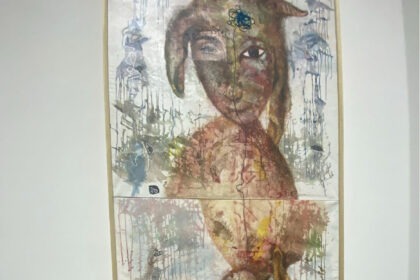
The parable has long been read as a meditation on “the transformation of things,” on the instability of selfhood, the porous boundary between waking and dreaming, the unstable overlap of reality and illusion, and the unreliability of any fixed ontological claim.[31] Gomez takes up this story as a framework for thinking about trans embodiment. In a small self‑portrait that explicitly echoes a sixteenth‑century illustration of the parable, the sleeper resting on the stone becomes the artist lounging on a turquoise beanbag, wrapped in a plush pink blanket. The field of the painting is saturated with hot pink, a chromatic shorthand for feminine dream‑space in Gomez’s visual vocabulary, while a collaged butterfly traverses the image as an emblem of metamorphosis. The beanbag from the self-portrait is itself installed in the gallery, accompanied by a volume of poetry by Farrah Fang,[32] extending the painting’s dream of trans reflection and rest into the space of the viewer.
Many of the paintings in the exhibition form a kind of living tableau of trans community life at the TransLatin@Coalition, the Trans Wellness Center, and a communal home for trans women, where trans women, including the artist, laugh, dance, and gather to support one another. The camaraderie and everyday tasks depicted in some of the paintings, such as vacuuming and changing out signage, foreground forms of co‑labor through which community life is maintained and made possible. In this sense, the exhibition extends Gomez’s long‑standing commitment to making the labor and laborers that usually remain unseen visible into trans spaces.[33] By rendering this maintenance work visible, Gomez underscores how access to rest, gathering, and care remains unevenly distributed, structured by who can afford the time, safety, and resources to sustain such communal life.
Against this backdrop of structural precarity, Fang names the world that makes that care urgent, calling attention to “a world that champions cis heteronormativity” and using her poetry to “radicalize” readers toward protecting their trans neighbors to advance the liberation of trans people,[34] even amid a surge in anti-trans legislation and violence. Drawing on art education scholar Kevin Jenkins’s research on how systemic cissexism produces precarity and hyper-visibility for trans people, Gomez’s work is read here as making visible the conditions under which legibility, as Jenkins notes, exposes trans people to surveillance and the ever-present risk of violence.[35] At the same time, her work is taken up here as carefully claiming space for a worker in the process of her own becoming. Gomez’s art inhabits this fluid terrain of trans selfhood and refuses to leave that instability unprotected, situating care as a condition sustained through ongoing labor and relational support. Her work calls for a world in which transitioning bodies are met with advocacy and held in mutual care, rather than always having to fight for the conditions of livable life. In the context of Gomez’s Butterfly Dream, these movidas frame trans subjectivity, rest, and community care not as retreat, but as part of the work of liberation.
Inner Fluttering in Nepantla World‑Making
The gallery’s description of Butterfly Dream leans into this language of liberation as self‑acceptance, framing the exhibition as a project that “seeks to accept Ramiro and to find love for the person she was, while at the same time moving joyfully into the future as Jay Lynn.”[36] One of the exhibitions most affecting works, we are told, “seeks to reconcile Gomez’s past and present selves,” reimagining a baby picture with a pink bow added to her head and “dreaming of a world in which she was able to experience girlhood from a young age.”[37] Although this language risks a romanticized view of trans emergence, it also provides an entry point for understanding Butterfly Dream as a meditation on how trans life might be held in love without being forced into an overly tidy fixed story of self and identity.
Trans writer B. P. Morton takes up Zhuangzi’s butterfly parable in precisely these terms, rereading the famous question, “Am I a man who dreamt I was a butterfly, or a butterfly dreaming I am a man?”[38] Engaging this question through their own early transition, for Morton, the problem is not choosing once and for all between “man” and “butterfly,” but recognizing the moment when two self‑descriptions become equally thinkable. “Maybe I was a man who routinely dreamed of being a woman, or maybe I was not a man, but routinely worked to convince myself that I was.”[39] From this impasse, Morton moves into what they call a “Daoist pivot,” a space in which distinct genders coexist as elements of a richer, non‑essentialist field of experience rather than mutually exclusive options.[40] That pivot, they suggest, is a kind of lived in‑betweenness, which is an idea that resonates with Anzaldúa’s nepantla, where identity is not yet, and perhaps never finally, resolved. It is this pivot, rather than a simple passage from one stable identity to another, that Butterfly Dream makes visible across its tableaux of trans women in Los Angeles. This state of in-betweenness does not occur outside material conditions but unfolds through the embodied and relational practices that structure daily life.
Philosopher Alexander Douglas, returning to Zhuangzi from a related angle, argues that the point of the butterfly dream is not to secure which identity is “real,” but to loosen identity itself. He emphasizes Zhuangzi’s claim that identity is a contingent configuration[41] and, in this light, keeps the self in what Anzaldúa calls nepantla, an “unstable, unpredictable, precarious always‑in‑transition space lacking boundaries.”[42] On this reading, attachment to a fixed identity—whether imposed or chosen—risks a kind of “identity foreclosure” that cuts us off from transformation and from the external influences that might otherwise help us survive change.[43] In Douglas’s terms, the ethical task is not to finally “be yourself” but to remain available to what he calls our “inner fluttering,” our capacity to take on new forms without being exhausted by any one of them.[44] In this sense, subjectivity remains tied to the conditions under which it is lived, including the forms of labor, care, and infrastructure that make it possible.
Read alongside Morton and Douglas, Butterfly Dream does not simply depict a linear movement from Ramiro to Jay Lynn that must be reconciled and then nostalgically embraced. Instead, its scenes of rest—friends on couches, women gathering in community centers and support spaces, Gomez’s own childhood image reimagined—figure trans life as an ongoing negotiation of that inner fluttering and pivot within nepantla spaces, where past and present selves are held together without being collapsed.
In Anzaldúa’s terms, people who dwell in such liminal spaces are nepantleras, “where others see borders, [they] see links; where others see abysses, they see bridges spanning those abysses.”[45] Here Anzaldúa’s nepantla names the in‑between in which this bridging work takes place, a space of continual transformation where identities are provisional, relational, and materially produced through daily acts of care, labor, and world‑making rather than discovered as reality or an inner truth. Liberation, in this frame, is not the achievement of a stable, authentic, reconciled self, but the collective capacity and agency to dwell in the threshold that sustains the labor, infrastructures, and mutual care that make such ongoing transformation possible. Against this backdrop, transformation is lived and sustained in relation to others. Ultimately, transformation is not only ontological but pedagogical, as subjects come to reorient themselves within shifting conditions of identity and relations.
These perspectives challenge fixed definitions of the self through art, poetry, and ancient philosophical inquiry, and they meet in the fluttering figure of the butterfly. When we map Zhuangzi’s paradox of “who is dreaming whom” onto my analysis of Anzaldúa’s nepantla crossings and Butler’s account of subjectivity as produced through repeated gendered acts, Gomez’s work comes into view as a trans nepantlera practice that explores identity as ongoing material transformation rather than a fixed endpoint. In this register, ways of living and making art—within and beyond the gallery—complicate normative assumptions about visibility and recognition within social and institutional life, particularly the expectation that subjects must become legible within stable or coherent frameworks of identity.
These converging frameworks also prepare the ground for a more sustained theorization of nepantla and performativity in relation to Gomez’s practice. For Gloria Anzaldúa, nepantla names the risky, often painful labor of repeated crossings, translations, and realignments through which a subject learns to live in contradiction rather than resolve it.[46] Judith Butler’s account of performativity clarifies how such crossings sediment over time: identity is not a stable essence that precedes action, but the effect of reiterated acts that cite, displace, and rework existing norms.[47] Anzaldúa and Butler allow us to understand Gomez’s rasquache practices not only as aesthetic strategies but as nepantla ways of being, in which the everyday routines of labor, care work, interdependence, and transition are enacted again and again across borders of class, ethnicity, gender, sexuality, and nation.
Read through trans theoretical frameworks, these transition-centered encounters complicate the assumption that visibility is a stable or desirable endpoint of representation and subjectivity. Trans studies scholars have shown that legibility operates as a regulatory condition, shaping which forms of life are recognized and how subjects become intelligible within existing structures.[48] For instance, Finn Enke and Susan Stryker both insist that transition is an everyday negotiation of embodiment and social legibility, rather than a singular event, forged in struggle with medical, legal, and cultural regimes that define a livable life; this work stages transition as continuous work on and against those regimes.[49] In Gomez’s tableaux, subjects are neither fully obscured nor fully resolved; instead, they occupy positions that invite layered and contingent forms of knowing and being. At the same time, José Esteban Muñoz’s concept of disidentification illuminates how these scenes neither fully align with nor fully reject dominant frameworks of recognition but work on, with, and against them from within. Disidentification names how those positioned outside the gender and sexual mainstream negotiate majority-controlled culture, not by aligning with or against exclusionary practices, but by transforming themselves and their worlds for their own social and aesthetic purposes.[50] Rather than securing legibility, Gomez’s tableaux foreground the conditions under which subjectivity is assembled, negotiated, and at times withheld, suggesting that visibility itself is structured through uneven relations of power and can be reworked through the very practices of labor, care, and world‑making that her work brings into view.
Pedagogy as Art: Co‑Labor, Subjectivity, and Legibility
In closing, this article extends debates in socially engaged and pedagogical art by arguing that pedagogy cannot be understood as a property of artworks or projects alone but must be located in the conditions through which practices are organized and sustained, and through which relations are formed. Rather than defining pedagogical art through intention or outcome, the art analyzed here suggests that pedagogy emerges through relations of co-labor, interdependence, visibility, and care that unfold across both institutional and extra-institutional contexts. In Sánchez’s collaborations with the DouglaPrieta Trabajan (DPT) collective, pedagogy emerges through co-labor and the infrastructures that support it—gardens, kitchens, and institutional negotiations that organize how knowledge is shared, how resources circulate, how authorship is redistributed, and how relations are grounded and maintained. Here, learning does not precede practice; it is inseparable from the material and social conditions through which participants work together to sustain life under constraint and mutual camaraderie.
Gomez’s work pushes this proposition further by relocating pedagogy into the domain of subjectivity and transformation. Pedagogy shifts from collective labor into the terrain of embodiment, subjectivity, and interdependent relationships, where the work of transformation is staged, enacted, and encountered through installations, staged tableaux, and community-based practices. Rather than stabilizing identity, Gomez’s art asks how subjects come into being within ongoing processes of transition, where labor, care, and community form the conditions under which that becoming remains possible. In this way, Gómez extends the pedagogical logic established in Sánchez’s work, demonstrating how the conditions of pedagogy shift as they move from shared labor into the terrain of embodiment, narrative, and communal care.
The conversations gathered throughout this special issue suggest important implications. If pedagogy is located not only in acts of making but also in how relations are structured and experienced, then socially engaged art and curatorial practices cannot be understood as socio-politically, economically, and aesthetically innocent acts of participation, display, or visibility. Instead, they become pedagogical encounters and experiences in their own right, structuring how artworks circulate, how subjects are encountered, and how meaning is produced, embodied, and enacted across contexts. What this reveals is that pedagogical work in art operates through a distributed field of relations—spanning labor, subjectivity, and institutional structures—within which socially engaged art and curatorial labor play an active role in shaping the conditions of knowledge, perception, and relationality. Across these constellations, pedagogical art practices do not appear as a fixed genre or method but as a set of practices and labor that take shape through the conditions under which life is sustained, negotiated, and made legible within—and against—the artistic, institutional, and social systems that organize its recognition, turning those systems themselves into sites of contestation and negotiation, and into collective borderlands and trans nepantlera practices of world making.
Adetty Pérez de Miles is an Associate Professor of Art Education at Texas State University. She holds a dual Ph.D. in Art Education and Women and Gender Studies from The Pennsylvania State University. Working across art education, visual culture, contemporary art criticism, and curatorial practices, her research explores the relationship between contemporary art and pedagogy, with a particular focus on socially engaged art, community-based practices, and Latin American, Latine, and Chicanx art. Drawing on decolonial, feminist, trans, and postqualitative perspectives, her work examines how art and pedagogical practices shape relations of responsibility, relationality, and collective world-making. Pérez de Miles is co-curating an exhibition featuring the work of M. Jenea Sánchez and DouglaPrieta Trabajan at the Wittliff Collections, opening in September 2026.
Notes
[1] Alison Hope Alkon and Julian Agyeman, eds., Cultivating Food Justice: Race, Class, and Sustainability (Cambridge, MA: MIT Press, 2011).
[2] M. Jenea Sánchez and Gabriela Muñoz, “Caldo de Pollo,” YouTube video, June 15, 2021.
[3] Gloria E. Anzaldúa, Borderlands/La Frontera: The New Mestiza, 5th ed. (San Francisco: Aunt Lute Books, 2021).
[4] Annette and Quebec, “Gallup Motel Butchering,” blog post, 2016, para. 4. <https://annetteandquebec.com/tag/gallup-motel/ > [accessed 31 May 2026].
[5] L’Hirondelle Hill, Gabrielle, et al. “Cony Island Baby.” In C Magazine, no. 136 (2018): 19–23.
[6] M. Jenea Sánchez, The Mexican Woman’s Post-Apocalyptic Survival Guide in the Southwest, artist project, 2016. < https://mjeneasanchez.com/en/the-mexican-womans-post-apocalyptic-survival-guide-in-the-southwest/> [accessed 31 May 2026]; Also see: DouglaPrieta Trabajan, ‘DPT Self Portraits’, Fronterizx Collective <https://fronterizxcollective.com/projects/dptselfportraits> [accessed 31 May 2026].
[7] Gloria E. Anzaldúa, “Now Let Us Shift: The Path of Conocimiento,” in This Bridge We Call Home: Radical Visions for Transformation, ed. Gloria E. Anzaldúa and Ana Louise Keating (New York: Routledge, 2002a), 540–578.
[8] Grant H. Kester, “FIELD Editorial 1,” FIELD: A Journal of Socially-Engaged Art Criticism 1 (2015), p. 7; Miwon Kwon, One Place after Another: Site-Specific Art and Locational Identity (Cambridge, MA: MIT Press, 2002); Gregory Sholette, “Delirium and Resistance after the Social Turn,” FIELD 1 (2015).
[9] Eleonora Belfiore, “Who Cares? At What Price?” European Journal of Cultural Studies 25, no. 1 (2022): 61–78.
[10] Gregory Sholette, “Swampwalls,” Women & Performance 26, nos. 2–3 (2016): 172–183. p. 175.
[11] Pablo Helguera, Education for Socially Engaged Art (Brooklyn: Jorge Pinto Books, 2011); Kester, “Editorial;” Sholette, “Swampwalls;” Sholette, “Delirium and Resistance.”
[12] M. Jenea Sánchez and Gabriela Muñoz, personal communication, January 27, 2026.
[13] Alkon and Agyeman, Cultivating Food Justice; La Via Campesina, “Globalization of War and the Starvation of Peoples: Food Sovereigny against Imperialism and Global War,” position paper, April 17, 2026 <https://viacampesina.org/en/2026/04/food-sovereignty-in-the-face-of-war-imperialism-and-the-hunger-of-peoples-around-the-world/> [accessed 31 May 2026].
[14] Galliera, Izabel, and Noni Brynjolson, eds. Pedagogical Art in Activist and Curatorial Practices. New York: Routledge, 2025.
[15] Sánchez, Mexican Woman’s Survival Guide.
[16] The Wittliff Collections is a nationally recognized research center, archive, and museum at Texas State University that preserves and presents the cultural heritage of Texas, the Southwest, and Mexico through major holdings in literature, music, film, and photography. I am especially indebted to Carla Ellard, Photography Archivist for the Southwestern & Mexican Photography Collection, whose guidance and collaboration were invaluable during my research there. The Wittliff Collections, ‘What Is The Wittliff?’, The Wittliff Collections <https://www.thewittliffcollections.txst.edu/about/what-is-the-wittliff.html> [accessed 31 May 2026]
[17] That earlier argument was shaped by works such as Rafael Lozano-Hemmer’s Border Tuner, which foregrounded communication and relation across the border rather than the daily visual emphasis on violence and division. Adetty Pérez de Miles, “Where Is the Border?” in Otherwise It Would Be Just Another River, ed. M. A. Sherman and J. A. Reed (Leipzig: Spector Books, 2022), 48–64.
[18] M. Jenea Sánchez and Gabriela Muñoz, personal communication, January 27, 2026.
[19] Galliera and Brynjolson, Pedagogical Art.
[20] Cris Scorza, “Afterword,” in Domestic Scenes: The Art of Ramiro Gomez, by Lawrence Weschler (Los Angeles: UCLA Chicano Studies Research Center Press, 2016), 40–44.
[21] Scorza, “Afterword”; Charlene Villaseñor Black, “Rasquachismo,” Aztlán 47, no. 2 (2022): 1–17.; Lawrence Weschler, “Jay Lynn Gomez’s Altered Magazines,” in Domestic Scenes, 87–95.
[22] Scorza, “Afterword.”
[23] Scorza, “Afterword,” p. 22.
[24] Tomás Ybarra-Frausto, Rasquachismo: A Chicano Sensibility (School by the River Press, 1989), p. 5.
[25] Ybarra-Frausto, Rasquachismo, pp. 5-6.
[26] I use Latina/e/o/x and Latine/x to name both gender‑inclusive and gender‑specific identifications in Latinx and Chicanx communities, emphasizing that language and culture shape gender identity, expression, and agency while also honoring those who claim Latina or Latino as part of their self‑definition and gender affirmation. See Adetty Pérez de Miles, ‘Disrespectfully Latinx and Chicanx: The Languaging of Nonbinary, Trans, and People of Color’, Studies in Art Education, 66.3 (2025), 300–318, doi: 10.1080/00393541.2025.2510174
[27] Ybarra-Frausto, Rasquachismo, p. 5.
[28] Gloria E. Anzaldúa, ‘Preface: (Un)natural Bridges, (Un)safe Spaces’, in This Bridge We Call Home: Radical Visions for Transformation, ed. by Gloria E. Anzaldúa and AnaLouise Keating (New York: Routledge, 2002b), p. 1.; Gloria E. Anzaldúa, Light in the Dark/Luz en lo Oscuro: Rewriting Identity, Spirituality, Reality, ed. Ana Louise Keating (Durham, NC: Duke University Press, 2015).
[29] Judith Butler, Bodies That Matter: On the Discursive Limits of “Sex” (New York: Routledge, 1993); Judith Butler, Notes Toward a Performative Theory of Assembly (Cambridge, MA: Harvard University Press, 2015).
[30] Zhuangzi, Zhuangzi: Basic Writings, trans. Burton Watson (New York: Columbia University Press, 1998).
[31] Jiani Chen, “Zhuangzi and His Butterfly Dream,” The China Story Yearbook, 2019. <https://www.thechinastory.org/yearbooks/yearbook-2019-china-dreams/forum-illusions-and-transformations-the-many-meanings-of-meng-%E5%A4%A2/zhuangzi-and-his-butterfly-dream-the-etymology-of-meng-%E5%A4%A2/> [accessed 31 May 2026].
[32] Charlie James Gallery, Jay Lynn Gomez: Butterfly Dream, exhibition text, 2024. <https://www.cjamesgallery.com/exhibitions/butterflydream> [accessed 31 May 2026].
[33] Charlie James Gallery, Butterfly Dream.
[34] Christopher Behrens, “Farrah Fang’s New Book Explores Trans Womanhood through Poetry,” Outsmart Magazine, October 8, 2024, paras. 7-9.
[35] Kevin C. Jenkins, “Cissexism and Precarity Perform Trans Subjectivities,” Journal of Social Theory in Art Education 40, no. 1 (2020): 85–99.
[36] Charlie James Gallery, Butterfly Dream, para. 5.
[37] Charlie James Gallery, Butterfly Dream, para. 5.
[38] Morton, “Zhuangzi and My Gender Identity,” paras. 3-4.
[39] Morton, “Zhuangzi and My Gender Identity,” para. 3.
[40] Morton, “Zhuangzi and My Gender Identity,” para. 4.
[41] Douglas, “Essence Is Fluttering,” paras.7-8.
[42] Gloria E. Anzaldúa, “Preface,” page 1.
[43] Douglas, “Essence Is Fluttering,” paras.18.
[44] Douglas, “Essence Is Fluttering,” paras.19.
[45] Anzaldúa, “Preface,” p. 4.
[46] Gloria E. Anzaldúa and AnaLouise Keating, eds, This Bridge We Call Home: Radical Visions for Transformation (New York: Routledge, 2002); Anzaldúa, Light in the Dark.
[47] Butler, Bodies That Matter; Butler, Notes Toward a Performative Theory.
[48] Susan Stryker, Transgender History (Berkeley: Seal Press, 2008); Dean Spade, Normal Life: Administrative Violence, Critical Trans Politics, and the Limits of Law, rev. and exp. ed. (Durham, NC: Duke University Press, 2015).
[49] A. Finn Enke, “The Education of Little Cis,” in Transfeminist Perspectives, ed. A. Finn Enke (Philadelphia: Temple University Press, 2012a), 60–77; Stryker, Transgender History; Enke, A. Finn, ed. Transfeminist Perspectives in and beyond Transgender and Gender Studies. Philadelphia: Temple University Press, 2012b.
[50] José Esteban Muñoz, Disidentifications: Queers of Color and the Performance of Politics (Minneapolis: University of Minnesota Press, 1999).