Who Defines the Disciplinary Area When the Diegesis Leaks?
Amanda B. Parmer
Pedagogical art is often understood to be interdisciplinary and, as such, normative patterns of knowing are emphasized to facilitate the interdisciplinary relation. However, this participation in the entrenchment of disciplinary boundaries often goes unchecked. As the scholars outlined in the following demonstrate, art and theory and art as theory tug at the disciplinary question of how we know what we know by directing and reorienting our attention to the material substrate and system through which disciplinarity itself operates. This focus on the modes of distinction at play provides us with space to consider the seamfulness of diegetic space and to inquire together how the material infrastructure of knowledge production shapes disciplinary norms and, by extension, diegetic containers.
The production of diegetic containers hides a double move that both produces and occludes gaps in the conceptual framework through which disciplinary norms are established in order to smooth their cohesion and continuity. In Dear Science and Other Stories, Katherine McKittrick explains how disciplines not only categorize knowledge but also code experience as data points, cleaving disciplinarity from experience and all of its messy attachments to the material ground of knowledge. This production of an extractive logic is a critical starting point for understanding the discretizing categorization of people, land, and culture whose stories are both subject to and capable of challenging the confines of diegetic space.
In her 2015 essay, “Mathematics Black Life,” and her 2021 book Dear Science and Other Stories, McKittrick goes to mathematics, science, and storytelling to work through the roots of ideology’s infrastructural violence and to reveal failed attachments en route to exposing their formative effects on black life. She models interventions in the disciplinary ordering of culture through the epistolary form addressed to the discipline of science. The form extends and thickens the discipline, asking it to return the vulnerability and pliability it demands of subjectivity. By doing this, McKittrick points to engagement beyond abstention and beyond the “yes, and” logic by doubling down in disciplinary rigor, throwing its logic back on itself to code disciplines as imperially colonized “areas of study” rather than the “practice and work of study.”[1] In doing so, she introduces structural and analytical tools to locate and work with new perspectives to engage with creative, artistic practice as theory.
Early on in Dear Science, McKittrick writes about the importance of storytelling for the endurance of black life and as a model for life building. Recognizing the ideology of empire, military, and factory work, McKittrick’s interrogation of discipline moves away from the instrumentalizing calibration of individual bodies and instead opens questions that require receivers’ assent and response to complete their message. She situates creative work and theoretical texts as forms of storytelling that shore up, ensure, foster, and support the dialectical motor of her model behavior, which entrains her readers in a liberatory praxis. Her work reorients our relationship to discipline away from its mythic solidification and distancing capacities without countering or adding to it. Instead, she proposes a modality to think through the multifaceted function of discipline.[2]
The stories metabolized by institutions to produce disciplinary boundaries may appear to be a humanistic endeavor, but artistic practices like that of artist, educator, and Black feminist scholar Tia-Simone Gardner put pressure on the ways in which that knowledge draws from the breadth of our entire material world and unsettles anthropocentric disciplinary assumptions. In her work, Gardner works with waterways to see, with the landscape, the sedimented layers of history that can still be perceived through traces reconnecting the material of story and histories in text and still and moving images to the material of place. As such, she provides close readings of the land in the same way that one might read a book, using waterways and their currents to orient viewers. In her work, Gardner has helped us recognize the intelligence of water, in particular its capacity to return to a place. The capacity is reflected in the collage of images and words that make up her 2019 work, There’s Something in the Water, which inspired Gardner to float a camera down the Mississippi River–a vein of connection between the Upper Midwest and Southeastern United States–for her later constellation of image, sound and performance that made up Salt Water Sweet Water (2019).[3]
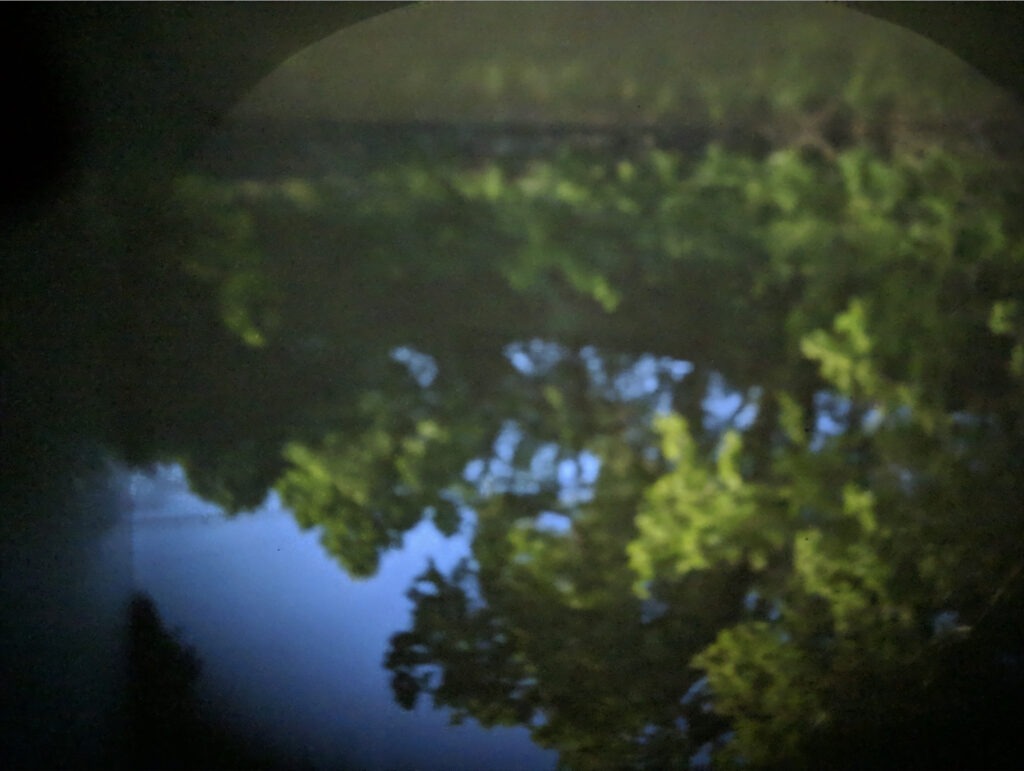
Gardner’s practice expands in curatorial and choreographic forms through her work with Shana M. Giffin for the book and exhibition A Nation Takes Place: Navigating Race and Water in Contemporary Art which gathered the work of thirty-eight artists and six writers to consider the process of naming and unnaming, settling and unsettling, possessing and dispossessing, through the imaginaries induced by seafaring and its resonances in the present.[4] We can think of Gardner’s expansive, aqueous praxis as an analogue to the grounded knowledge McKittrick discusses. As McKittrick asserts, this embodied place-based knowing always re-finds its grounds and, as a byproduct, creates “erotic infrastructures” that show up as traces of the felt, libidinal call and response of knowledge and embodiment. This is resonant with what “Black, lesbian, feminist, socialist, mother, warrior, poet” Audre Lorde has called the “yes within ourselves.”[5]

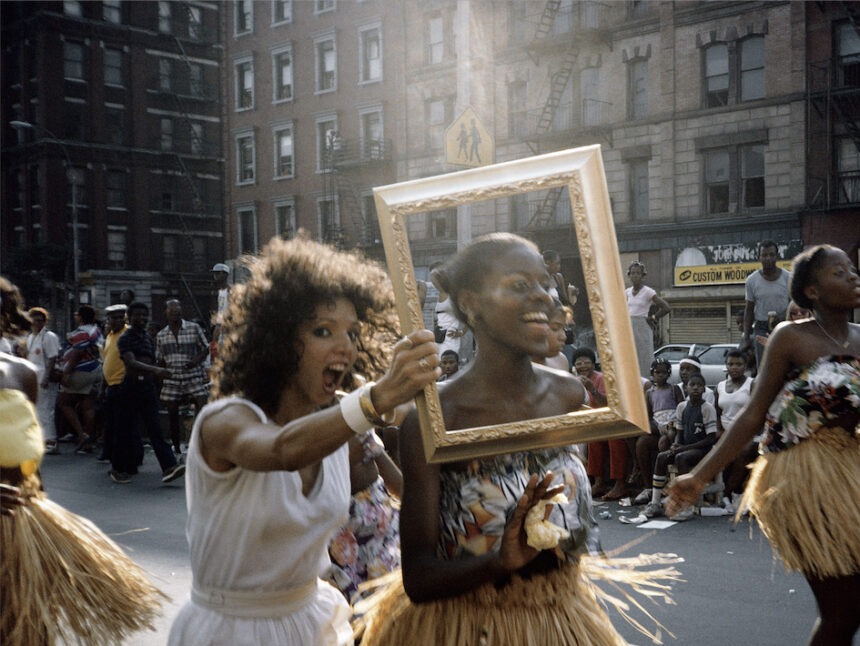
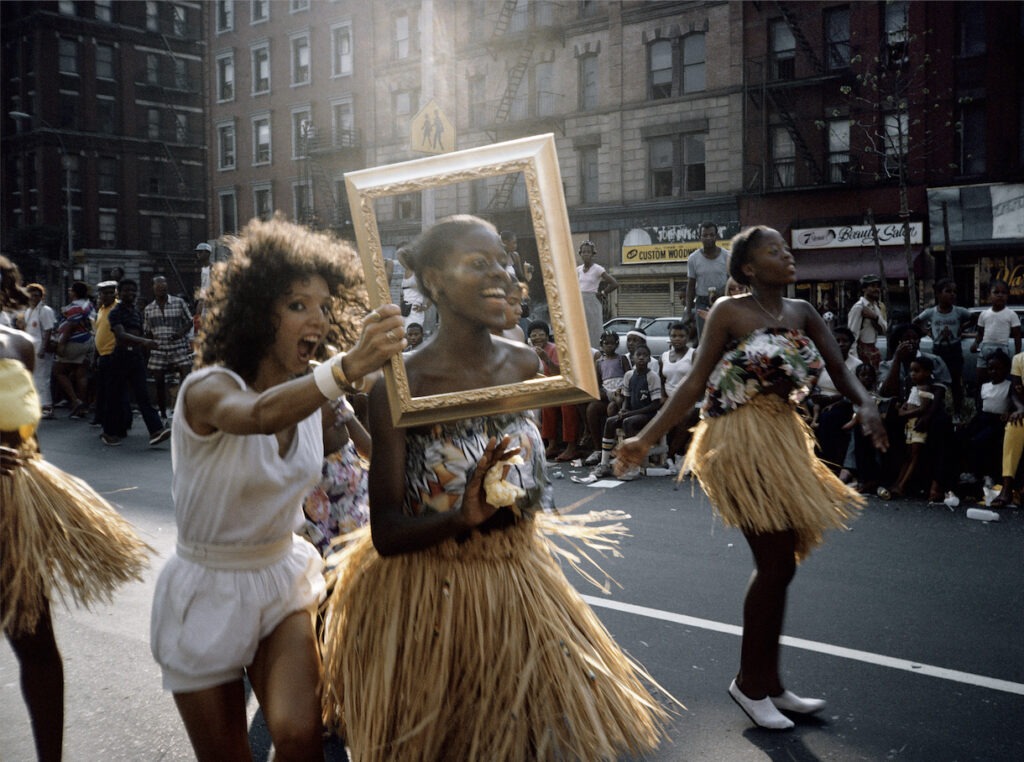
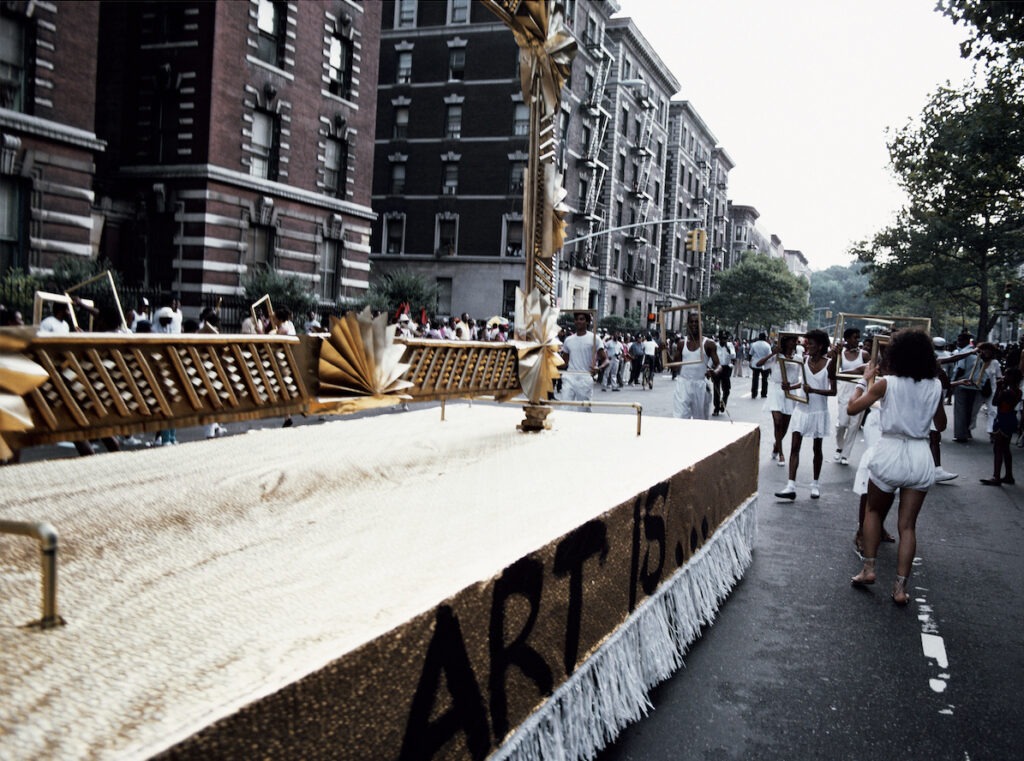
Just as such erotic infrastructure is grounded in the land and perceived through the intelligence of water, it also travels across and through social and cultural relations to shape diegetic expectations. Like Gardner’s floating camera that refracted and captured histories written into the material landscape, the artist and writer Lorraine O’Grady’s float and performance for the 1983 African American Day Parade in Harlem, Art Is…, recorded the social and cultural landscape of Harlem as it traveled up Adam Clayton Powell Jr. Blvd. The work features a flatbed with a white skirt and a large, open gold frame with the words “art is” running the width of the float itself. The frame effectively “captured,” continuously, every street scene it passed as it travelled up this critical geographical vein of black culture. O’Grady rode on the float with fifteen collaborators who were all dressed in white and were each carrying a more modestly sized empty gilded picture frame. The group jumped off the float as it travelled uptown, enthusiastically gesturing to people in the crowd to get in the frames while others of the same crowd were encouraged to snap pictures documenting the event, forty of which have been gathered as the official documentation from the day.[6]
This intervention into the parade came on the heels of several of O’Grady’s Guerilla performances as Mlle Bourgeoise Noire (Miss Black Middle-Class) 1955 (1980), wherein she went to gallery openings dressed in the style of a beauty queen with a gown made up of 180 white gloves from New York thrift stores and carried a white cat-o-nine tails embellished with chrysanthemums, at once presenting herself as an art object and responding to the racially divided art world in her comments during these visits. The work took up Futurism’s promise that art has the power to change the world. Given its reception, which did not meaningfully unsettle the apartheid order of the New York art world, it was perceived by O’Grady as a “failure.” And yet it has endured beyond the guerrilla tactics, “as a state of mind.”[7]
Art Is… (1983) was developed three years after the first appearance of Mlle Bourgeoise Noire and was built, persistently, on this interventionist ethos, as it was made in response to a friend’s comment that “avant-garde art doesn’t have anything to do with black people.”[8] The work implicitly throws light on the seam at which bodies of color are elided and papered over, yet which in the continuity of the social fabric still serves as the ground against which the value of other (white) bodies are figured in the cultural technology of art institutions. O’Grady made this exclusion intelligible when she developed an array of roles in performance, designed to hold together the discrete bodies and identities attending the parade. Appropriating the formal trope of gold frames, she signaled the malleability of the frames as institutional signifiers by modifying who was framed and how they got there. In addition, the reference makes light of the way that art institutions cherry-pick and valorize elements of societal fabric that re-entrench their desires.
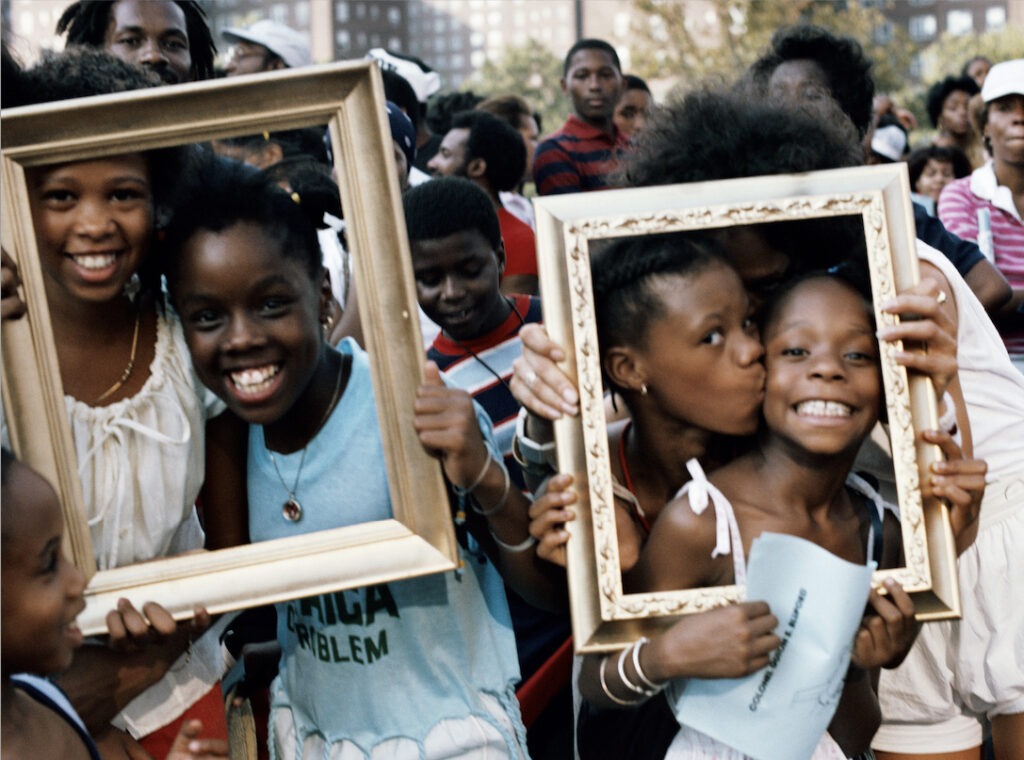
Throughout the performance, O’Grady and the trope traveling with her on the float demonstrated the continuity of community that flowed in and out of the frame, which dissembled the established sensibility of atomization by capturing and performing the act of distinction that the formal device of the gilded frame used to engender. In the 40 framed photographs documenting the performance, which now make up Art Is,… 1983/2009, O’Grady suspends the exposure and perception of this division. This could be understood as what Bernard Stiegler has called the tertiary retention of images, or the externalization of what would otherwise be personal memories in material substrates like photographs, films, and books. Through the longue durée series of still images, wherein volumes of essayistic analysis can populate the liminal fold, O’Grady pulled focus on the glitch in the system, which in this case was the alienating effects of framing and the institutional hierarchization of subjectivities.[9] In this suspension, O’Grady makes space for viewers to jostle with questions such as who and what gets valued and how these values are instantiated and reified, which are otherwise institutionally and structurally determined.
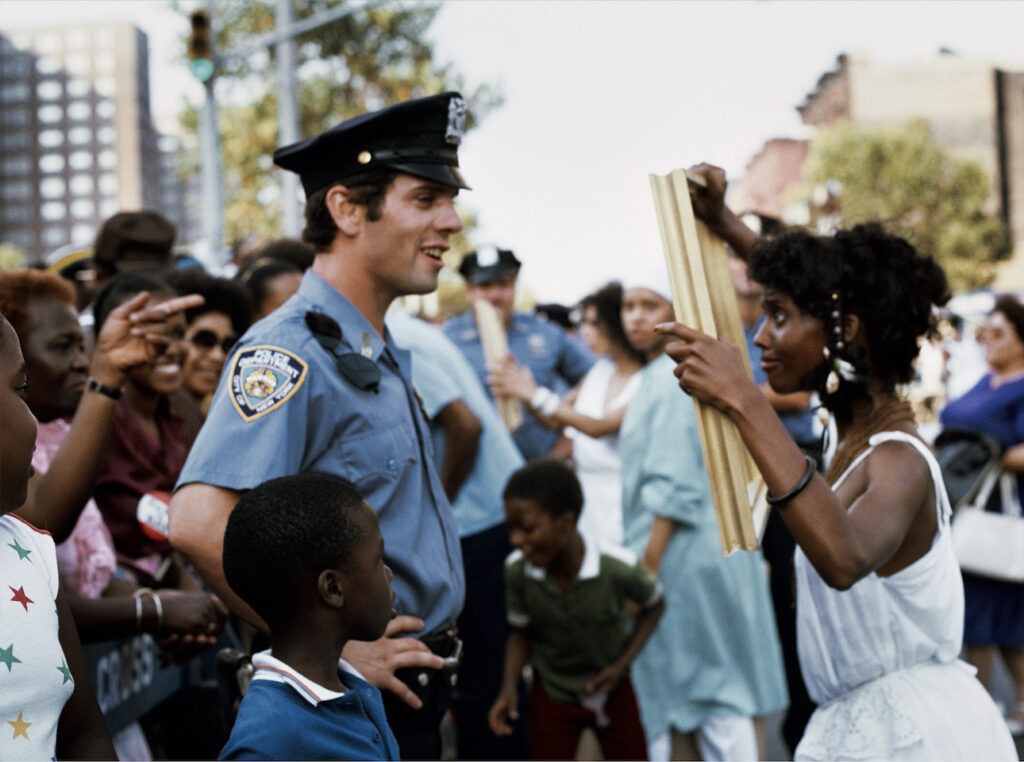
In this work, O’Grady inverts the alienating force of white western art that would have us believe in the myth of the individual and the individuated genius. Instead, she synthesizes the relation between the bodies of those in and out of the framed image, which could be understood as one layer or level of the diegetic/extradiegetic divide. In doing so, she emphasizes the relations generated by a whole event rather than the ideology embedded in the discretization of events, individuals, and objects one might find in a museum that necessarily works to exclude the extradiegetic elements outside of the frame. The work also shows the impossibility of true exclusion as we are all inevitably co-constituted, whether or not the extradiegetic subjects and structural elements are immediately intelligible.
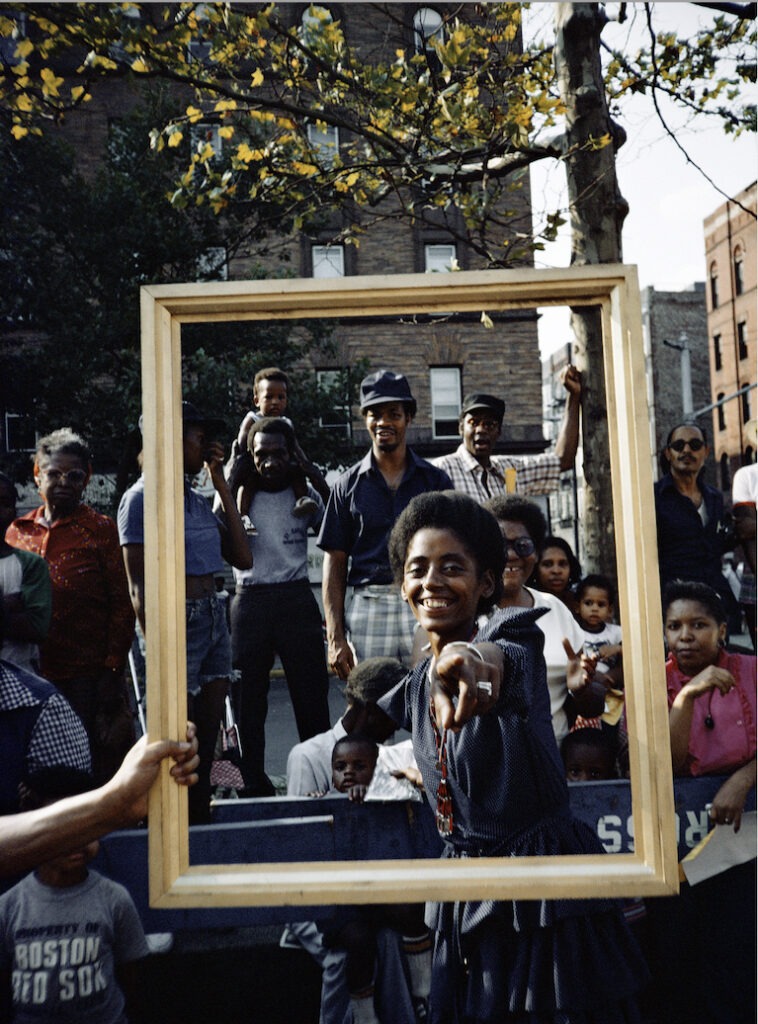
The collision of the diegetic and extradiegetic is exposed by what media theorist Shane Denson has called the compression glitch, referring to the technological, human, institutional elements of the media interfaces that we as viewers are habituated to accept as inevitable. In Denson’s analysis, we learn how the post-cinematic viewer’s attention is corralled into particular modes of imagining, which trained their expectations to a particular array of affective relations and responses. Such imagining ensures a continuous engagement with the diegetic elements of the film, smoothing over the extra-diegetic distractions that stand to ensnare their attention. Denson’s intervention is to focus on moments that expose the integration, construction, and production of images through the diegetic and extradiegetic in real time. These singular instances negate the possibility of learning through the kind of ideological inscription that results from watching again and again. Instead, they attune us to the possibility of a more attentive viewership tasked not only to capture but also to assign meaning to the schism in the protentional image that operates in the diegetic-extradiegetic space.
It is when we look again at O’Grady’s work with this post-cinematic model in mind that there emerges a discursive space for us to consider the kinds of glitches we encounter. For instance, O’Grady engages with the institutional glitch. The institution’s highly produced infrastructure has historically provided cover for tacitly excluding those it codes as invaluable while also operating as the authorial agency responsible for determining who and what is valued. This dual role enables institutions to paper over such dismissals as disciplinary glitches rather than enduring acts of exclusion. O’Grady’s instantiation of a layered temporality of reception in the performance, namely its immediate reception, its documentation, and the reception of its documentation, as a work in itself loosens the institutions’ normative distinguishing capacities to discriminate art against non-art. As such, the work creates a casualization of the diegetic space.
Then there is the protentional, the real-time, one-time glitch of compression that operates through and is organized by media forms in the extra diegetic space of cultural production that functions outside of and contextualizes art, literature, film, games, etc. In the 2004 film The Ister, named after the ancient name of the Danube River and the central figure of the cinematic collage, Bernard Stiegler draws on the work of Martin Heidegger to explain how the relay between history and future is formatted by “tertiary retentions”–media forms such as books and films that synthesize shared histories and condition our protentional futures to exclude others. The protentional is the historical blip, the swallowed remainder of history that allows institutional systems to return to a state of clarity and stability. Stiegler considers it a hijacking of our imaginative capacities. But, reimagined in our algorithmically driven, prepersonal present, when works such as O’Grady’s co-constitute the field of tertiary retention, it also reveals the diegetic containers that make it up, rendering the protentional glitch intelligible.
The glitch is nothing new and does not require an apparatus outside our bodies. The human body itself is a glitchful technology and engages with the disciplinarity that not only shapes and individuates it but also helps it gain the capacity to maneuver and manipulate the glitch. In this recognition, we can also recall Stiegler discussing the human being as a technological animal, or Sylvia Wynter saying that we become human beings in concert with culture coming into being as we are bound up with one another.[10]
So, what happens when the infrastructures of mediation are externalized, and what becomes of their capacity to mediate when they move from infrastructure to interface? If we, as humans, are technological animals as Bernard Stiegler has asserted, what happens when this infrastructural technology operates outside of and alongside us?[11] How does this compel extra, additional layers of the diegetic? As Alexander Galloway has explained in The Interface Effect, “any mediating technology,” which includes the technology of the institution, “is obliged to erase itself to the highest degree possible in the name of unfettered communication, but in so doing it proves its own virtuosic presence as technology, thereby undoing the original erasure.”[12] This mediating technology is operative within the interface the same way it is operative within our subjectivities. The failure to eradicate the indexical traces that shape the hierarchization of subjectivity and knowledge production is related to what Shane Denson has called “seamfulness,” which operates in everyday life yet is outside of conscious engagement and instead taps into our affective response. As Denson explains, “the infrastructure of life in our properly post-cinematic era has been subject to radical transformations at this level of ‘molecular’ spacetime or prepersonal affect.”[13] It is by interrogating such affective reaction that we can understand how the interface Galloway delineates operates alongside and conditions but does not fully conceal the political experience of embodiment that is inevitably filled with friction.
Such internal divisions of subjectivity are important as we come to know ourselves in the recognition we receive from others, recognition that comes from outside of ourselves and that we identify with in external media forms. In considering the constructedness of the conscious ego, the psychoanalyst and psychiatrist Jacques Lacan recognized that subjects are divided by language, the symbolic order, and as such they represent themselves as effects produced by signifiers. Given how mediation, via language, is embedded in the ways that we represent ourselves to one another, Lacan was able to assert that “the subject is always nonidentical with itself.”[14] What is at stake in such splitting is the potential breakdown of our capacities to perceive such externalized infrastructures that are individually calibrated in the disciplinary sense that McKittrick discusses, as these new technologies threaten human subjectivity by curtailing human imaginaries. Our capacity to recognize seamfulness is key in revealing the farce of liberal individualism, when the dividuated being is at once one and many, participating in an entity at once radically riven and collectively and socially constituted.
This foundational and formative psychoanalytic relation between selves and signifiers, selves and selves, signifiers and signifiers, is also addressed in the concluding chapter of Kevin Quashie’s The Sovereignty of Quiet: Beyond Resistance in Black Culture, where he describes the experience of Shadrack, the traumatized character in Toni Morrison’s novel Sula. The veteran, disorganized in his body by the trauma he has endured, seeks to find his own reflection. With the water in the toilet bowl, he makes out only the clear contours of his face and yet is relieved by their definitiveness after he had been “harboring a skittish apprehension that he was not real—that he didn’t exist at all.”[15] The affirmation of existence alone is the salve that affirms and thereby calms Shadrack’s traumatized sense of self. This continuity of experience within and outside of the toilet bowl, what Quashie calls “an astonishing boundlessness of (his) humanity,” is akin to the diegetic leaking in and out of the gilded frames in O’Grady’s Art Is….
As Quashie points out, Shadrack’s desire for “nothing more” than the reflection is striking as Shadrack might be speaking of himself as the “nothing.” Here it is helpful to think with Quashie about the vulnerability and liberation that embracing “nothing” engenders. Quashie holds together nothing and abundance by explaining how “nothing is, literally and always, something, and in a state of abundance where everything is plentiful, no one thing is ever supremely significant.” It is this relation that he calls the “spirituality of oneness” that absorbs the seeming inconsequence of singular human existence into the enormity of planetary existence.[16]
As Quashie explains, this recognition of oneness, through the affective register of vulnerability, “returns the mystery of being human to the black subject, who often seems to be known even before he or she arrives.” The dual significance of oneness could also be compared with the frictious correspondence between the diegetic and extradiegetic representation in O’Grady’s work that gives it significant cultural meaning. The elision of the two is traversed in affective vectors: outward, performative expressivity shoots out of and into the golden frames in the forty images documenting O’Grady’s work. O’Grady shifts the production of this frame. Her intervention comes not only from the float, performers, photographers, witnesses, boulevard, etc., but also importantly from her insistence that there is no single author. The “trope” and crowd are mixed with quiet subjects who have chosen not to perform yet nonetheless co-constituted the social field of relations taken up in the images, challenging resistance and public expressiveness as what Quashie has marked out as the unconsciously assumed and overdetermining disposition of black subjects. In Quashie’s concept of oneness, the extradiegetic of the invisible black body may also be the hypervisibility of black bodies. This noisy field of relations is also experienced by viewers whose fragmentary recognition of their own subjectivity in the externalization of ourselves–in images, mirrors, and reception by others– affirms our perpetual splitting in moments of identification. Expansive and unbound, these arrays of identification are mediated, organized, and held together by the political battery of difference and distinction.
We can understand O’Grady’s work here as a theoretical text in McKittrick’s conception of creative work. As such, Art Is,… contributes to the thickening of interdisciplinary narratives, to glimpse the affective infrastructure and complexities of black life. If we accept and take seriously McKittrick’s assertion that story is a form of theory cast as fictive knowledge and operates in the affective register, so too we can apply the diegetic and extradiegetic forms of analysis to such artifacts, traces, remnants, relics, myth place holders, and other aspects of creative aliveness. The extradiegetic and diegetic serve, in Denson’s analysis, to produce the “prepersonal,” which is a “body-battery” that stores the affects of various material impacts–the unfixed relationships that convey of sound and image in optimized media–in a liminal space between objective substrates and subjective forms, which conditions our embodied habits or orientations.[17] In particular, the extradiegetic pushes us to think about the political framing of the image that we are relating to.
In a conversation celebrating the launch of McKittrick’s Dear Science, Ruth Wilson Gilmore recounted the myth of nasturtiums flashing at dusk. She spoke about grappling with the biology the ecology of perception that biologists and botanists tussled with, before recognizing the perceptual gap in human vision that produced this experience. As it turns out, in the movement of color from rod to cone in the eyeball, the intense color of the nasturtium produces a gap that the eyes represent as a flashing light. However, as Gilmore says, “this doesn’t make the light not real.”[18] Similarly, the diegetic elements we elect to incorporate into the stories we tell are choices informed by the extradiegetic infrastructures and entities that surround them. They sit outside of and drive the diegesis, orienting or disorienting, correlating or discorrelating us with and towards these relations between what counts in the story and what information remains in the margins.[19]
Recognizing the leakiness and impossibility of neatly separating diegetic and extradiegetic space reveals the way that “seamfulness” is produced and often treated by institutions as full of intangible glitches to cover the contradictions and exclusions it produces. McKittrick’s insistence on storytelling to loosen disciplinarity through relationality, Gardner’s methodology of following the water to perceive and connect buried histories, and O’Grady’s demonstrative reframing of what art is, all rely on both the retention of diegesis and its casualization. This reclaiming of the ways we orient ourselves to story, history, and its reproduction makes it possible to shift our conception of diegetic space, to see it as leaking, amorphous, and aqueous, rather than fixed, out of reach, and immutable. These reconsidered relations instruct us in imagining how to repattern normative ways of knowing, to think and act critically towards our disciplinary relations, and to perceive the ways that we are–and are not–reflected in them.
Amanda B. Parmer’s work considers the ways that radical pedagogy shows up in institutions through aesthetic practices and communities. In 2014 she inaugurated parmer projects—a space for exhibitions, programming and writing that focuses on queer, feminist strategies and post-colonial analysis. From 2018-2019 she worked as the Director of Programs at Independent Curators International and previously served as the inaugural Curator of the Vera List Center for Art and Politics. She is currently a PhD Candidate in Media, Culture, and Communication at New York University. She has presented exhibitions, programs and events for The Kitchen, e-flux, the New School, The New York Armory, and Cleopatra’s, Brooklyn and Berlin. She has contributed catalog essays for many organizations including CUE Art Foundation, Brandts Museum of Photographic Art, Fotografisk Center, Independent Curators International, and the Whitney Museum of Art. She is a contributing writer for Art in America, art&education, Artforum and BOMB Magazine. And she has co-edited several publications, amongst them: Undercurrents: Experimental Ecosystems in Recent Art (Yale University Press, 2011); Art, an Index to (see also Politics): 25 Years of Vera List Center Fellowships (2018); and Comradeship: Curating, Art, and Politics in Post-Socialist Europe (Independent Curators International, 2019).
Notes
[1] Katherine McKittrick, Dear Science and Other Stories (Duke University Press, 2021), 35.
[2] Ibid., 36.
[3] “Projects,” Tia Simone Gardner, accessed June 11, 2026, https://www.tiasimonegardner.info/projects/salt-water-sweet-water.
[4] Tia Simone Gardner, “Dear Science and Other Stories, A Reading and A Conversation,” May 11, 2021.
[5] Audre Lorde, “Uses of the Erotic: The Erotic as Power,” in Sister Outsider: Essays and Speeches (Trumansburg, NY: Crossing, 1984), 55.
[6] “Art Is. . .,” Lorraine O’Grady, October 5, 2017, http://lorraineogrady.com/art/art-is/.
[7] “Mlle Bourgeoise Noire,” Lorraine O’Grady, October 5, 2017, https://lorraineogrady.com/art/mlle-bourgeoise-noire/.
[8] “Art Is. . .,” Lorraine O’Grady, October 5, 2017, http://lorraineogrady.com/art/art-is/.
[9] Shane Denson, Discorrelated Images (Durham: Duke University press, 2020), 94-95.
[10] Sylvia Wynter. “No Humans Involved” An Open Letter to my Colleagues by Sylvia Wynter, Forum N.H.I. Knowledge for the 21st Century, Vol. 1 No. 1 (Fall 1994), Knowledge on Trial.
[11] The Ister. Directed by David Barison and Daniel Ross, Icarus Films, 2004.
[12] Alexander R. Galloway, The Interface Effect (Cambridge, UK: Polity, 2012), 52.
[13] Shane Denson, Discorrelated Images (Durham: Duke University press, 2020), 25.
[14] Jacques Lacan and Bruce Fink, “The Mirror Stage as Formative of the I Function as Revealed in Psychoanalytic Experience,” in Écrits: The First Complete Edition in English (New York: W.W. Norton, 2007).
[15] Kevin Everod Quashie, “Conclusion: TO BE ONE,” in The Sovereignty of Quiet: beyond Resistance in Black Culture (New Brunswick, NJ: Rutgers University Press, 2012), 121-122.
[16] Ibid., 122.
[17] Shane Denson, Discorrelated Images (Durham: Duke University press, 2020), 60-61.
[18] Ruth Wilson Gilmore. “Dear Science and Other Stories, A Reading and A Conversation” May 11, 2021.
[19] Ibid.