“Move With What You Feel”: Mohammad Omer Khalil on Printmaking and Pedagogy
Leila Abdelrazaq
On May 26, 2026, I spoke with the 90-year-old Sudanese master printmaker Mohammad Omer Khalil over Zoom. He joined me from the Robert Blackburn Printmaking Workshop, the United States’ oldest community print shop and the first to be Black-run. The Workshop has been a central point of connection across Khalil’s creative and professional life for over 60 years, and is currently serving as a core part in a multi-city survey exhibition of his work. The five-site exhibition, Common Ground, represents Khalil’s six-decade career in printmaking and painting spanning Sudan, Italy, Morocco, and New York City. Khalil is also a dedicated and generous teacher with decades of experience mentoring artists of all levels in both community printshops and institutions of higher learning. When our meeting window opened, Mohammad was already awaiting my arrival. I was met by his warm smile as he peered out below the rim of his signature Scooby Doo bucket hat and proclaimed, “Ah, there she is!”
As our conversation traversed the many spaces he has made into creative homes, from New York City to Asilah, Morocco, it became clear that both place and community are central to Khalil’s creative practice, along with his pedagogy and mentorship. From the Blackburn Workshop, to his own printmaking atelier which he opened in New York City 1970, to the print shop at the Asilah Cultural Moussem, Khalil’s artistic practice as a master printmaker is intertwined with his commitment to rooting deeply in communities where there is space for experimental and innovative forms of art making to emerge. Uncompromising in his dedication to his students, his creative vision, and his relationship to the materials of his craft, Mohammad spoke to me with candidness and generosity about the challenges of supporting artists, his relationships to the creative communities that he has moved through, and how these experiences have collided with and informed his trailblazing artistic practice.
This interview transcript has been edited for length and clarity.
Leila Abdelrazaq (LA): I wanted to start out by asking about your work in community print shops. I know that you’ve taught at Pratt, you’ve taught at NYU, Columbia, but I’m really interested in your work in community print shops, because that’s kind of how I came into printmaking. I have always learned from peers in print shops, so I’m really interested in your work at the Bob Blackburn Printmaking Workshop and the Asilah Cultural Moussem. It seems to me like these spaces became creative homes for you. Community print shops have felt like creative homes to me, and it seems like they influence our practices as printmakers. So I was wondering if you could share a little bit about your involvement in these spaces.
Mohammad Omer Khalil (MOK): Well, you know that I started with Bob [Blackburn] and worked for about one year. After that, I got my own studio. And I did projects for him, with artists that wanted to work in the workshop. Because there was nobody there to work with them, he would call me and I would go there and either do the project there or take it in my studio. Usually, I’d take it back… And [Bob] was the bridge between me and Asilah, because [Mohamed] Benaissa met Bob before, or he knew him through [Mohamed] Melehi, when Melehi was in America. Benaissa was in the Midwest, not in New York. But Melehi was in New York. So [Bob] called me and asked me if I would like to work with this guy [Benaissa] in Asilah. He was inviting artists from different parts of the world to start this Moussem event.
Before that, I tried a couple of times to go to Morocco. But because of my background it used to terrify me. [As a child when] I did something that they [the adults] didn’t like, they would, you know, tell me they will send me to Fez, where nobody lives, that it’s like a cliff, and they throw you down the cliff. So, for a young little boy, you know, it’s terrifying. I always wanted to see this Fez, where it’s located. And I discovered that it’s in the middle of the country, not on a cliff.
Anyway, I tried a couple of times to go [to Morocco] and twice I got sick. When Benaissa invited me, it was like I said, now God is allowing me to come… I ended up working with him twenty-seven years…They [Benaissa and Melehi] knew each other from, you know, very young to adulthood. And they wanted to do this for Asilah because it was so neglected and abandoned by most people because there was no work in Asilah, they [the locals] went out [for work]. And three quarters of the homes were either closed or broken up. So, I asked him to bring me somebody so that I could teach him what to do, and I did it for twenty-seven years. Melehi asked me [to continue], I said twenty-seven years is enough. He said to me, but we couldn’t find somebody to take your place. I said, I would do it for you, not for Benaissa, because my relationship with Benaissa went sour. So I did that twenty-seven years, and I split. But I go there every summer to see friends and to have relaxation.
LA: What was it like in the print shop in Asilah? What kinds of workshops and activities did you do there? And what kind of people came through?
MOK: Very good artists. I mean, they invited artists who were established in the business and in their work. I just, you know, made everybody feel comfortable and working together because sometimes artists don’t like each other or work against what is happening because, you know, they’re princesses. I passed through some of those here in this country.
LA: Like you said, there’s a lot of personal dynamics in these spaces. There can be tensions, there can be difficulties, but there can also be so much joy, I think.
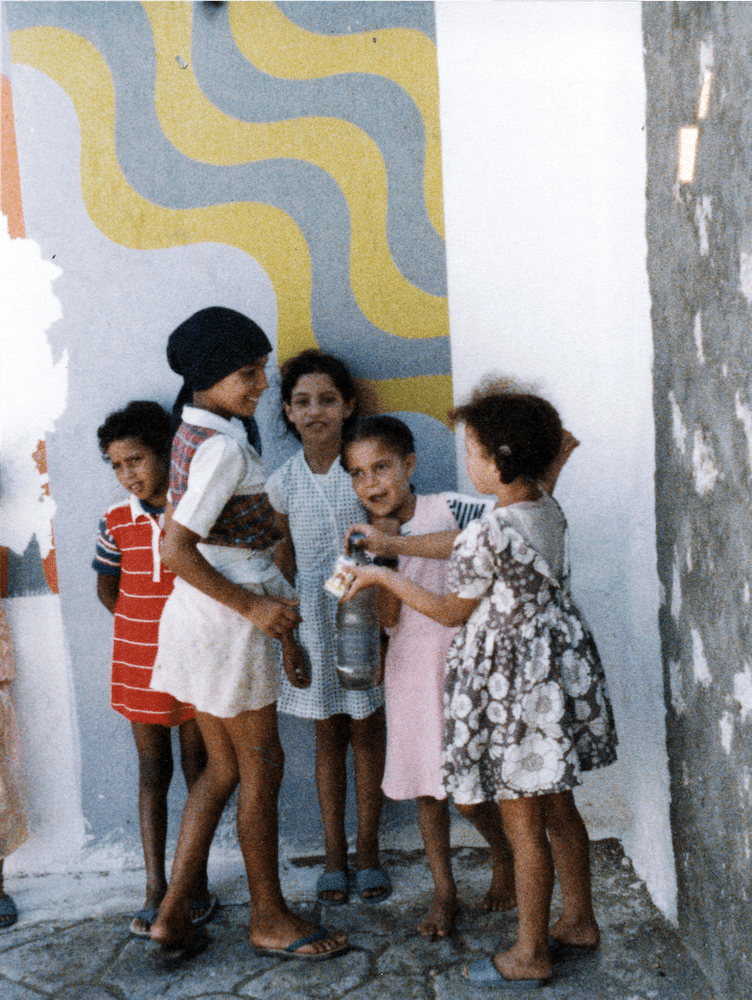
MOK: Absolutely. And so let me say this, because at the beginning, I used to call it paradise… And the nice thing about the paradise is that we brought in kids. I used to bring the kids that would stand at the door. I’d give them a small plate to do something. And then they opened for the kids to come one day a week. Like Friday or something like that. And it caught up like, you know, fire. I never thought a very small spark like that would change a place completely… Asilah, the population was so small, it was about 2,000 in that village. But it [the Moussem] brought – the first year – 20,000 Moroccans. 20,000. And that was the most unbelievable thing that I’ve ever seen. But also the kids made it beautiful.
LA: What do you think that spaces like the Blackburn Workshop, like Asilah – when it was at its prime – have to offer?
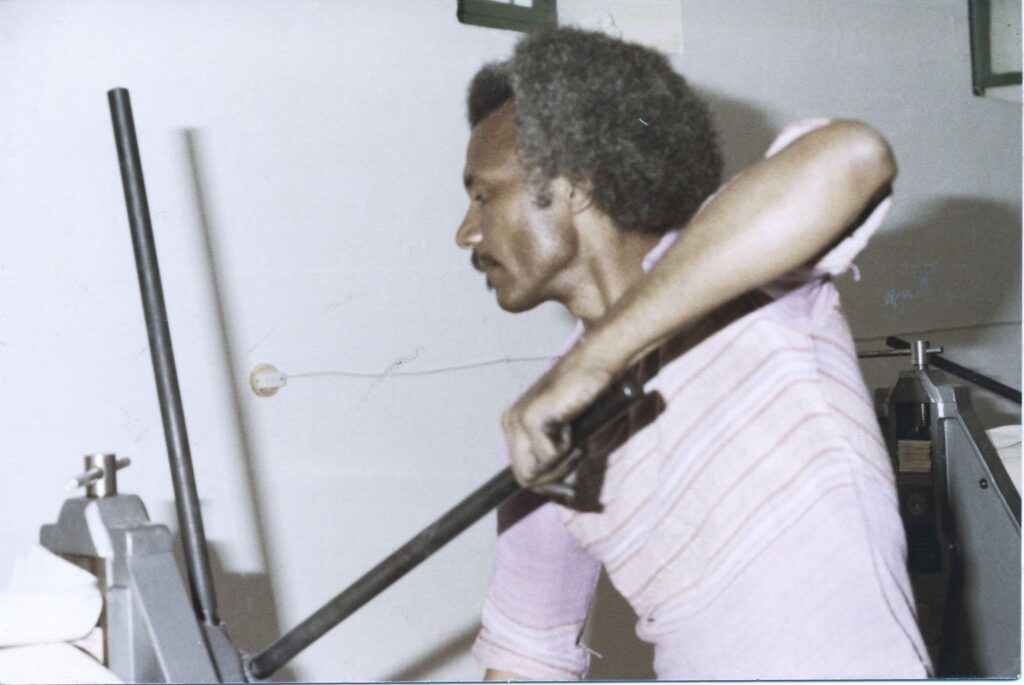
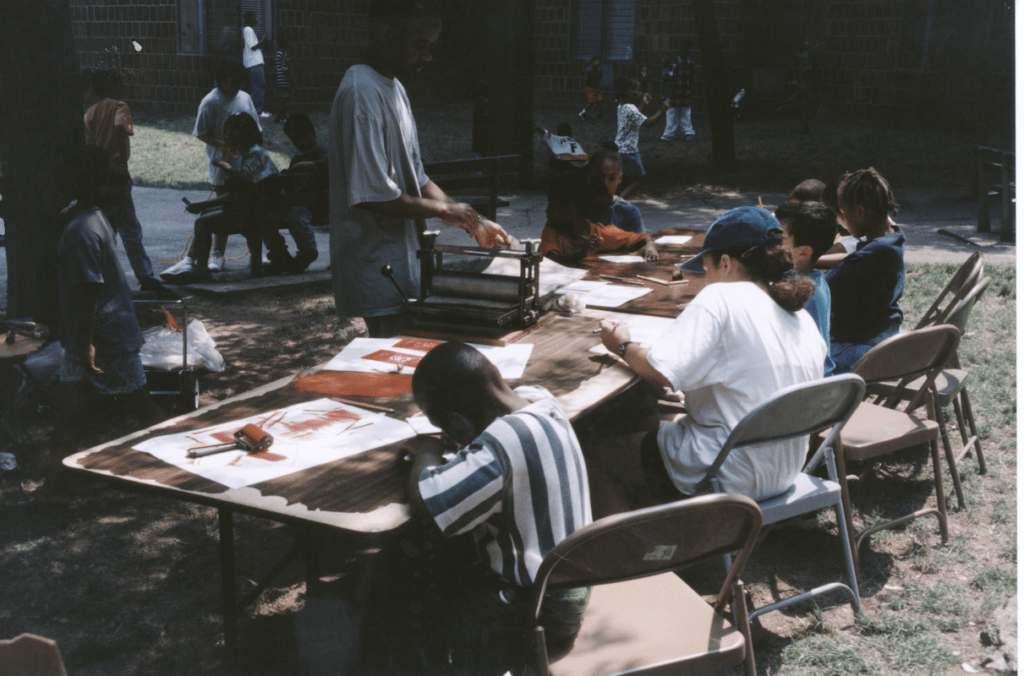
MOK: I mean, I am amazed that Bob has had this studio from ‘47, and up to now, up to the time he died, he managed. He was a terrible director, but he brought people from the street – like if he met somebody, artists or non-artists – to give them time in the workshop. And that’s all from donations. The first time I saw the studio it was in a very dilapidated building, a four-story or three-story building. And when you walk on the floor, [it goes] crack, click, crack. And I noticed that they had a Chock full o’Nuts can, and you put, you know, whatever you can pay. You went, you do editions, and you leave, you take your edition and go. Nobody paid money. You could bring kerosene or alcohol or benzene or paper towels. And that’s what you do, the workshop worked like that. And then because, you know, he was kicked out of this place, I’m sure the rent was very little, he moved to a bigger space across the street, and that was expensive. So, he started looking for bigger donations or foundations to give him money. And after the time that he had the MacArthur Foundation [grant], he spent it on the workshop, and spent it on himself. You see? I mean, he was so generous to a fault… He did it up to the time he died.
LA: That reflects a real commitment to the space and to community.
MOK: Absolutely. They used to have a van, with a small press in the back. And that’s how the Fourth Street shop started. With him.
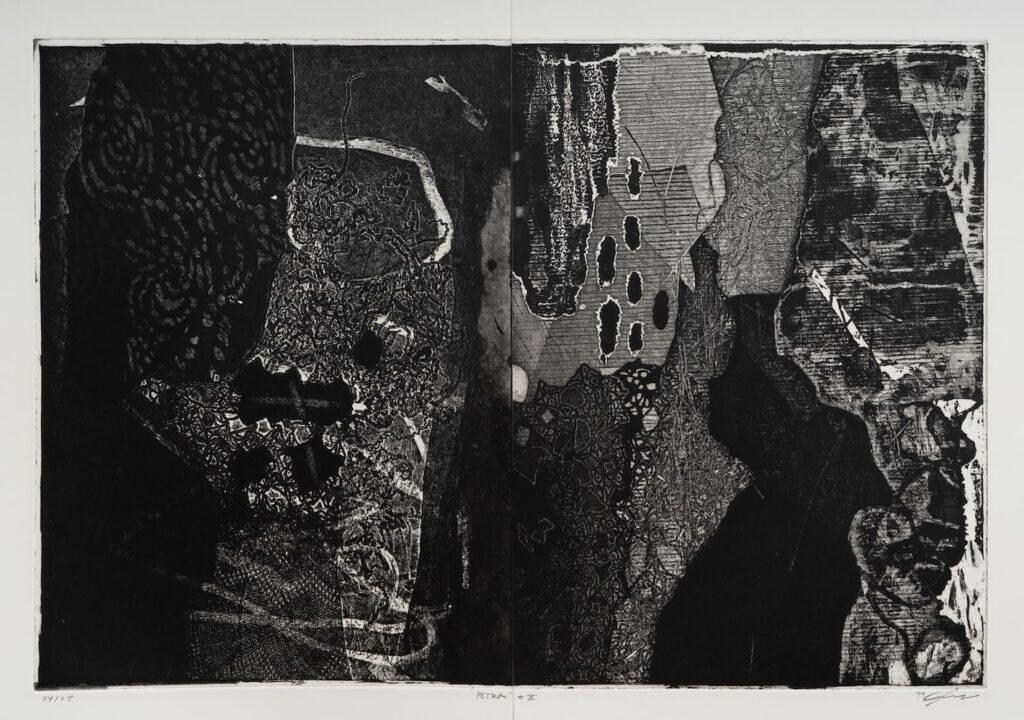
LA: We’ve sort of been circling around this topic of place. And so I want to now talk about place in your work, because it seems like a lot of your work has a real sense of presence and of place. Often it seems to me like you’re sort of translating almost the intangible elements of place, like the sounds, the air, the light, the spirit of the place into your work. I was wondering if you could talk about the importance of place. For example, the Common Ground series which captures Asilah, or your series capturing your visit to Petra.
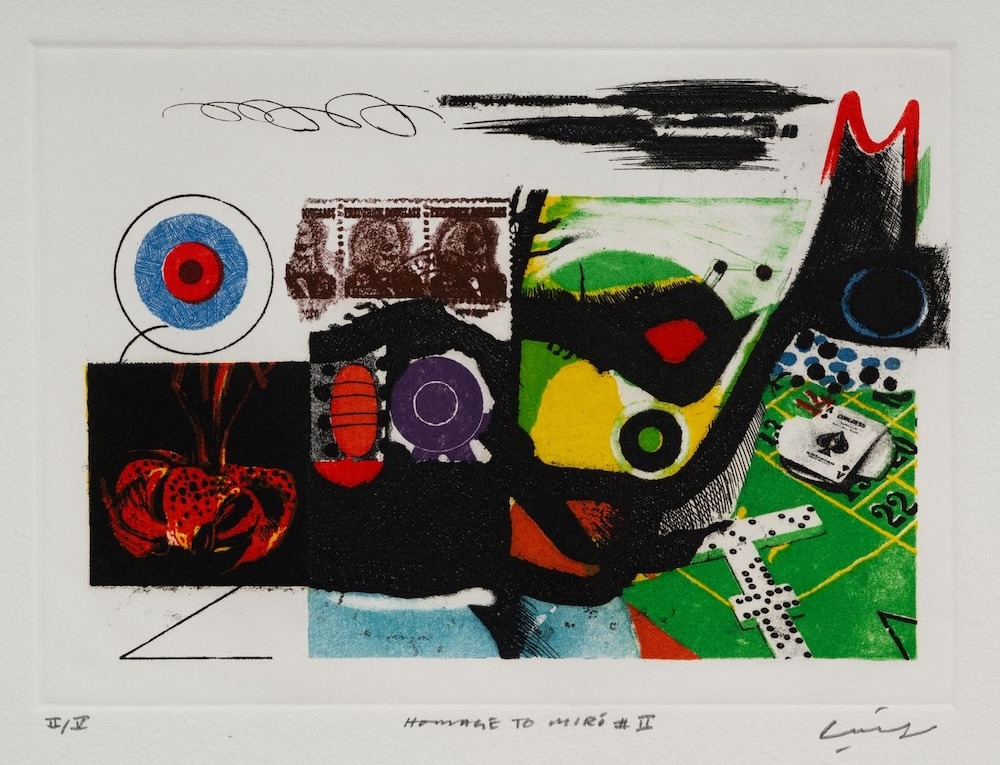
MOK: That’s my work. I work in series and most of the work that I did, I did after I did the job that I was supposed to do, print for other people. And I would give myself one hour, an hour and a half maximum. By about dinner time, I’d stop printing. I go and have dinner, or continue just printing, or doing my work. Whatever I did, whether I etch one plate or not, I have to give myself time. And that’s how most of the etchings were done, like that. For the Asilah Common Ground series, actually, what started me in that is, I did five prints for [Joan] Miró when he died. And I said, OK, well, I will continue because I was thinking, you know, what shall I do for this group of people coming to that place [Asilah]? And I used the stamps. I used them in black and white [for Miró], and I said I would use the stamps, the colored ones. Because of the light of Asilah, they have to be in color. So, the title…I said, you know, we are [all together] in that place. Why don’t I call it Common Ground?
LA: You mentioned that you were helping others. That was your job. You were supporting people with their own printmaking, and then you would work on your own personal work in the evening. What is the relationship between those two things, between your practice of supporting others and your personal creative practice?
MOK: I only worked with people that I liked their work… or they were nice – because I had one that was a nightmare, and I told his gallery, I will never work with this guy again if you give me a million. I’m not mentioning his name. So, it’s a joy when you work with, like, Louise Nevelson. I mean, I love Louise because she came to the studio, did her work, and left, and we had the most wonderful time together. Other people, they didn’t want to come to the studio and work on their plates… So, the others, I guess, out they went.
LA: There’s something that can feed your spirit about collaborating with people whose work you respect. To me, maybe that’s what makes these spaces sometimes magical, or sometimes sour. Because you can go from this spirit of great collaboration, and it makes it so much worse when it goes wrong.
MOK: Absolutely. You know, I taught for forty-seven years because I love teaching and I love the students that came to my class. Anyway, after forty-seven years, I quit also because the school changed. They took zinc out of the program. They took out nitric, aquatint. I said, what are you teaching the students? I mean, we had incredible ventilation, and nobody got sick. You know, they wear a mask when they use the aquatint box, don’t smell acid… Those people who run the program don’t know anything about what we do.
LA: It seems like you have a strong relationship to material in your work. The process and the materials that we use, they influence the work. And these set the boundaries around what we can and can’t do with the work in a way. There’s also this element, I think, in printmaking where you want to try to control the material, but the material sometimes has its own will.
MOK: Well, I say you have to know technique to do anything. You don’t allow the technique to take over. You see, if the technique is just aquatint or etching this or that, you kind of become illustrative, you become superficial about the image or what you want to convey or whatever it is. It has to, you know, move with what you feel and do and understand the limitations and the expansions. It’s the expansion of painting or art, the limitations. And, you know, some people kill the image, because they do too much, and it doesn’t breathe. The work for me has to breathe. If it doesn’t breathe, it’s dead, or mechanical. The artist, if he knows his technique, he would express it better. And he will get close to what he has in his head. Because you can never get exactly what you’re thinking. But as close as possible. And that’s, you know, for me is sufficient. Nobody is perfect.
LA: In a recent interview, you said something that had to do with printmaking, almost as a way of thinking or seeing the world.
MOK: I said that printmaking taught me something about painting. That’s true. When I was in Italy, I used to go fast with painting. I do still now because that’s the only thing that I’m doing. And I don’t work on one canvas. I work on three, four canvases at the same time. The same with the plates, that came from the plates. And because, with printmaking, you have to be patient, at the beginning, I was. But, you know, I work with accident, I work with the idea, I mean, if the idea doesn’t work, I do something different.
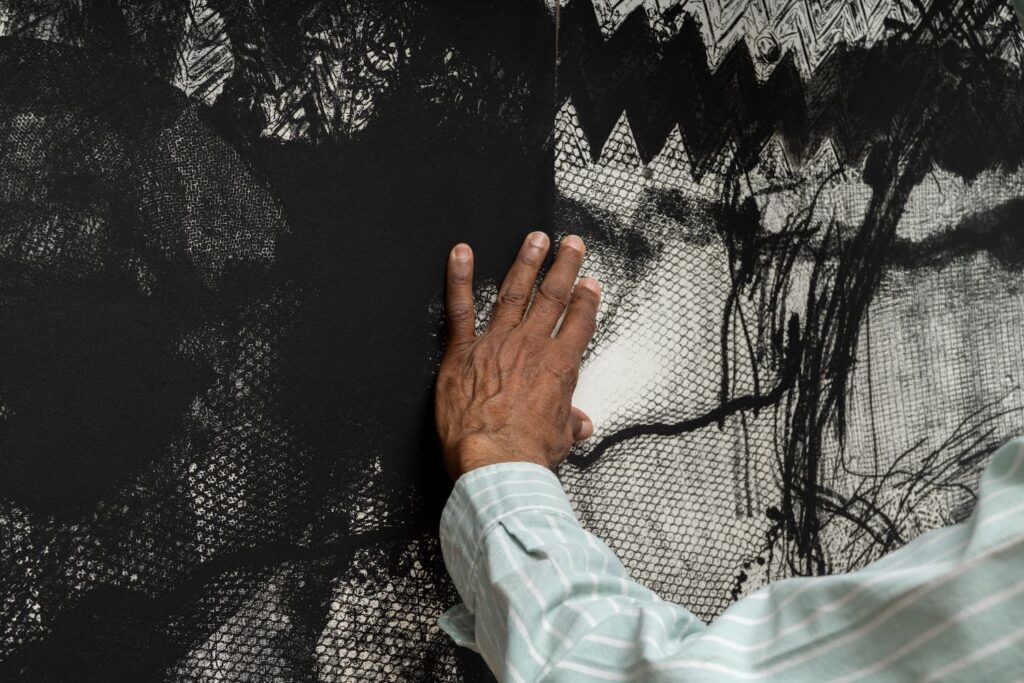
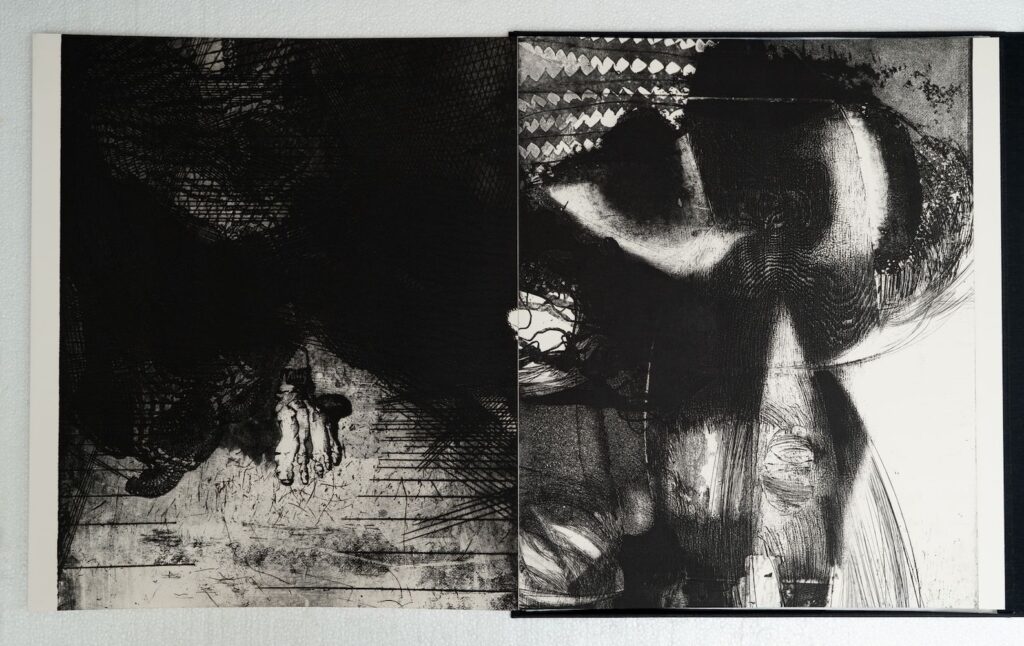
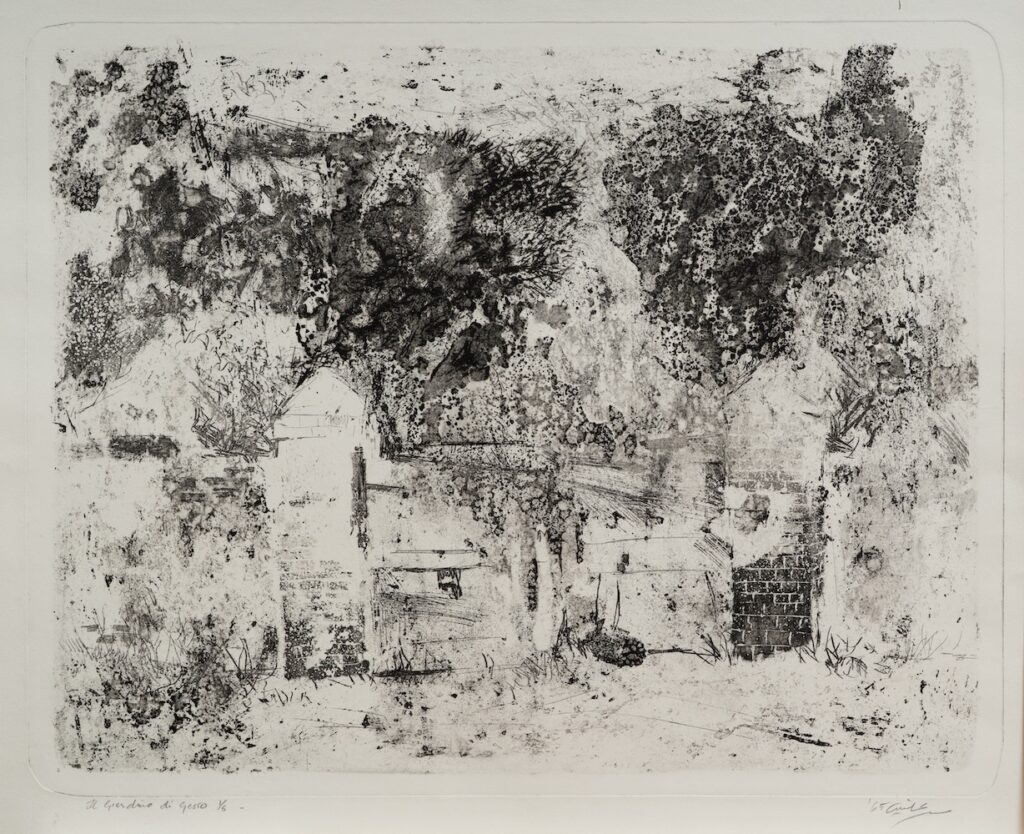
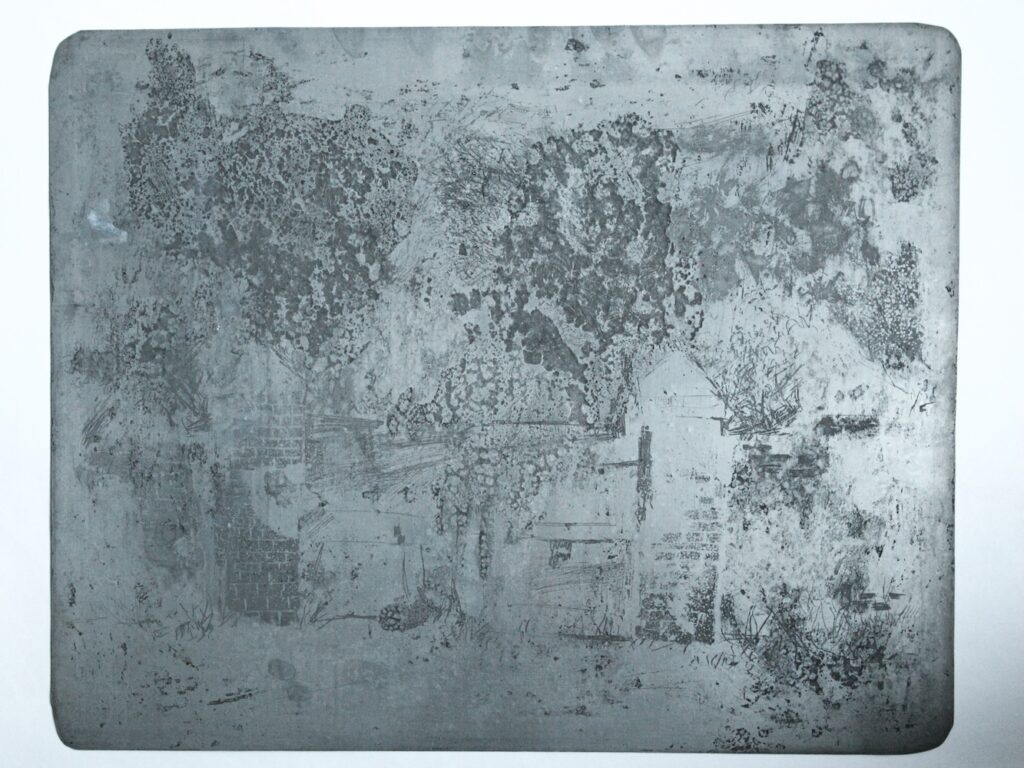
There is a print here [at the Robert Blackburn Workshop exhibition] and a plate of the piece, it’s called Il Giardino di Gesso. It’s from a movie that I saw the night before the last day for the piece. I was etching this nude, lying down, it wasn’t going [well] because I used a litho plate, and I looked at it before I started, it has like a covering. I had no idea that the covering was impossible to etch, except for the line, because I used a needle. For two days, I was struggling. And then after I saw the movie, I went to the studio to finish on the last day. And I had no print. So I cleaned the plate back and front. And when I turned it back, because we use ground to cover it up, and running it through a press, you pick up the ground, I cleaned it and I saw all these bits of areas, I knew what I had to do to it. And I finished the print in half an hour. Because I [added] the gate [in the image] only to it. And it became Il Giardino di Gesso. With a little bit of dry point. That was like an accident, but I used that accident and made it work for the print.
LA: From our conversation, and also some of the things I’m interested in or that I think about, there’s this aspect of, I don’t know if collaboration is the right word, but relationship with the material. And there’s also a collaboration, sometimes, with other people in printmaking. What do you think is the relationship between printmaking and collaboration, whether it’s with materials or other people?
MOK: I don’t know. You know, a lot of people work in different ways. But because I have this thing in my hand that I control, I can use it the way I feel. It doesn’t go beyond that. That’s the relationship, because of the knowledge that you know about this material. Neither take it too far nor less. That is a balance. It has to be there.
Leila Abdelrazaq is a Chicago-born Palestinian writer, artist, and cultural organizer. She is the author and illustrator of the graphic novel Baddawi (PM Press, 2015), a novice printmaker, and writes on SWANA creative production, material culture, and political imaginaries. She is a Ph.D. student in Art History, Theory and Criticism + Art Practice at UC San Diego.