Wade in the Water: A Constellation on the Artist as Culture Worker and Practitioner of Fugitive Pedagogy
Melissa Ferrer Civil
Preface
From the roots of language and the heart of humanity, the word “Justice” blossoms, entwined with the essence of equity and equality. In its truest form, justice is the sacred act of restoring balance to the scales of life, tipping gently towards fairness where there is imbalance.
As an abolitionist, I envision a world where justice is not a weapon of punishment, but a tender hand that nurtures and heals our communities. When a pauper steals a loaf of bread, true justice does not confine him to a cell but sows the seeds of plenty so that hunger is but a distant memory.
In our misguided pursuit of retribution, we imprison the brightest lights of our generation.
These souls, forged into flints by the weight of oppression, hold the potential to ignite transformation. Yet, what does it say of our society when gentle genius and profound insight are shackled, hidden from the world behind bars?
Take, for example, Marcellus “Khaliifah” Williams. Khaliifah was lynched by the state of Missouri on September 24, 2024. Khaliifah was a father, prolific poet, devout muslim and served as an Imam at the Potosi Correctional Center. During the 24 years Khaliifah was on death row he served an immaculate sentence free from incident. In prison, Khaliifah developed a practice of writing poetry that speaks deep into the human experience.
His poems are stark perspectives on his life, his relationships, and the world at large. Through his words, Khaliifah reminds us of the ways that incarceration can rob the world of genius and beauty.
When I was an educator, my children with the most disruptive behaviors, were children for whom the classroom model did not work. Each of them held a brilliant fire not often stoked or valued by the education system. What was seen as disruptive behavior was simply a child attempting to meet their own needs within a system that neglected them. The cost of trying to fend for themselves was often detention, displacement from the classroom and other punitive measures.
These responses taught our kids (because they’re really ours) that society was going to reject them for being themselves, that they were wrong for not fitting in and doing so loudly, and that they could not trust these institutions to hold them with the respect, attention, and tenderness that they deserved.
Those kids become adults who are continually making decisions for their survival in a world that does not value, honor, or believe in them. Some of them become artists (culture workers), some of them don’t make it to the age of 30, and some of them move from confinement (detention) to confinement (prison).
And still, there are other adults who get caught up in the racial profiling of an institution that disproportionately criminalizes and penalizes Black men. In Khaliifah’s case, the St. Louis County Prosecuting Attorney reviewed the DNA results and filed a motion to vacate Williams’s conviction, asserting the DNA evidence clearly exonerates him. Despite this, Attorney General Andrew Bailey remained unflinching in his judgment that the state should move forward with the execution.
To date, no evidence has been found that links Williams to the murder of Felicia Gayle in 1998 and until death Khaliifah maintained his innocence. If anything, Khaliifah’s story shows us that at its core, this system cannot provide true justice.
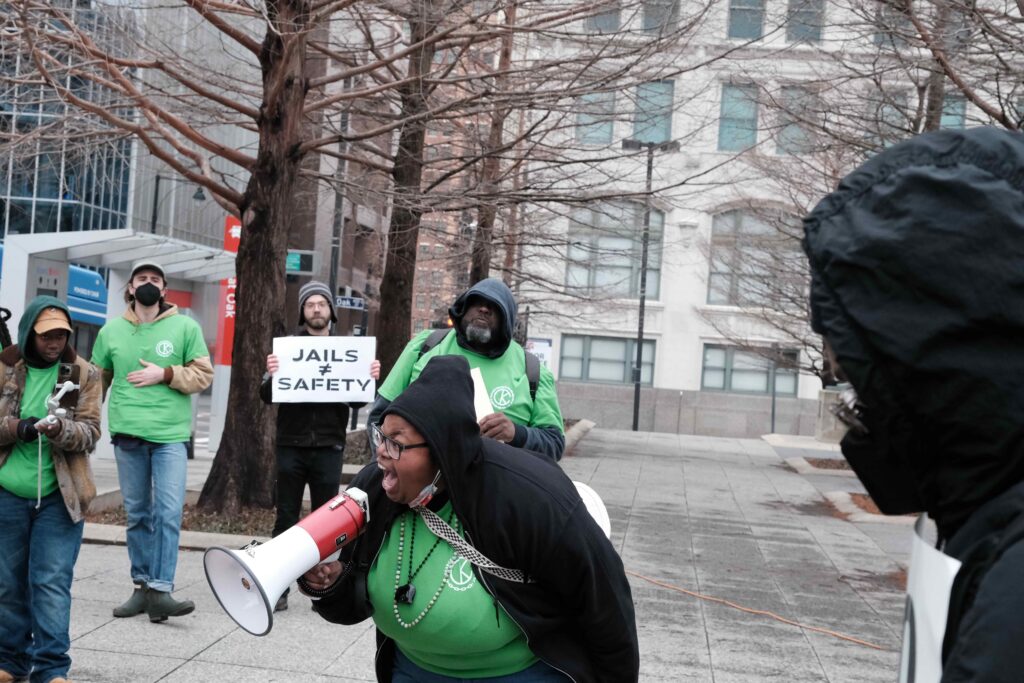
In a world that is quick to dehumanize the voices and perspectives of “undesirables,” organizations like MADP (Missourians to Abolish the Death Penalty), Decarcerate KC and A Nation In Exile are fighting to uplift the voices, stories, and perspectives of those who have been banished into the shadows. In August of 2024, these three organizations gathered together local performance poets in our KC community to give a public reading of Marcellus “Khaliifah” Williams’ work.
◊
When I was asked by the editors to write a preface for the essay “Wade In The Water” that included the story of Marcellus “Khaliifah” Williams, I couldn’t think of better words than the ones that I had already written on August 21st, 2024 in The Kansas City Defender just a month before Khaliifah was lynched. Those are the words that you just read with minor time-based edits.
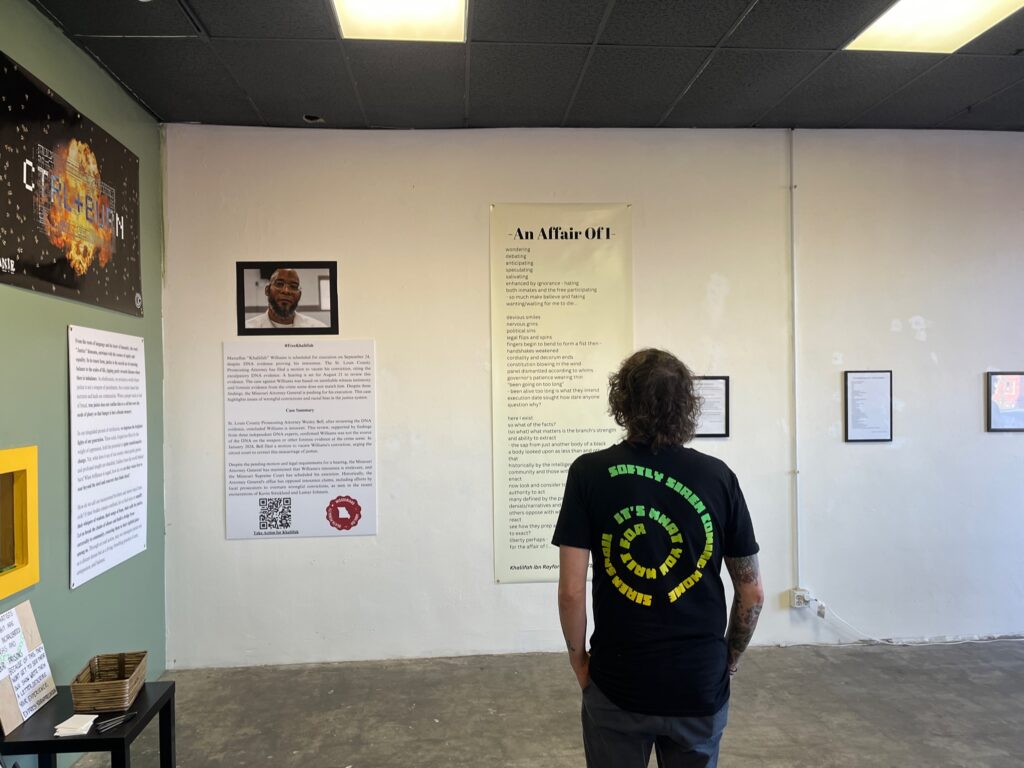
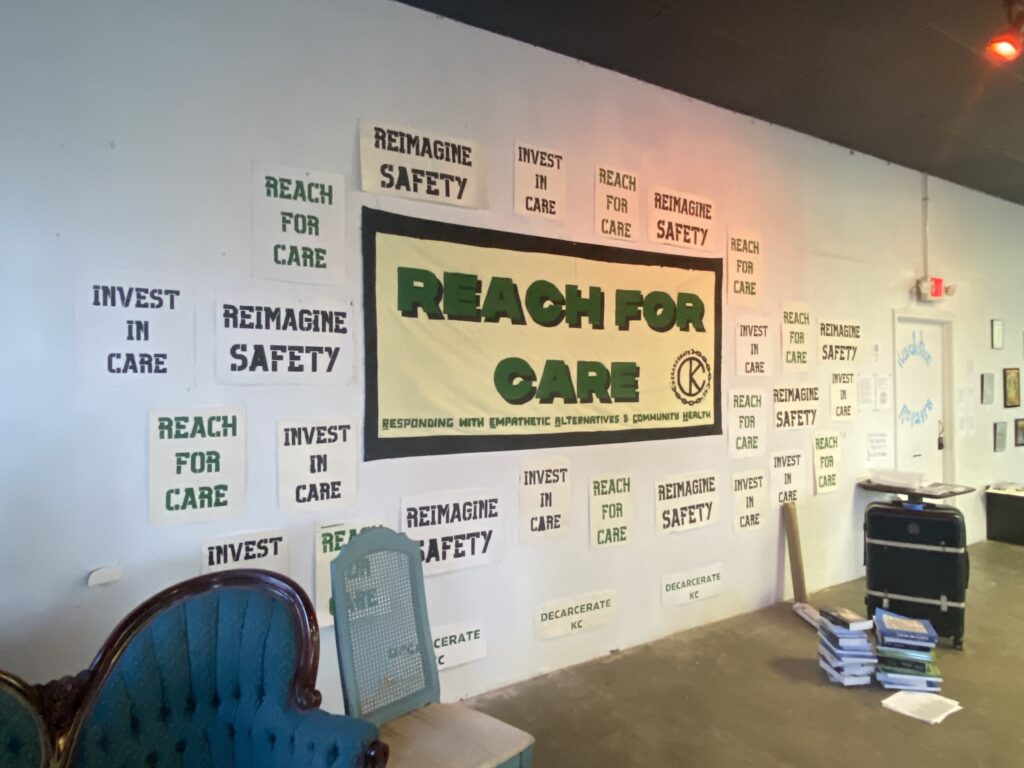
The essay that you are about to read wrestles with the artist’s identity as a culture worker and practitioner of fugitive pedagogy. When A Nation In Exile, my abolitionist arts and organizing event series, put on CTRL + BURN, a month long arts exhibit with five nights of programming featuring visual, written, and performed work by currently and formerly incarcerated community members, it was with the intention to burn the steel barred encasing in people’s minds that had their perspectives locked into the belief that prisons, jails, and general carceral and punitive responses were accurate representations of justice. We live in a carceral culture. And this culture promotes not only locking up our neighbors into a constitutional slave class, but also justifies genocides, occupations, and enslavement in other countries for the sake of our comfort and convenience. Out of this event we raised money for Decarcerate KC, an abolitionist organization fighting the construction of jails and carceral policies in KC. We connected with formerly incarcerated community members who were recently out of prison and looking for a world better than the one they had left. We amplified the voices of community members behind bars that would otherwise go unheard. And we made anyone who walked in Turnsol Books aware of Marcellus Khaliifah Williams’ story and his work (pictured below).
It was obviously not enough, but it was the beginning of much more to come.
For his final statement Khaliifah wrote “All Praise Be To Allah In Every Situation!!!”
For more information about Khaliifah (and MADP) and to read some of his work please go to: freekhaliifah.org.
The text above was originally published by Melissa Ferrer Civil in the Kansas City Defender on August 22, 2024. See “How Marcellus Khaliifah Williams’s Story Shines Light on the Injustices within the Legal System.”
◊
The dissolution of The Academy from a pillar of cultural understanding and reasoning into a corporate megalopoly is rampant and ravenous. Thus, the need for fugitive pedagogical practices re-emerges from the depths of the human will. As a staunch abolitionist, I argue that the need has always been there, but our ears have been deafened to its groaning. The institutionalization and standardization of learning in our society has always oriented the educated masses toward a Euro-centric perspective, essentially white-washing members of the global majority toward a certain erasure of their own lineageaic memory into a perspective that both covertly and overtly delegitimizes their humanity. An induced cultural amnesia of sorts. The criticism of such educational practices can be found in Carter G. Woodson’s “Mis-education of the Negro,” as well as Frantz Fanon’s “Black Skin, White Masks” and Paulo Friere’s “Pedagogy of the Oppressed.”
In times like these, which they have virtually always been, the responsible artist must recover their indigenous identity as cultural worker, healer, medium and prophet. Inherently fugitive positions in oppressive societies and passersby roles in healthy ones. The idea of “politicizing art” can only come from a society that has worked hard to obfuscate the impact of art upon the human psyche and human behaviors, as they utilize those same practices to further propaganda and influence the numbed masses. My good friend, Sicangu Lakota poet and activist Robert Bordeaux, says that for many indigenous people art has always served the purpose of communication.
I curate an abolitionist arts and organizing event series entitled A Nation In Exile as well as direct the Black Abolitionist freedom school B-REAL (Black Radical Education for Abolition and Liberation) Academy. It is from the perspective of one born into fugitivity that I examine the impact and intentions of these projects while highlighting the ways artists of all disciplines employ a level of fugitive pedagogy to educate and liberate in the undercurrent and the mainstream.
◊
A Note on Form: The form of this lyric essay is called a constellation, “invented” by the author of this essay. Etymologically, the word constellation comes from “Late Latin constellationem (nominative constellatio) “a collection of stars,” especially as supposed to exert influence on human affairs,” from constellatus “set with stars,” from assimilated form of Latin com “with, together” (see con-) + past participle of stellare “to shine,” from stella “star” (from PIE root *ster- (2) “star”).”[1]
Colloquially, a constellation is a grouping of stars, shining together. Culturally, constellations may act as guides to understanding a person’s characteristics, proclivities, or essence. It is important to note that this understanding is not definitive, but suggestive, or, perhaps, diagnostic. The author chose to name this form as such because this essay is written in illuminatory fragments, using luminary perspectives and voices that burble an essence of the argument being engaged with/in this essay. In some cultures, stars are thought to be angels or ancestors.
Separating these fragments are fermatas. A sign in music composition that suggests the musicians hold the note or rest for slightly longer than the measured time, an immeasurable amount of time, that is really just a vibe, a breath, a stop, a pause, a
Selah
Curiously the word firmament, meaning “expanse of space above the earth where the heavenly bodies move” – comes from the same root as fermata. “Strong, steadfast, enduring.”
◊
When I was appointed as Kansas City, MO’s inaugural poet laureate in February of 2024 one resounding question came at me from all sides: “What does a poet laureate do?” At first, I would joke that no one knew. Not the mayor, not me.
Officially, on the city’s website, the poet laureate was to serve as “an ambassador for poetry and the arts” in the KC metro area. The more I dug, the more I learned that poets laureate were often attached to some sort of literary or literacy based community project that served to spread the love of poetry. As a former educator and current organizer for social justice movements I wracked my brain to figure out what I should be doing as the first poet laureate of my city. What path did I want to pave for those who would traverse it after me? In preparation for a panel discussion in Portland, Maine with Black Poets Laureate, the poet laureate emeritus of Houston, TX, Aris Kian said “We don’t get the Poet Laureate title to activate anything but because of what we are already doing.” I was struck by this thought. At the time of receiving my appointment, I had founded and was facilitating an abolitionist arts and organizing event series called “A Nation In Exile”. Born from the perspective of an orphaned, first-generation Haitian-Cuban-American who had spent most of her life seeking a home, ANIE was organized with the understanding that we were a nation of exiles in exile from one another, our culture, our lands and ourselves. ANIE asks the big question: what does home look like after centuries, millennia really, of long violent exile? And who is responsible for our return? The whispered answer that ANIE puts forth is that we walk each other home with the help of artists and organizers. Artists re-organize our insides through broadening our perspectives and expanding our vision for possible futurities – thus altering our actions and interactions in our daily lives as we learn to live according to the visions we hold in our hearts. Organizers artfully and strategically create the conditions externally through fighting for policies that give breathing room for the fires we tend in our hearths to blaze all around us.
In March 2025, I met the poet laureate emeritus of San Francisco, Tongo Eisen Martin, at a poet laureate panel in LA during AWP (Associated Writers and Writing Programs) Conference. As an organizer, I valued his perspective when it came to juggling being an appointed “official/royal” writer and an abolitionist. So, I asked him a question: “Hey Tongo, I’m the first poet laureate of Kansas City and I’ve been struggling with how to serve in my position. I run a Black abolitionist freedom school in KC and have an abolitionist arts and organizing event series. I hear poets laureate are supposed to be focused on literary community projects but given the times, I feel more called toward organizing and educating the people in my community about their material conditions, how we got here, and how to change them. When you were poet laureate did you find yourself prioritizing literary community projects or organizing?”
Without missing a beat Tongo replied: “Always be an organizer first because they’re going to be an imperialist first.”
◊
In 2025, a craze swept the globe – it was named K-Pop Demon Hunters. In it, a central message that has been echoed by radicals, abolitionists, and revolutionaries wherever and whenever empire is found:
A world peace, or world order, that demands inauthenticity, hiddenness, lies, and silence in order to be maintained deserves to be demolished. Even if it purports itself to be for the greater good.
◊
In 2004, a 12-year-old girl sits at her desk in her 7th grade English class. Externally, the walls are closing in. Her oldest sister, Sophia, 16 years her senior, has just committed suicide. Her family has placed themselves in individual silos, unable to process their emotions. Her classmates taunt her and assure her Sophia is going to hell for what she has done. Her school counselor would not permit her to speak without clearly stating that her sister is dead instead of using the euphemism “passed away.” Internally, she is drowning in her own chasm of despair. A sludge that blocks her airways begins to spread through her veins and capillaries.
Her English teacher places Maya Angelou’s “Still I Rise” on the desk of each student. Silently, she begins to read the text before her. As she reads the final stanza–
Leaving behind nights of terror and fear
I rise
Into a daybreak that’s wondrously clear
I rise
Bringing the gifts that my ancestors gave,
I am the dream and the hope of the slave.
I rise
I rise
I rise.[2]
– the sludge begins to recede. Her breathing steadies. Light begins to disintegrate the darkness within. She is rising.
◊
During the 2026 Superbowl, Toyota airs an ad that depicts adults of varying professions being egged on by representations of the children they once were.
I find my eyes dewy and my heart churned. I’m touched.
I can’t help but clock it as a measurement of where the collective consciousness is on the journey home. We are healing. We are understanding how to listen to our inner child, which frees us to our innocence and thus frees children the world over, arguably, the most oppressed class of humans, to their innocence and freedom of movement, healing and growth.
Then, suddenly, reality sets in. They sell us products by tying them to our yearning. And this, too, is culture work – even if in reverse. Where we are mined, bought, and sold according to what we already know.
The propaganda of the slave catcher.
The leaven of the Pharisees.
◊
I decided to become a poet when I was 12 and Maya Angelou’s “Still I Rise” revealed how poetry had the ability to comfort my broken heart. I wanted to use poetry as a tool to help others who felt alone, like me, to know that they were not alone. I wanted to uplift their experiences, let them know that they were seen and felt, and that we were one. I wanted to help provide a sense of solidarity among the hopeless and the outcasts.
At 14, I started performing spoken word poetry on stages at open mics and poetry slams, thanks to my high school creative writing teacher and the mentor that she connected me with. I would write poems about race relations, processing my sister’s suicide and my mother’s death. I would write poems about the dangers of bullying and gossip. At some point that year we were assigned to read e. e. cummings’ “[anyone lived in a pretty how town].” After reading that poem over and over again and gleaning a new understanding, a new depth of meaning, with each reading, I knew that I wanted to study poetry in college.
children guessed (but only a few
and down they forgot as up they grew
autumn winter spring summer)
that no one loved him more by more
…
stars rain sun moon
(and only the snow can begin to explain
how children are apt to forget to remember
with up so floating many bells down) [3]
◊
Sitting with our desks in a circle, it is the first day of our poetry workshop. It is my junior year at Florida State University, an academic institution that, at the time, boasted their place as 3rd in the nation for undergrad Creative Writing programs. Our teacher, Scott Bailey, asks us to go around and share what some of our fears entering into the workshop are.
“I’m just afraid that this workshop will kill my poetry,” says the Latine student sitting next to me.
“Well maybe your poetry is just shit,” replies Professor Bailey.
◊
During a Q & A at UC Berkeley in 1973, James Baldwin is asked to comment on public education in America especially with respect to Blacks and UC-Berkeley’s low Black enrollment rates. He responds:
“…You can’t begin to answer without feeling terribly futile… Look, the truth is it’s very hard to talk about education in this country without talking about the society in which it mainly fails to occur. You can hardly talk about schools without talking about cities – and the cities are in the hands of financiers, [the] cities are in the hands of pirates, thugs. And our children, therefore, are victims of the principles according to which this country is run. The country is not run according to the will of its citizens (I hope). Or the good of its citizens (I know that) – but for profit, for money, to make money. And education is a billion-dollar industry and the least important part of the industry is the child. I think this is criminal but this is the way it works. Now the public education in the city in which I grew up [Harlem] is enough to break the heart, enough to make you want to kill. And when we have tried, and we are trying again, and we are trying over and over and over again to educate our children ourselves. To be responsible for the teaching, for the curriculum, for the books. We did that for three years in New York some years ago and the experiment succeeded for three years. And because it succeeded it was crashed, it was smashed by the boards of education, the teacher’s union, and Albany. So that is what you are up against…
As for the enrollment at this college, let’s face it, Black people in this country have a terrible time just getting through 24 hours a day (laughter and applause). It’s actually true, you know. It’s hard to talk about education in a country in which illiteracy is adored. It’s hard to talk about education in a country where people take seriously such a creature as John Wayne and Ronald Reagan (laughter and applause). You know, I’m really not trying to be funny, it’s true, you know. And for a Black person to get an education in this country he has got to have a lot of guts, first of all. And to endure (aside: sorry I don’t mean to be rude) but this institution is like many other institutions, which means it’s a racist institution. (from aside: amen) There’s no way around that. All the American institutions are racist. And to get an education under those circumstances is a tremendous act of the will – and also you risk schizophrenia (laughter).”[4]
◊
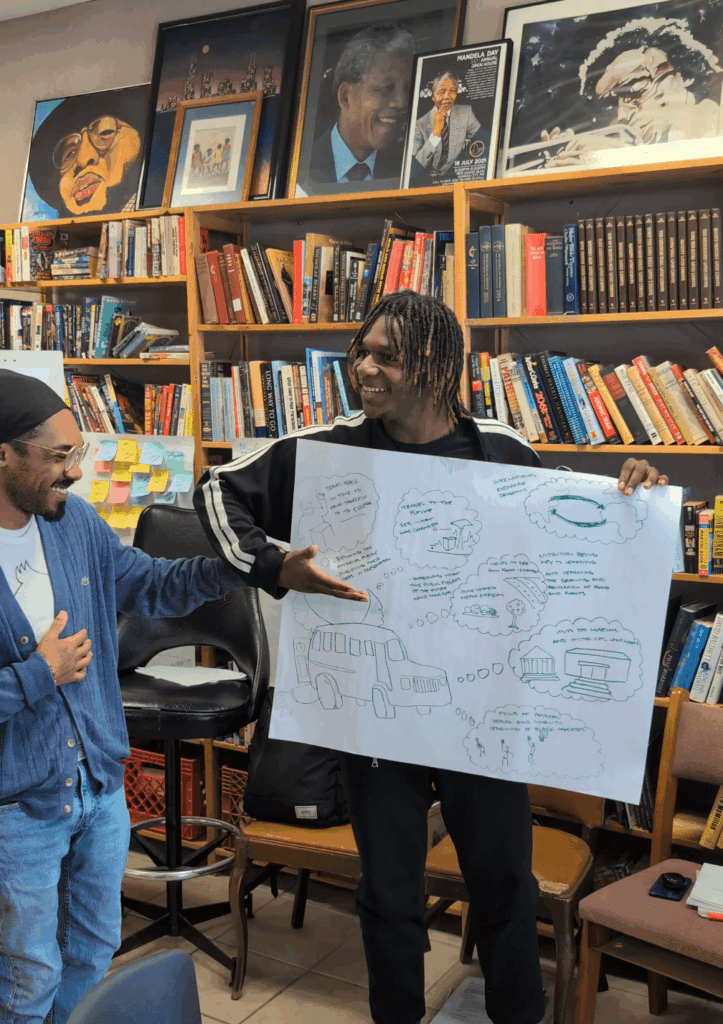
In September of 2024 the Editor-In-Chief, Ryan Sorrell, of the Kansas City Defender, KC’s local abolitionist Black digital media organization, approached me with an offer. Ryan wanted to start up an abolitionist freedom school that got Black community members connected to journalism and organizing or community building through teaching them radical Black history. An education that represents us, as a people, a legacy, a lineage, and a tradition. We wanted to knit together the proverbial collective, cultural quilt that had been torn at the seams by continued colonization through the empire’s most pervasive propagandistic arm – the education system. Together we came up with the name B-REAL (Black Radical Education for Abolition and Liberation) Academy. We fashioned the curriculum for the 14-week, 3 hour Saturday class cohort model from a pre-existing 12-week curriculum shared with us by the W. E. B. Dubois Movement School, an abolition school in Philadelphia, PA. For us, it was important to make the content all black (with help from our indigenous and third world cousins) and accessible to teens because we wanted to focus on high schoolers while making sure each cohort would be intergenerational – so we took out Gramsci, toned down Marx and Freire, and added Cedric Robinson, Jarvis G. Givens, and Frantz Fanon. We added Black Feminists such as June Jordan, The Combahee River Collective and bell hooks. We added a class on tech and AI and surveillance centering the work of Dr. Ruha Benjamin. We wanted to lean into the tradition of Black Study and the revolutionary necessity of Fugitive Pedagogy. And we fashioned the class structure so that at any age any student could be granted access into the substance of the material.
◊
Black Study lives under the umbrella of Fugitive Pedagogy. The modern essence of which was perhaps first born in a barn, on a plantation, in the dead of night after a long day’s work being forced to toil in someone else’s field and being viewed and treated as someone else’s property. And that someone else’s commitment to disregard one’s humanity in order to justify the violence one suffers. For such a one to believe in their own humanity and in the prospect of liberation, a life free from chains, enough to extend their long day into a long night of teaching themself and their kin to read and write, necessarily shielded from the master’s sight so as to not be put to death– is the essence of Fugitive Pedagogy. An education (lit. leading out) that precedes and opens doors unto liberation for the captive and oppressed.
The Black identity itself is a fugitive one. Under the current imperialist structure to be perceived as Black AND human is a fugitive perspective. In a world that utilizes language of dehumanization (e.g. terrorist, slave/prisoner, suspect, criminal, etc.) in order to justify genocide, war, and economic and biologic pillaging (i.e. rape), we are Black, Dark, and Fugitive because the light cast upon us is the shadow of White fears, White greed, and White ignorance and we dare to resist.
◊
In a 1982 interview with Kay Bonetti, Toni Cade Bambara responds to her question “What do you view as the function of the artist?” by saying:
“The task of the artist is always determined by the status and process and agenda of the community that artist serves. If you are an artist who identifies with, who springs from, who is serviced by, or drafted by say a bourgeois capitalist class, then that’s the kind of writing you do. And your job is to maintain status quo, to celebrate exploitation, or to guise it in some lovely romantic way – that’s your job. If you are a writer in Cuba, post-revolutionary Cuba, your job is to celebrate the triumph of the national will. If you are a writer coming out of Kenya, the post-independent era in Kenya, your job is really to critique the failure of class struggle in Kenya and to tell the truth and to try to envision, to share a vision of what that society should be like – if they’re gonna really liberate itself.
As a cultural worker who belongs to an oppressed people my job is to make revolution irresistible.” [5]
◊
From Etymonline, an online etymology dictionary:
propaganda(n.)
1718, “committee of cardinals in charge of foreign missions of the Catholic Church,” short for Congregatio de Propaganda Fide “congregation for propagating the faith,” a committee of cardinals established 1622 by Gregory XV to supervise foreign missions. The word is properly the ablative fem. gerundive of Latin propagare “set forward, extend, spread, increase” (see propagation).
Hence, “any movement or organization to propagate some practice or ideology” (1790). The modern political sense (“dissemination of information intended to promote a political point of view”) dates from World War I, originally not pejorative or implying bias or deliberate deception. Meaning “material or information propagated to advance a cause, etc.” is from 1929. Related: Propagandic.[6]
◊
In December 2025, I wrote a critique on archival practices for the local art criticism magazine Fortresses where I utilized a special exhibit at the Nelson-Atkins Museum, Painted Worlds: Color and Culture in Mesoamerican Art (exh. 11/25-2/26), as a portal into reflections on the ethics and functions of the archive informed by Saidiya Hartman’s concept of “working with and against the archive.”[7][8]
Though the stance I take in the critique is a bit agitational, I must say was pleasantly surprised by the information offered up in the exhibition description:
“Mesoamerican gods and goddesses were often described as artists; in the poem above, the divine “Giver of Life” painted, sang, and colored humans into existence. Human artists acting as scientists, technicians, and sages, played a critical, generative role by transforming natural materials into vibrant colors saturated with meaning. Their works connected communities to the natural world, the spiritual world, ancestors, divinities, and the cosmos.”[9]
The act of uncovering, discovering, and communicating (re: propagating an understanding of) our collective orientation as humans in the cosmic schema of creation has always, in every case, in every society, from indigeneity to today, been the work of “the artist” – the culture worker.
◊
Bailey-isms directed at me:
“Melissa, what would you write about if there were no angels?”
“This folder says students who doodle in class are showing signs of distress. Ms. Civil, are you in distress?”
“I picked on you because I liked you.”
◊
What happens when the hegemonic class who control the zeitgeist is hell-bent on suppression, erasure, and confusion in order to carry out their millennia old divide-and-conquer practices?
◊
While writing this essay, I finally pick up Christina Sharpe’s In The Wake: On Blackness and Being. My brother, DJ, had suggested I read it back in 2022. My friend, Miranda, gifted it to me in 2025. In the first chapter, Sharpe writes:
“There are, I think, specific ways that Black scholars of slavery get wedged in the partial truths of the archives while trying to make sense of their silences, absences, and modes of di/appearance. The methods most readily available to us sometimes, oftentimes, force us into positions that run counter to what we know. That is, our knowledge, of slavery and Black being in slavery, is gained from our studies, yes, but also in excess of those studies; it is gained through the kinds of knowledge from and of the everyday, from what Dionne Brand calls “sitting in the room with history.” We are expected to discard, discount, disregard, jettison, abandon, and measure those ways of knowing and to enact epistemic violence that we know to be violence against others and ourselves. In other words, for Black academics to produce legible work in the academy often means adhering to research methods that are “drafted into the service of a larger destructive force”(Saunders 2008a, 67), thereby doing violence to our own capacities to read, think, and imagine otherwise. Despite knowing otherwise, we are often disciplined into thinking through and along lines that reinscribe our own annihilation, reinforcing and reproducing what Sylvia Wynter (1994,70) has called our “narratively condemned status.” We must become undisciplined. The work we do requires new modes and methods of research and teaching; new ways of entering and leaving the archives of slavery, of undoing the “racial calculus and… political arithmetic that were entrenched centuries ago” (Hartman 2008, 6) and that live into the present.”[10]
◊
Fugitive Pedagogy. The need for an education that is hidden from the cold, capitalistic, desecrating gaze of the oppressor. Presented in a way that allows people to enter in, in their own way, as they are, valid and believed.
◊
Cue: Music. Wade in The Water. Swing Low, Sweet Chariot. Don’t Go Chasing Waterfalls. Mathematics. Changes. Fight The Power. We Got Love. Liberation technologies used by the enslaved to inform fellow captives of impending plans of escape, detailing the road to liberation, and the struggles that will ensue upon it.
◊
Cue: Art.
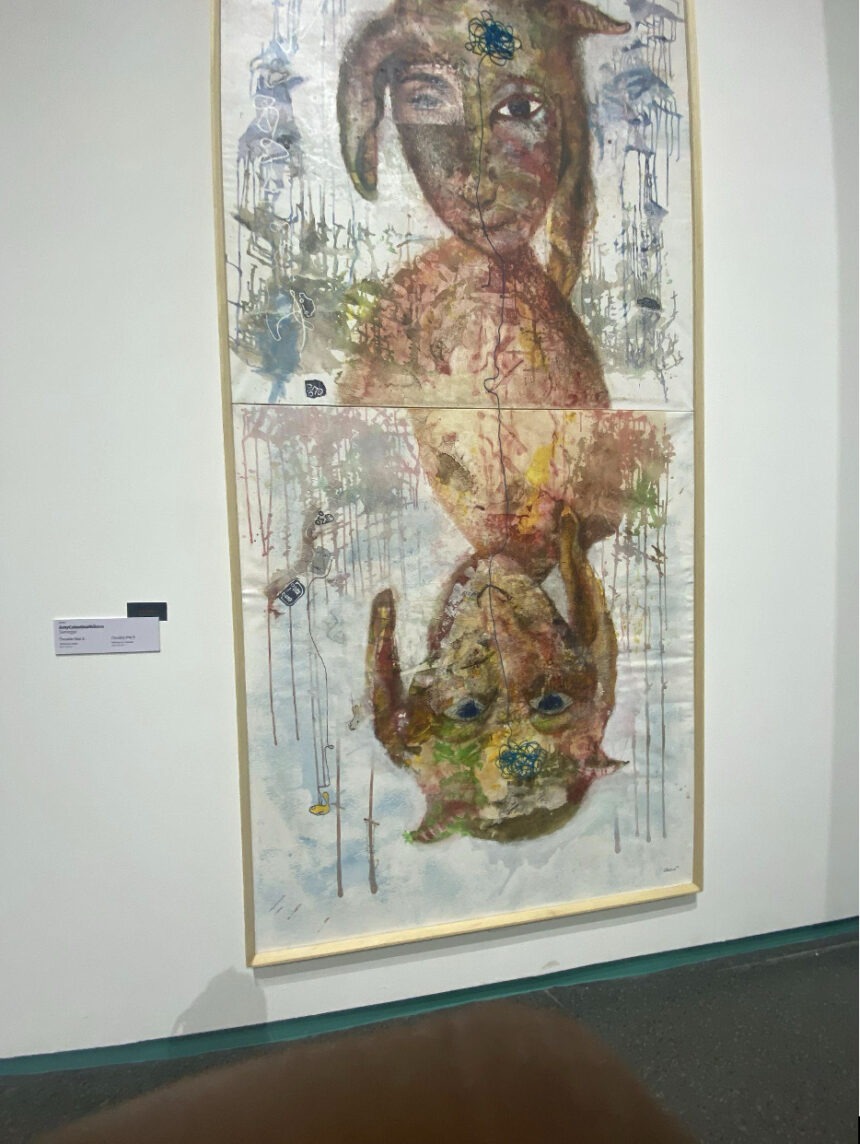
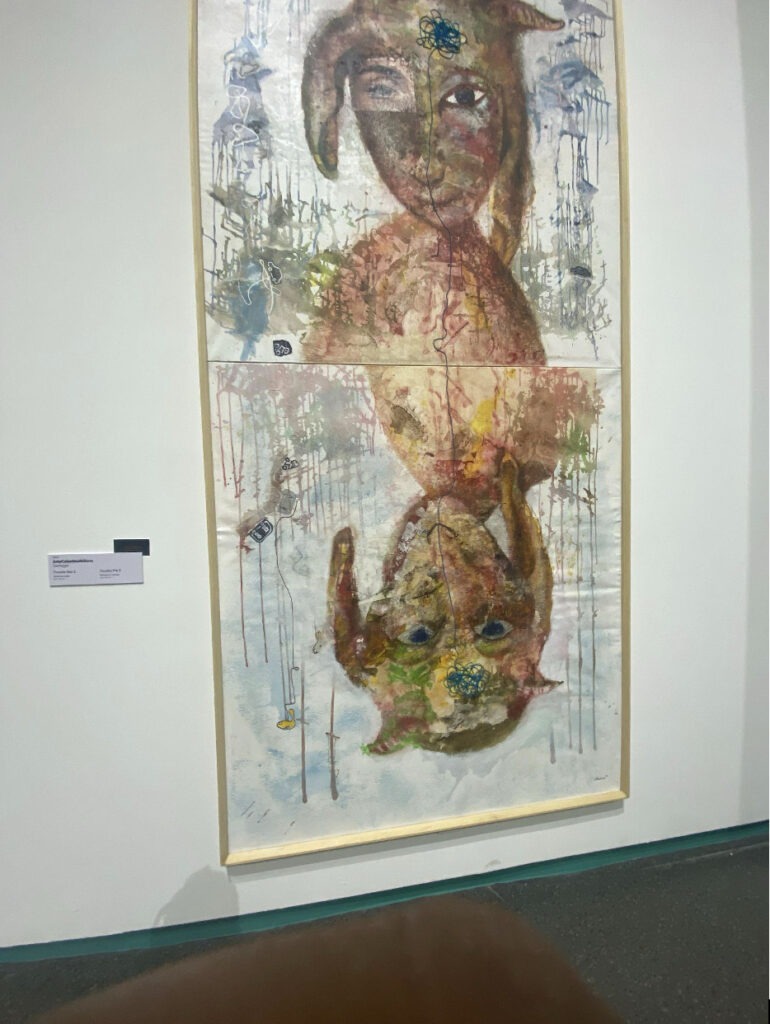
In November 2024, I was given the opportunity to attend Senegal’s Biennale in Dakar with two other artists (one musician, one visual artist) from Kansas City. The theme for that year’s Biennale was The Wake, inspired by Christina Sharpe’s book In The Wake: On Blackness and Being. The first night on my journey to Senegal, I was visiting a friend in Philadelphia. An ancestor in a curious form visited me in my dream with an important message. A word of warning. In Dakar, I walked into one of the many exhibits that were scattered around the city and saw the same ancestor, in the same form on a wall.
◊
The hegemonic perspective of art’s function in society is busted. That is, pedestalized and out of touch, out of reach, not accessible to the masses. A nice-to-have, not a have-to-have. Entertainment, confection, and navel-gazing. Thus, broke-down and made impotent in comparison to its uses throughout time immemorial. From the spiritual ceremonies of everyone’s indigenous ancestors, to the storytelling and recounting that situated every distinct culture’s place in the cosmos, to the very intentional Medicean propaganda that utilized art to hitch status, wealth and reputation to divinity during the Florentine Renaissance (the shadow still cast upon us today).
Despite this perspective, the truth of art’s ability to shift mindsets and human cultural behaviors (re: change the world) remains untouched.
◊
See: The overarching storyline of Scheherazade and King Shahryer in One Thousand and One Nights.
◊
In October 2023 I attended the Bethany Arts Community’s Multidisciplinary Artist Residency. There, I met the choreographer Bernard Brown who was working in collaboration with a documentarian/dancer and music producer/dancer to prepare his project entitled Un/Broken to be performed with African-American dancers and African dancers from Burkina Faso. It was about healing the middle passage. He asked if he could borrow my voice to recite and record his poem for the spoken portion of the piece.
◊
Will you lend your voice to the movement?
◊
A year later, I would find myself suddenly in Senegal. On Gorée Island. At the door of no return. Now called “the door of return” by the Senegalese for all the descendants now making the journey home. I found myself in a cell, our tour guide draped around a pillar, demonstrating what happened to enslaved folks who fought back.
“And for the Africans whose spirits they couldn’t break with the whip — they sent them to Haiti and Jamaica.”
My eyes shot open, my skull suddenly expanded, as if seeing for the first time, as if a large stone had been rolled away, and a vast hallway revealed…
◊
and so, and so, and so
“Take it and eat it. It will turn your stomach sour, but
in your mouth it will be as sweet as honey”[11]
Bones, Maddie’s dog,
has eaten yet another thing that will kill him
and so, and so, and so,
medicine coated in peanut butter.
another girl
another boy
another me
another you
finds solace in
The Book Thief
Dante’s Inferno
My Girl
Catch-22
The Giving Tree Anansi’s Fables
Pay It Forward
Doechii My Chemical Romance
The Kite Runner
Life Of Pi
Ender’s Game
A Wrinkle In Time
“and here is the secret that [everyone] knows”[12]
The Hunger Games
Captain Planet
Everything is Illuminated
A Thousand Splendid Suns
Roll of Thunder, Hear My Cry
◊
What are the reasons for our existence? Where can we find shelter in the midst of turmoil? When all is crumbling do we scramble to catch it or do we allow it to all fall down?
During yet another psychotic break, I find myself unable to grasp the voices, the sights, the sounds aiming at the center of my existence, determined to undo me in my most secretest of parts. The viscera of my existence is laid bare before a spiritual, unseen, firing squad and I am instructed to let it be.
Mwen pa konnen sa mwen tap fe anyen Jezi.
a squirrel skitters up the corner of my house, buries itself in its treasure hidden in the rafters. says: this, too, is my home.
the lacquered forest of homes we find ourselves in boasts a story of life after death – how what comes after fills and contours the space left behind by what has been (re: the wake) and still is. as my consciousness finds itself nestled in the spaces between paragraphs, between lines, in long held notes, in the moments my friends stop to ponder and breathe in the midst of conversation, and impregnated silent moments on my tv screen, i feel my cells begin to flicker like stars, like lights, once extinguished, now ablaze.
◊
My organizer-turned-best-friend, Jenay, introduced me to organizing and also taught me about home:
“Home isn’t where you stay, it’s where you can always come back to.”
and again;
“You got people.”
◊
During my first semester attending Randolph College’s low-residency MFA program in Winter 2022, I was blessed to witness the poet and author Kaveh Akbar give a lecture on Revolutionary Poetics, centering the film work of Iranian poet Forugh Farrokhzad. Farrokhzad spent time in a leper colony in Northern Iran to create a film in service of humanizing the patients with leprosy per request of a doctor at the hospice who wanted to improve the way they were treated by the general public. Who, according to accounts, would toss pebbles and candy at them over the gates to hit them on their heads. Farrokhzad went into the colony and spent time with the patients before filming to build a relationship with them.
“Do you know? She would kiss us. She would touch us. She would hold our kids, even the ones who were not in perfect health. She would sit at the sofreh with us. Share a meal with us. Eat from the plate we were eating from” (Akbar reading Patient accounts).
In tears, I received a message about revolutionary poetics. A message I already knew but was illuminated by language and exposure to the depths of another poet’s conviction, thanks to Kaveh’s talk.
Words are not enough.
Art is not enough.
Poetry is not enough.
Poetry must walk off the page and into the streets. And in order to do so, the poet themself must live their conviction.
And that is what a poet laureate must do.
That is what any artist must do.
Even you, yes, you.
Melissa Ferrer Civil (she/they) is a gnostic, first-gen, Haitian-Cuban, queer poet, organizer, and educator living on Kaw, Otoe, and Osage lands (Kansas City, MO). They are preoccupied with constructing new communication for the manifestation of a home we all hold in our hearts. Melissa’s first chapbook BIRTHING PAINS (Turnsol Editions) was published in 2020 with a reprint in 2024. Their second chapbook STENO PAD (Turnsol Editions) was published in December of 2024. Melissa received their bachelors in Creative Writing and Italian from Florida State University, their Masters of Education in Urban Education from Park University, and their MFA from Randolph College, was a Charlotte Street Studio Resident, Chrysalis Institute Alumni, Heartland Arts KC fellow, is the Director of Political Education and Movement Strategy at The Kansas City Defender where they run B-REAL (Black Radical Education for Abolition and Liberation) Academy, an organizing fellow with Decarcerate KC, and the first Poet Laureate of Kansas City, MO. Melissa is the founder of the abolitionist arts and organizing event series, A Nation In Exile. You can find more publications and media on their website www.melissaferrerand.com. Stay connected on instagram: @melissaferrerand
Notes:
[1] constellation | Origin and meaning of constellation by Online Etymology Dictionary. (n.d.). Www.etymonline.com. https://www.etymonline.com/word/constellation
[2] Angelou, M. (1978, August 12). Still I Rise. Poetry Foundation. https://www.poetryfoundation.org/poems/46446/still-i-rise
[3] Foundation, P. (2021, March 3). [anyone lived in a pretty how town] by E. E. Cummings. Poetry Magazine. https://www.poetryfoundation.org/poetrymagazine/poems/22653/anyone-lived-in-a-pretty-how-town
[4] thepostarchive. (2025, February 21). James Baldwin: Q&A at University of California, Berkeley, 1974-04-26 – thepostarchive. YouTube. https://www.youtube.com/watch?v=59MnTxJFD2w
[5] Bambara, T. C. (1982). The Writer As Cultural Worker (K. Bonetti, Interviewer) [Review of The Writer As Cultural Worker]. In American Audio Prose Library. https://anotherworldarchives.org/podcast/toni-cade-bambara-1982
[6] Search “propaganda” on etymonline. (2026). Etymonline. https://www.etymonline.com/search?q=propaganda
[7] Civil, M. F. (2025). Notes On The Archive: On Reverence, Violence and the Ethics of Exhibition [Review of Notes On The Archive: On Reverence, Violence and the Ethics of Exhibition]. Fortresses, 1(1). https://vulpesbastille.com/fortresses-cravings-civil
[8] Hartman, S. (2008). Venus in Two Acts. Small Axe: A Caribbean Journal of Criticism, 12(2), 1–14.
[9] (n.d.). Exhibition Description (Kansas City, MO) [Review of Exhibition Description]. Nelson-Atkins Museum.
Painted Worlds: Color and Culture in Mesoamerican Art exhibition
[10] Sharpe, C. (2016). In The Wake: On Blackness and Being (pp. 12–13). Duke University Press.
[11] New International Version, 2011, Rev 10:9
[12] E.Eee . Cummings. (2019). Poetry Magazine. Poetry Foundation. https://www.poetryfoundation.org/poetrymagazine/poems/49493/i-carry-your-heart-with-mei-carry-it-in