The Proximity Paradox: Authorship and Institutional Limits in Rigo 23
Ana Nolasco
- The Proximity Paradox: Authorship and Institutional Limits in Rigo 23
- Introduction
- Making Family in the Field: A Methodology of Kinship
- The Kinship Ethos: How Proximity Becomes Practice
- When Solidarity Meets Structure: The Uncomfortable Politics of Kinship
- The Autonomous InterGalactic Space Program (PEAI): An Ethics of Accompaniment
- When Institutions Say No: The Architecture of Refusal
- The Boat That Sails in Memory
- The Institutional Unconscious of Collaborative Practice
- The Demanding Questions That Remain
Introduction
When I observed Rigo 23 working with master boatbuilder Bailinha on Madeira’s Ilhéu in 2021, their collaboration revealed something fundamental about socially engaged art: the gap between ethical intention and structural possibility. It was neither artist directing artisan nor visitor documenting locale: it was two men building together something neither could accomplish alone. This understanding emerged from following the Madeira-born artist’s practice since the 1990s, with intensified proximity over the past six years. This article examines two contrasting projects. The Autonomous InterGalactic Space Program (PEAI, 2009–2012) demonstrates collaboration under favorable conditions: Zapatista communities co-creating objects that circulate through international museums while maintaining political integrity. The Malvinas Project (2018–2021) in Câmara de Lobos reveals what happens when institutions refuse: a work truncated by bureaucratic inertia that exposes structural limits constraining even ethically motivated practices. Rather than presenting success versus failure, these cases reveal how Rigo 23’s work refuses to resolve the contradictions it encounters. I am not claiming resolution. The work keeps a public record of institutional choices while operating within them. His practice operates as “kinship-making”[1]: cultivating bonds that transcend traditional categories of artist and subject, individual authorship and collective creation, challenging both the art world’s emphasis on individual genius and the market’s demand for clear ownership.
Kinship, as any family knows, is messy. It involves power imbalances, unspoken expectations, and emotional labor that exhibition budgets cannot quantify. The question is not whether such relationships are “authentic” or “exploitative,” but what they reveal about collaboration inside the institutional artworld. By ownership I mean three forms of control: (1) interpretive control (labels, tours, wall texts); (2) circulatory control (what moves, who travels, when); and (3) income control (fees, honoraria, editions). By systems I mean museum governance and operations: acquisition and loan protocols, education departments, insurance and risk procedures, visas and customs, and donor or board oversight. This analysis examines what happens when art attempts to embody the kinship relations it seeks to create, tracing how ties formed in the field travel into the gallery and take shape in who speaks, who is paid, and which backstage work becomes visible. From radically portable objects designed to escape monumental fixity to tactical redistribution of narrative authority, Rigo 23’s strategies constitute what might be termed “kinship-based museology”: transforming institutional spaces by treating them as sites where new forms of kinship can be forged. This takes concrete form at ZDB-8 Marvila (Lisbon, 2025). The interiors of the wooden crates that transport the exhibition were used to replicate streets from a caracol. A commissioned painting by a Zapatista collaborator served as a working model for the ship. The room was set for sharing rather than a staged talk. Loren, an embroiderer from Mexico, was present–it was her first trip abroad. She did not speak in public; she spoke with me about process and shared the result. Sebastián, a long-standing friend of the artist, supported the install as part of the on-site team. The room worked as a space for sharing rather than a staged talk. Questions on site moved from authorship to making and movement context. In this staging, kinship is built by how the room is used, who is present, and what work remains visible during the run.[2]The methodology here is unapologetically situated: what I call “kinship criticism.” This proximity provides access to the granular realities of collaborative work while implicating the researcher in the dynamics being studied.[3] It reveals not privileged access to truth, but how much more complicated truth actually is. There is no resolution to this contradiction. What remains is to keep a public record of it where the work unfolds. The work addresses curators and educators through labels and public events. It addresses registrars and lenders through loan and schedule files. Visitors meet it in what is on the wall and in the room. Collaborators are addressed when travel and fees allow them to be present. Small changes are possible: a revised label, a short public event, a budget line for collaborators’ fees and travel. The aim is not a cure. It is to carry decisions forward case by case.
Making Family in the Field: A Methodology of Kinship
The critique developed here emerges from informed proximity: a methodological stance that acknowledges its own implication in the processes it examines. My engagement with Rigo 23’s practice evolved from critical observation into sustained dialogue, providing access to the subtle negotiations and material conditions that determine collaborative work. This approach understands kinship as forged through “shared suffering, working together, and mutual vulnerability”; not biological connection but persistent entanglement across difference.[4] The invisible labor of socially engaged art is what sits off the wall and outside standard tour scripts. It is invisible to general visitors and often to docents and front-of-house staff. It is visible to curators, educators, registrars, insurers, and to collaborators who carry the work. Agency is distributed: curators and educators adjust labels and schedules; registrars and insurers set movement and risk; collaborators speak as named makers and are paid for time; the artist coordinates these parts. It becomes visible only through such sustained relationship. These factors rarely appear on wall texts because space is tight, risk and privacy matter, and donor-facing scripts favour finished objects. Time is short. Staging is negotiated. Where possible, process enters the room through install elements, a slot in the public programme, or labels that name collaborators. At ZDB-8, process remained in view and the room was set for sharing, as described above. Why keep the institutional link? One reading is strategic: repurpose the museum to redirect resources to collaborators, visas, travel, and pay. Another stresses reach and archive: publics and records that off-site work rarely secures. A third path exists outside museums, chosen by others. I keep the question open and track venue-specific effects[5]. Funding structures vary by venue. The artist is based in Los Angeles. In Portugal support is often public; elsewhere it is museum or foundation budgets. This is one reason to keep the institutional link in some cases.[6]
The research combines interviews, on-site observation, and document review. I first encountered Rigo 23’s work around 2010. Sustained research runs 2018–2025, with fieldwork and on-site observation at key moments of his collaborative projects. This included extended fieldwork in Câmara de Lobos, Madeira, where I documented the entire trajectory of the Malvinas Project from initial community workshops through the construction of Coroa do Ilhéu and its subsequent institutional abandonment. The analysis draws on interviews conducted via Skype (Lisbon-California), email correspondence, and in-person meetings in Madeira. Between 2018 and 2021, I conducted interviews with master boatbuilder Jorge Oliveira (“Bailinha”), residents from the Malvinas neighborhood, fishermen from the original Ilhéu community, and municipal workers like Gonçalo Henrique who maintain the sites of Rigo’s interventions. More recently, extensive conversations with collaborators Santiago T.M., Christian H., and Lorena R. during the 2025 exhibition of the Autonomous InterGalactic Space Program at ZDB, Lisbon, provided insights into how collaborative work circulates institutionally.
The research encompasses documentation of significant relational events: the 2003 visit to Lisbon by Robert H. King, former Black Panther and member of the Angola 3, whose presence fostered critical dialogue on racial injustice and carceral violence; and multiple site visits to Madeira that documented both community response to Rigo’s interventions and the institutional resistance that ultimately truncated the project. During the 2025 Lisbon exhibition, I observed this labor firsthand. While visitors engaged with PEAI’s visual poetry, Rigo managed visa applications for Lorena’s first international travel and mediated between institutional requirements and collaborative ethics. The interiors of the wooden crates that transported the exhibition were used to replicate streets from a caracol, and a commissioned Zapatista painting functioned as a working model for the ship. This administrative choreography, visa negotiations, insurance conditions, shipping logistics, sets the bounds of what is possible yet rarely appears in wall texts. These choices are negotiated: curators and educators shape labels and the public programme; registrars and insurers define movement and risk; the artist proposes keeping install elements in view. At ZDB-8 the team kept installing elements in the room and set it for sharing rather than a staged talk; process was shared on site by Lorena.
Rigo 23’s own account reveals this expanded artistic responsibility: “I also build, hammer, glue, paint, carry, push.”[7] His authority rests on shared work, not pre-existing status. The time this accompaniment requires is funded case by case: in Portugal, often through public support; elsewhere, through museum or foundation budgets; sometimes through private donations; and, between commissions, through the artist’s unpaid time.[8] These arrangements vary by venue and cannot be standardised into a method. They depend on budgets, visas, insurance, and trust built on site. Negotiation is triangular – the artist, collaborators (for example, Jorge Oliveira “Bailinha”; Lorena R.), and host institutions.[9] The differences are concrete – passports, income security, language, and curatorial control. For this reason, the work treats budgets for fees and travel, and labels that name collaborators, as part of its form rather than afterthoughts. Kinship here does not mean fusion; it names a difficult entanglement sustained by shared work and mutual vulnerability. This is the ground from which the analysis proceeds.
The fieldwork revealed patterns that challenge conventional narratives about collaborative art, exposing tensions between artistic intention, community reception, and institutional mediation. This complexity extends to how a given work circulates. The journey of the Autonomous InterGalactic Space Program through contrasting contexts, from conventional museum spaces like the Queens Museum, New York (2019) and Weltmuseum Wien (2023–24)[10], and ZDB-8 Marvila, Lisbon (2025)[11], made this dynamic particularly clear. As both Rigo 23 and Christian H. noted, the work’s reception changed depending on venue: in institutional art spaces, questions focused on authorship and materiality, while in contexts with greater political affinity, dialogue shifted toward the Zapatista movement’s struggle for autonomy. The installation frames questions differently by venue. Its structure invites some readings over others, and its meaning is rebuilt each time by the questions and expectations that arise in a given context.[12] These observations inform what I term “kinship criticism” – a approach that treats analysis and co-presence as part of the same process rather than opposed modes. Instead of claiming objectivity, this stance accepts that sustained engagement with collaborative practices draws the researcher into the relationships under study, in line with traditions of participatory action research.[13] The analysis that follows does not promise privileged access to truth. It traces how kinship-making unfolds within museum and funding systems that organise circulation, access, and risk in ways that often work against the relations the projects seek to sustain.
The Kinship Ethos: How Proximity Becomes Practice
Rigo’s practice can be understood as a form of “accompaniment”: a practice of staying with people and places over time, in which the shared process is already part of the work, even before any finished piece exists. Only after watching him spend months learning traditional boat construction with Bailinha did I grasp that accompaniment is kinship-making articulated as method: the name he gives to the bonds that form through long-term, practical involvement rather than through a single project event. By kinship I mean ties that grow over years of shared labour and mutual obligation–from his alliances with former members of the Black Panther Party and supporters of Leonard Peltier, including family members, to enduring relationships with Zapatista communities and other collaborators. Unlike more punctual forms of collaborative, relational or dialogical art, these ties are built and maintained over years. Projects emerge from sustained presence[14]: a commitment that extends across his practice, from the recently concluded Leonard Peltier advocacy to current collaborations with residents of Câmara de Lobos in Madeira. This sustained presence is less a fixed protocol than the slow work of building trust through doing things together over time. If it has a method, it lies in repeated, situated actions that matter to the people involved, and that also leave their mark on Rigo himself.
Yet this relational investment raises awkward questions. By “temporal luxury” I mean the ability to spend long periods on site because fees, travel and accommodation are covered by institutions based in Europe and the United States. In Rigo’s case, sustained accompaniment – months learning traditional construction methods with Guarani boat-builders and repeated stays with Zapatista communities over several years – relies on structural asymmetries of passport, income and mobility that his collaborators do not share. Teko Mbarate: Struggle for Life (2008) (Figures 1 and 2) makes this tension clear. Guarani, Quilombola and Caiçara artisans collectively transformed a replica missile submarine into a ceremonial structure, but the collaboration depended on his role in the “Human/Nature” exhibition, which funded four trips to Brazil between 2005 and 2008 and covered local production costs. This institutional support opened the time needed for him to learn traditional construction methods. According to Rigo, part of the project budget went directly to the artisans who trained him, at rates they themselves proposed. Cultural humility here is inseparable from the transnational funding streams that his projects often question.
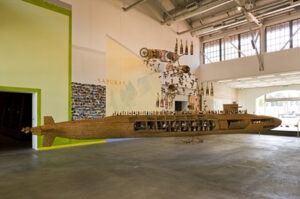
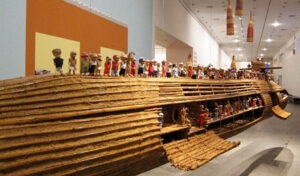
The Autonomous InterGalactic Space Program reveals different dynamics. Born from Rigo’s speculative question to Zapatista communities: “how would the Zapatistas attend a gathering on another galaxy?”, the project challenges conventional authorship categories[15] Participants were integral to production, mediation, and logistics, and were paid for their work through project budgets, yet they did not design the initial framework – the speculative question, overall structure and spaceship iconography that anchored the installation. The ambiguity over who counts as collaborator, who counts as author, and how pay and credit are distributed is central rather than incidental. Even when labels and public programmes name collaborators, symbolic capital and long-term invitations still attach primarily to Rigo as the artist of record, not to the communities whose aesthetics and stories sustain the work. I use “kinship” here in a subjunctive sense, to name relationships oriented toward possible futures rather than fixed identities.[16] It marks forms of attachment that sit uneasily beside legal and market frameworks built around individual ownership. Kinship in this sense does not cancel the asymmetry between the named artist and the collaborators. Instead, it traces how those ties persist and sometimes reshape the terms of collaboration within these uneven conditions.
When Solidarity Meets Structure: The Uncomfortable Politics of Kinship
Sometimes politically urgent interventions emerge from individual decisions made under pressure. They create tension between the ethical obligations that grow out of long-term relationships (what I call “kinship ethics”) and the demand to act in the face of immediate harm (“solidarity” here). Kinship in Rigo 23’s practice does not always entail a fully shared process. The West Bank mural (2003–2007) sits at this limit. Painted during intensifying Israeli military occupation, and coordinated with activists from the International Solidarity Movement, the work responded to the construction of the separation wall. Houses were being demolished and the surrounding landscape was militarized. There was no time to build deep ties with local residents. In this case solidarity meant using the visibility of the wall and of the international activist network to mark opposition in situ. I have no evidence that the mural altered the course of the occupation or changed policy. Its effects were more modest: it offered a visible sign of support for those already resisting and briefly linked a local struggle to transnational activist circuits. It also shows the edge of the kinship framework I use in this essay, where the artist’s commitment to a cause runs ahead of the slow work of relationship-building.
The Leonard Peltier advocacy work offers a complex example of how institutions transform solidarity-rooted practice while simultaneously revealing collaborative work’s mobilizing potential. Beginning in 2014, Rigo created an 18-foot bronze sculpture of Leonard Peltier – an Indigenous activist imprisoned since 1975 for convictions related to the deaths of two FBI agents on the Pine Ridge Reservation. Peltier consistently maintained his innocence, and his case became a symbol of Indigenous rights struggles and concerns about justice system bias. The sculpture emerged from sustained collaboration between Rigo and supporters including family members, activists, and the American Indian Movement who financed the project. During its transportation from Los Angeles to Washington D.C., the artist visited Pine Ridge Reservation, Standing Rock, and other significant sites, inviting public and supporters to photograph themselves standing on the statue’s feet (Figure 3). The act of standing on the feet and sharing the images can be read as a small ritual of alignment with the campaign.
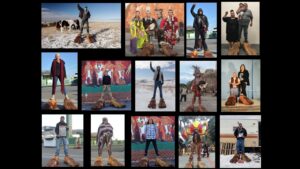
The reach of these works is uneven. Some unfold in museum galleries for relatively specialised publics; others enter local civic life. In 2010, for Taté Wikikuwa Museum: North America, 2024 at The Warehouse Gallery in Syracuse, he used an invited exhibition to stage a fictive museum centred on Peltier’s paintings, photographs and case materials rather than on his own authorship. The tour of Peltier’s bronze feet organised a chain of small ceremonies in which supporters literally “stood in his shoes”, posed for photographs and circulated those images through family and activist networks. In Madeira, the fire station tower mural at the Volunteer Fire Brigade of Câmara de Lobos reached a different public. In July 2019 it was inaugurated with a ceremony that brought together firefighters, their families, local residents and representatives of the municipal council and regional government. On the Sunday before the opening, around forty musicians from the municipal band and members of the brigade occupied the scaffolding around the seventeen-metre training tower, playing across its eight levels. For a moment the mural functioned less as an art object than as part of a local civic ritual honouring the “soldados da paz”. These events do not cancel the structural limits analysed in this essay, but they show how Rigo’s work sometimes moves beyond art-world audiences into settings where civic and family publics take temporary ownership.
Peltier was released on February 18, 2025, after serving nearly fifty years. His release resulted primarily from the intensive campaign led by NDN Collective, an Indigenous organization that assumed leadership of the Free Leonard Peltier campaign in 2022. Rigo’s contribution took the form of a series of projects over more than a decade, including the “Taté Wikikuwa Museum: North America, 2024” installation in Syracuse and, later, the fundraising and tour of the statue. These works helped to keep the case visible within art institutions and among the publics who encountered them. The statue and its tour did not alter legal strategy or produce new evidence. Their effect was quieter and harder to measure: they offered a rallying point for supporters, a recognisable image for press coverage, and a way for Peltier’s family and allies to see their struggle acknowledged in public space. In this sense the project raises a persistent question for politically engaged art: when is keeping a cause visible, without clear causal impact, enough to count as success?
On 9 December 2016 American University installed Rigo 23’s nine-foot Leonard Peltier statue outside the Katzen Arts Center. On 3 January 2017 the university removed it after the FBI Agents Association urged its removal; the university’s statement cited the placement implying institutional advocacy for clemency and security concerns for the artwork and campus. Later presentations at The Main Museum in Los Angeles placed the work within a different frame and public. Rigo read the removal at American University as part of the work rather than its end. The statue forced the institution to state, in public, how far it was willing to go in support of a controversial Indigenous prisoner and whose complaints counted as a security risk. In this sense the work made the university position plain: support for clemency extended only to the point where it threatened relations with the FBI and major donors, and the fears of law enforcement and alumni carried more weight than the voices of Peltier’s supporters on campus. For Rigo, this reading of the university is not a step toward measurable reform but a way of keeping certain futures and solidarities open by making these trade offs visible and part of the record. He holds to a modest belief that art can shift how a public imagines its obligations, even when no immediate change follows. Later venues made different calculations. The Main Museum in Los Angeles framed the work within local histories of policing and Indigenous activism. For Rigo, these shifts in framing were not a separate chapter from the sculpture. They were the terrain on which the work operated: letters from the FBI Agents Association, risk assessments by university lawyers, fundraising statements by activist groups, and speeches delivered beside the bronze figure. To work “with” a place, in his words, meant treating these institutional responses as part of the material he was handling, alongside bronze, concrete and steel. The same attention to context shaped more intimate moments around the statue.
During a blessing ceremony in Los Angeles, when Native activist Shannon Rivers needed both hands free to drum and burn sage, Rigo held the microphone. He later described this as “amplifying his voice, not speaking for him”. The scene shows a careful form of support, but also the uneven access to equipment, permits and fees that shapes who can appear and be heard in public. The Leonard Peltier sculpture is sometimes presented, by Rigo and supporters, as a work that does not fully “settle” inside institutions because it has also travelled to reservations, protests and university campuses. In practice, every stage of that movement depends on institutional backing: unions and galleries that help fund and ship the work, museums that provide space, insurance and security, collectors who agree to loans and long term storage. The work does not stand outside institutional containment; it circulates within it. Rigo’s response is not to claim purity but to narrate this dependence when the work is installed, in public talks, recorded interviews and didactic material. In public sites such as the Los Angeles campus, this narration reaches a mixed audience that may include passers by, families, students and staff. In museum and gallery settings, it mostly reaches an art public from middle class backgrounds, even if Rigo tries to widen this circle through invitations and outreach to people who would not usually attend exhibitions, for example by bringing collaborators from Chiapas or Native communities into the space. In these different contexts, the project asks those who encounter the sculpture to consider the visas, fees, travel risks and institutional calculations that stand behind the carved figure they see. The ties of care and friendship that formed around Peltier’s case grew slowly out of repeated visits, shared meals, ceremonies and conversations over time, rather than from any stable procedure that a museum could simply adopt and reproduce.
The Autonomous InterGalactic Space Program (PEAI): An Ethics of Accompaniment
Another long term project, the Autonomous InterGalactic Space Program (PEAI), developed between 2009 and 2012 (Figures 4, 5, 6, and 7), emerged not from a pre-set artistic plan but from sustained dialogue with communities connected to the Zapatista movement in Chiapas, Mexico. The project’s conceptual anchor was a speculative question that inverted ethnographic inquiry’s colonial gaze: “If invited to a gathering on another galaxy, how would the Zapatistas get there”[17]The project’s origin story illustrates accompaniment rather than direction. After meeting with a Zapatista legal representative in Chiapas, Rigo asked for his speculative question to be passed on to a local painter, who remained anonymous under the name “Tomás.” In a gesture of reciprocal trust, Rigo left a monetary offering. The response he received established the project’s core iconography: three paintings from Tomás, one of which depicted a spaceship in the form of a giant corn cob – a potent symbol of Indigenous resistance – carrying Zapatista caracoles (snails, representing their autonomous municipalities).[18] This vision, authored by the anonymous painter, became the conceptual and visual foundation for the installation’s central sculpture, which Rigo later helped realize in San Cristóbal de las Casas, Chiapas, using traditional carpentry techniques in collaboration with local artisans. The spaceship was presented at EDELO, an art space in San Cristóbal, and later travelled to REDCAT in Los Angeles and other museum venues.[19]
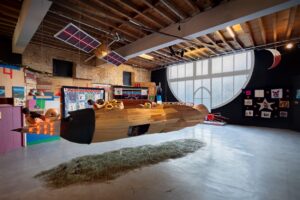
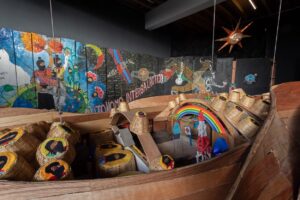
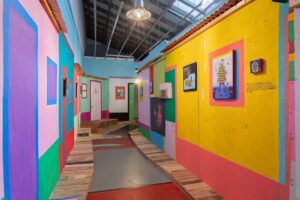
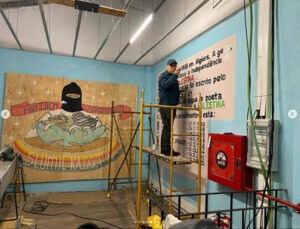
The production process functioned as practical test of shared authorship under asymmetrical conditions. Rather than prescriptive blueprints, Rigo presented loose sketches, often drawn on napkins, which local artisans interpreted freely and adapted in their own style. He has described himself as “a caretaker of stories already in motion.”[20] Many embroidered compositions already existed as independent works made and sold locally. Rigo’s contribution was to propose the larger background fields and overall layout, sketching the areas where those scenes might be placed; artisans then translated these sketches into full-sized textiles and decided how to position and stitch the pre-existing images. These composite works, together with the spaceship, have since been shown at REDCAT in Los Angeles, UCR ARTS in Riverside, the Queens Museum in New York and later venues in Europe, reaching mainly museum publics. Artisans set their own fees and kept control over the content of their scenes, while Rigo assumed responsibility for the overall frame of the installation. This differs from simple subcontracting of creative labour in that decisions about imagery, payment and pace were negotiated in the workshop, and the project aimed to support an existing local cooperative economy rather than a private studio brand. At the same time, the ethical tension does not disappear. Even when labels and public programmes name collaborators, most symbolic capital and future invitations still attach to Rigo as the artist of record. He describes his position as that of an “instrumentista”, a player within a collective ensemble, and this was a deliberate ethical stance grounded in working on site and sharing risk.[21] Yet the structural asymmetry remains: the installation circulates under his name in museum circuits, while collaborators continue to live within far more precarious conditions. As Santiago T. M., a key participant, put it, “Some people worked because they believed in Zapatista principles–‘everything for everyone, nothing for ourselves’. But others, like me, needed to be paid. Rigo understood this was not a contradiction but simply the reality of our different situations.”[22]
Rigo’s navigation of this reality – respecting both ideological commitment and pragmatic needs – demonstrates the project’s ethos was continuous practical negotiation, not romantic ideal. Participants were remunerated for work. Fees were discussed with collaborators on site.[23] A USD 10,000 grant from REDCAT (Los Angeles), then directed by Clara Kim, supported collaborator fees and the artist’s six-month stay in Chiapas.¹ This careful attention to economic equity, combined with his refusal to dictate form, loosened some of the usual hierarchies between conceptualisation and labour within the project. It shifted fees, authorship and visibility in ways that gave collaborators greater control over how their work would appear. At the same time, it did not remove the structural gap between Rigo, who travels and exhibits as a recognised artist, and collaborators whose participation rarely translates into comparable symbolic or material capital. As Santiago notes, this was not “a one-size-fits-all agreement; each person had their own relationship to the project.”[24] This refusal to direct from distance extended to the project’s public life. As PEAI traveled internationally – REDCAT, Los Angeles (2012); Queens Museum, New York (2019); Weltmuseum Wien (2023–24); ZDB-8, Lisbon (2025)[25] – the set-up changed with each venue. Hosts supported the project for concrete reasons: education and public programmes, audience targets, and curatorial interest in Zapatista contexts. They also pursued visibility with new publics and funders, and reputational alignment with policy goals and social-justice agendas. These same conditions set limits: risk rules, time slots, and label copy. I audit these motives case by case, not as moral verdicts. On site, installation involved long-term collaborators such as Santiago T. M. and Christian H.; their room for decision varied by venue.[26] At the level of individual collaborators, the gains were concrete but modest: fair fees, travel when visas and budgets allowed, and the chance to see their work circulate. At the level of Zapatista and other Indigenous communities, the benefit was mainly symbolic. The exhibitions carried their images and narratives into art circuits in Europe and North America where these struggles are less familiar, even if that visibility remained largely confined to museum publics.
Rather than acting as the sole spokesperson, Rigo asked collaborators to help decide how the project should be described in wall texts and catalogues, to appear as named co-authors in credits, and to share or lead public conversations when possible. In this way their voices shaped how the work was framed, not only the labour that produced it. In conversation, Rigo sometimes describes PEAI as “invading” the museum with “Zapatista truth”.[27] ”. I read this less as a literal power reversal and more as his way of naming a small shift in how resources circulate: for a limited time, museum space, budgets and attention are redirected towards Zapatista stories and collaborations. The installation brings objects and narratives rooted in Chiapas into museum circuits without fully detaching them from the communities that produced them. The installation brings objects and narratives rooted in Chiapas into museum circuits without fully detaching them from the communities that produced them. This redistribution becomes visible in material displacement and in the way wall texts, talks and screening programs refer to ongoing land defense and self-government struggles in Chiapas, often including the names, voices or recorded messages of collaborators who remain involved in those processes. This commitment was evident during 2025 Lisbon exhibition when Lorena R.–original embroiderer–traveled outside Mexico for the first time at Rigo’s invitation. Though not present as Zapatista movement representative,[28] her presence offered embodied continuity with original Chiapas collaboration, illustrating how the project strategically uses institutional platforms to enable mobility and testimony. Christian H., reflecting on decade-long involvement with Rigo’s projects, captures the fundamental incompatibility: “The projects are a form of ‘social sculpture, an environment,’ where ‘the objects are only a part of that. It’s really about the interaction among people, that’s what matters.'”[29] But the museum is primarily equipped to display the object, not the web of relationships, struggles, and affective labor from which it emerged.
This limitation is not only practical but epistemological. Museums work with a logic of fixed objects: clear authorship, stable meaning, measurable value. Collaborative practices follow a different logic: ongoing processes, shared authorship, context dependent meaning and social value that cannot be reduced to numbers. When these two logics meet, museum protocols pull the work toward legible, collectible forms, while collaborators may expect support for open ended organising. That clash can bend the project away from its initial aims. Santiago’s observation about different institutional contexts reveals the systematic nature of this transformation: “When we set up the work in different places, people see it differently. In activist spaces, they ask about the Zapatistas, about autonomy. In art museums, they ask about materials, about the artist. The objects are the same, but the questions change everything.”[30] PEAI exemplifies Rigo’s broader method: neither speaking for nor delegating authorship, but accompanying collective vision. In institutional settings this has meant using the visibility and budgets attached to his name to support communities already engaged in struggles against dispossession and state violence.Yet this strategy requires constant navigation of institutional constraints that no collaborative ethics can fully overcome.
When Institutions Say No: The Architecture of Refusal
When I observed Rigo working in the Malvinas neighborhood, what became evident was what happens when art that claims to resist power meets the municipal and housing structures that regulate public space and spending. This is not an artistic failure. It is the gradual erosion produced by routine bureaucratic delay and risk avoidance. Rigo often names this pattern “institutional negligence” because, from the point of view of residents, the refusal to decide or to answer feels like a lack of respect for their time and memory, even when the institutions are behaving in line with their usual procedures.[31] If PEAI represents Rigo’s practice under optimal conditions, the Malvinas Project reveals what happens when those conditions collapse. Beginning in 2018 with Michelle Kasprzak’s invitation to work in the Malvinas social housing neighborhood of Câmara de Lobos, the project confronted a crucial historical context: the neighborhood was created in the 1980s to relocate fishing families from the Ilhéu, a rocky outcrop stigmatized for decades in press reports as a zone of poverty and “moral degeneracy.”[32] The relocation was both material improvement and social erasure, moving the community from what became a tourist-centric bay.
Rigo’s response rejected “the tokenist model of the visiting artist who paints a wall and leaves,” proposing engagement “meant to unfold at the rhythm of local life.”[33] Early phases proved promising: painting workshops with youth, a fire station tower mural, collective staircase transformation that residents still maintain. These modest but relationally dense gestures established trust and demonstrated collaborative possibility. From this foundation emerged a more ambitious vision: “adding cultural value to infrastructural renovations” through community participation in public space redesign.[34] At this point housing and municipal structures began to neutralise the work in line with one of their usual ideological functions: they translated political questions about who decides the shape of the neighbourhood into technical concerns about “cost” and “maintenance”. Most significantly, the housing authority IHM (Investimentos Habitacionais da Madeira) simply stopped responding to participatory design proposals. This pattern of bureaucratic delay transforms political questions of community agency into administrative technical problems, neutralizing its potential to pose any structural challenge l Michelle Kasprzak described the result as entering “a weird bureaucratic no man’s land.”[35] In Malvinas there was no structural change in housing policy or decision-making procedures that I can document. The project did produce smaller shifts: temporary paid work for local collaborators, public recognition of Bailinha’s expertise, and renewed discussion of the Ilhéu’s erased history. The absence of deeper change underlines how far political will, rather than artistic method, determines what is possible in this context.
This passive resistance proved more effective than direct censorship, functioning not through prohibition but by narrowing what counted as administratively feasible. For Rigo this pattern was not a surprise. Earlier projects had already shown that the same municipal and housing structures that speak the language of “community development” often limit residents’ say over their own streets. In Malvinas the proposed co-design of public space became impossible once the community was consistently denied a meaningful role in decisions that shaped their lives.[36] Some artists faced with similar blockages have turned the negotiations themselves – meetings, minutes, legal disputes – into the main material of the public artwork, making the process of co-option visible in real time. Rigo’s choice was different. Rather than staging the blockage as a new project, he stayed with the unfinished plan and the relationships it had created. In this sense the Malvinas work became more revealing in its impossibility than a completed commission would have been, tracing how kinship relations are worn down by structures that present themselves as neutral while operating as exclusion filters.
The Boat That Sails in Memory
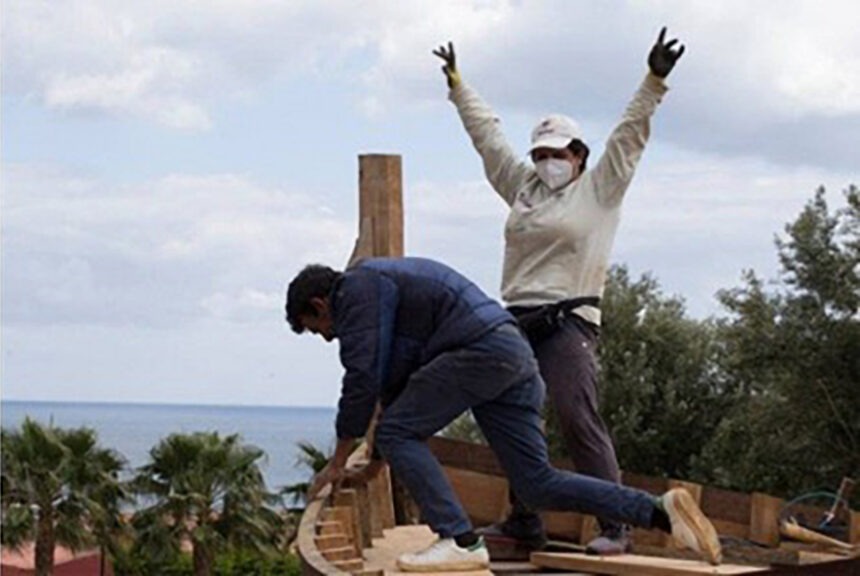
When institutions close doors, artists find other ways to work. Responding to institutional blockade, Rigo pivoted toward “tactical persistence” and collaborated with master boatbuilder Jorge Oliveira, known locally as “Bailinha,” to construct a symbolic vessel on the Ilhéu for local residents, former fishing families and visitors who visit the garden on the Ilhéu overlooking the bay (Figures 8–11).[37] There was no formal exhibition frame. The main audiences were neighbours, fishermen returning to the site and occasional tourists who encountered the work on their way along the seafront. This rocky outcrop once housed Câmara de Lobos’ fishing community for generations before relocation to social housing neighborhoods like Malvinas. The demolition left the site “without any visible marker that this was once a neighborhood,” erasing not just buildings but entire ways of life.[38] The collaboration addressed multiple erasures: physical demolition of the fishing community, cultural disappearance of traditional maritime knowledge, and personal crisis of an artisan whose depression stemmed from watching his craft become economically obsolete in a tourism-driven economy. For Bailinha, the project meant far more than symbolic gesture. “It made me be reborn in the area that I like,” he explained during my 2021 interviews with him.[39] His son provided more explicit context: “This wasn’t just about making a boat. My father was working through his own memories. For him, this gave meaning again.”[40] Francisco Côrte, who assisted with the construction, described how the work site transformed into an “oral school”– a working space where Bailinha passed on boat-building techniques and stories about the Ilhéu mainly to three young collaborators as they worked on the hull, with a few Malvinas youths and occasional visitors joining an early boat trip and brief exchanges.
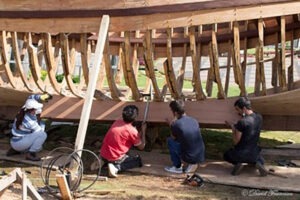
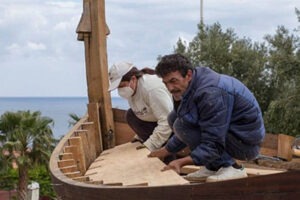
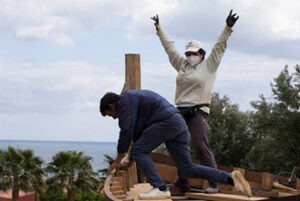
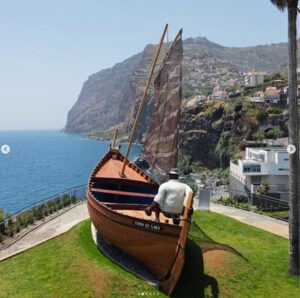
Even this scaled-down collaboration revealed precarious conditions under which kinship relations operate amid economic marginalization. Rigo found himself managing not just creative collaboration but psychological support, financial assistance and family mediation. These extra tasks–checking on Bailinha’s mood, helping with small expenses, mediating tensions inside the family–are not glamorous political acts. They are forms of social maintenance that keep a fragile working relationship going and make any further production or organising possible. The project’s suspension by IHM devastated Bailinha. “He fell back into sadness,” his son recounted during our 2021 interview. “It was as if life had faded away again.”[41] For Rigo, the timing felt deliberate: “It was a form of silent sabotage that revealed the profound indifference of institutions.”[42]
Community reception revealed the project’s complexity and contradictions. The sculpture’s completion, financed through a separate cultural budget that paid wages for Bailinha, his son and three young collaborators and installed without support from the housing authority, crystallised rather than resolved underlying tensions . Although the sculpture was eventually placed in the very site from which the community had been erased, it remains a fragment of the original plan, crystallizing part of the local imaginary but unable to substitute for the deferred co-design process. Media coverage fundamentally shaped public reception. In 2020, a headline in the Diário de Notícias da Madeira reduced the project to cost–”‘Coroa do Ilhéu’ for €65,500″–without clarifying that this amount covered salaries for Bailinha, his son, and three other young collaborators who worked with Rigo eight hours daily for nearly a year.[43] This omission fueled public misunderstanding and controversy that I witnessed firsthand during community visits.
Following this sensationalist coverage, reactions among local residents became polarized. Some fishermen from the old Ilhéu expressed pragmatic ambivalence, suggesting the project’s symbolic value was disconnected from their material reality: “What I wanted was for there to be something here so I could continue to go fishing, right?”[44] Others, influenced by the cost narrative, viewed the sculpture as another example of misallocated resources–a perception rooted in their own experiences of economic precarity. This sentiment crystallized in the pointed observation regarding fishing subsidies that “The owners are the ones who take care of that money,”[45] reflecting a deep-seated belief that financial benefits rarely trickle down to the workers themselves. Gonçalo Henrique, the municipal gardener responsible for maintaining the site, offered nuanced perspective: “It’s a good initiative for preserving memory in a place where traditional fishing culture is fading. But few residents actually visit the site, and some doubt whether the structure will be cared for long-term.”[46] These responses reflect not only the symbolic potency of the project but also its socio-political fragility within a context of economic precarity and limited institutional support.
More recently, in 2025, regional newspaper JM documented visible deterioration and lack of maintenance.[47] Rigo, had anticipated this risk, since no formal budget for long term care had been agreed and previous projects had shown how quickly maintenance falls away once inaugurations pass. He described this neglect as a symbolic offence:”The citizens of Câmara de Lobos with roots in that Ilhéu are the true subjects of that sculpture–as such, I understand the neglect in maintaining the piece as a form of disrespect toward them and their collective memory.” He stayed in contact with Bailinha and other neighbors and kept returning to the Ilhéu. For him the aim was not to rescue a clean success story but to remain accountable to the relationships that had been created. Bailinha’s assessment captures the project’s complexity: “This boat isn’t for sailing on the sea, it’s for sailing in memory.”[48] The distinction between practical and symbolic function reveals both poetic power and material limitations. Memory, however culturally important, cannot substitute for economic opportunity or political representation.
The trajectory of incompletion extends beyond sculpture to encompass what never happened. Years after officials blocked a proposed mural celebrating local football players Telma and Beatriz, Telma scored a historic goal for Portugal’s national team in a World Cup–community pride that could have first been celebrated on a wall in her own neighborhood.[49] This absent presence marks the gap between what is and what could be for residents who remember the blocked project: the mural is felt not in paint on the wall but in the refusal that kept it from being made. The Malvinas Project raises uncomfortable questions for artists, curators and municipal partners about what collaborative practice can do inside systems that continue to exclude the communities they claim to serve. Can art create meaningful change when basic economic and political structures remain unchanged, or does it only gain real traction when it works in alliance with ongoing social and political movements that are already fighting for that change? For Rigo, staying with the work in these conditions is not a discretionary choice but the way he understands his responsibility as an artist.What are the ethical implications of initiating kinship relationships that institutional indifference makes impossible to sustain?
Rigo did not answer these questions by declaring the project a failure and leaving. He stayed in contact with Bailinha and other neighbours, kept returning to the Ilhéu, and continued to press local authorities about maintenance. For him the point was not to salvage a clean narrative of success, but to remain accountable to the relationships that had been formed. In our conversations he often described the Malvinas work as something done “with” the place rather than “about” it, shaped by the rhythms of Bailinha’s workshop, local elections, and shifting municipal priorities. That choice does not resolve the structural problems that the project exposed. It does, however, tie his artistic presence to the everyday tempo of the neighborhood rather than to the exhibition cycle of the art world.
The contrast with PEAI is instructive. While PEAI benefited from sympathetic institutional contexts and adequate funding, the Malvinas Project encountered systematic resistance that no ethical commitment could overcome. This disparity suggests that the success of collaborative practice depends less on artistic methodology than on structural conditions that remain beyond an individual artist’s reach for as long as they choose to work through museum and municipal systems. This recognition challenges dominant narratives about socially engaged art’s transformative potential. What the Malvinas Project ultimately reveals is how kinship can be both forged and systematically undermined by the same institutional forces claiming to support community development. The bonds between Rigo, Bailinha, and community were real, but proved insufficient to overcome structural violence of bureaucratic indifference. The blocked trajectory is part of the project’s political charge: it makes visible, for those directly involved and for readers of this account, how quickly community-led plans can be stalled or cancelled by routine administrative decisions, even when there is local support and long-term presence on the ground. I use “political art” here in a narrow sense to describe this kind of work: it grows out of collective organising around concrete conflicts over housing and tourist pressure, and it helps participants to analyse who controls the future of the neighbourhood, even when the circle of witnesses remains small.
The Institutional Unconscious of Collaborative Practice
After following Rigo’s work across multiple contexts for six years, one pattern becomes undeniable: his practice is defined not by successes but by systematic encounter with structural limitations that no individual methodology can transcend. The trajectory of PEAI across different institutional contexts illustrates this dynamic. When the work appeared at Vienna’s Weltmuseum—a deeply institutional space—it prompted Rigo’s questioning: “What is Zapatismo doing here!?” The question registered his awareness that the installation also served the museum’s need to signal decolonial concern and openness to Indigenous movements, even as it offered a platform for Zapatista stories.This institutional contradiction became more apparent during my observation of the installation at ZDB-8 Marvila in Lisbon, where Rigo 23, Christian H., Santiago T. M., and Francisco Côrte collaborated on mounting the complex exhibition. The installation involved reconstructing elements of a Zapatista village street and house interior, requiring intensive collaborative work that mirrored the original community-based production process. At ZDB the gallery explicitly supports social movements and artistic practices that sit at the margins of national canons and funding structures, so the work’s political integrity seemed less compromised by the institutional frame.
Yet even in sympathetic contexts, the transformation remains inevitable: the corn cob spaceship that emerged from Zapatista imagination becomes “contemporary art” the moment it crosses any museum threshold. This transformation operates below explicit curatorial decision-making through what I term the “institutional unconscious”: automated processes of categorization and value assignment that function regardless of good intentions. Rigo’s response involves what he describes as “invisible labor”: logistical, emotional, financial work required to maintain collaborative relationships within systems designed to frustrate them. This labor extends across all his work, from community-initiated projects like PEAI to institutional commissions. Even within sympathetic frameworks like municipal arts commissions, maintaining political integrity while meeting bureaucratic requirements demands constant negotiation.
The global art world’s infrastructure, while enabling cultural exchange, simultaneously constrains that exchange according to existing power relations. Bureaucratic categories reproduce colonial hierarchies through apparently neutral administrative processes. When Lorena R. traveled outside Mexico for the first time to participate in the Lisbon exhibition, her presence required navigating European immigration systems designed to exclude precisely the communities her work represents.
Rigo offers what he calls “dialectical interpretation” of institutional engagement. He insists that the same museum structures that instrumentalize his work can also be used to support embattled communities. Rather than seeing exhibition as simple neutralization, he proposes reading it as “counter-appropriation”, in which PEAI redirects institutional visibility, budgets and prestige towards fragile collaborations. In conversation he sometimes describes this as an “invasion” of institutional space by resistant content. The Whitney Museum’s cancellation of the performance No Aesthetic Outside My Freedom and the subsequent shutdown of its Independent Study Program, described by Leila Abdelrazaq, show how conditional such “invasions” are: when institutional authority feels genuinely threatened, programs can be cancelled, staff dismissed and spaces closed instead of hosting militantly aligned work. Any “occupation” of the museum is therefore temporary and reversible.
In my view, Rigo’s position makes a basic paradox of socially engaged art very clear. He can only claim to blur the line between art and life because he is already recognized as an artist by museums, journals such as FIELD, curators and collectors. Without that status, similar actions are more likely to be read as volunteering, social work or art therapy than as art. This double status is also a condition for any social effect the work may have: the practice has to remain legible as art in order to mobilize resources and protection, and at the same time it has to function locally as help, presence or shared struggle.
PEAI’s presence in institutional contexts can therefore be read neither as straightforward cultural domestication nor as simple tactical victory. The institutional frame often shapes interpretation more strongly than resistant content. Collaborative works enter museums as foreign bodies that must be translated into familiar categories, and this translation alters both meaning and political function. Rigo’s willingness to carry this structural contradiction on his own shoulders raises questions about sustainability. Can practices that depend on exceptional personal commitment serve as models for broader change, or do they allow institutions to postpone the structural changes that would make collaborative work more viable?
The Demanding Questions That Remain
The analysis of Rigo 23’s practice reveals an artistic approach committed to long-term relational processes, marked by sustained attention to the material, symbolic, and political conditions of collaboration. However, this commitment does not exempt the work from tensions, contradictions, and zones of ambivalence that demand rigorous critical examination. Following Rigo’s practice reveals not a successful collaboration model but rigorous documentation of structural impossibilities constraining socially engaged art within contemporary capitalism. By expanding artistic responsibility to include invisible labor of mediation, solidarity, and infrastructural support, his work exposes the gap between collaborative aspiration and institutional reality.
The embrace of “failure” emerges not as aesthetic pose. Failure works here as method. It leaves a trace in schedules, budgets, emails, and labels that record which steps could not proceed, and why. These traces are not addressed to an abstract public. They are read by specific groups who can act on them, even in limited ways. Staff members can adjust timelines, fees, and loan conditions in future projects. Activist partners can cite written refusals or delays when they negotiate with the same institutions. Collaborators can use past arrangements around travel, visas, and pay as precedents. At this scale the work does not transform the museum. It does, however, convert institutional goodwill into concrete commitments that can be named, counted, and contested.These contradictions constitute the actual substance of Rigo’s practice. Rather than offering solutions, his work work keeps open questions that recur for those who work with it. How can collaboration avoid instrumentalization? How can museums host without domesticating? What does shared authorship mean when asymmetries persist? For curators and administrators, these questions surface in decisions about budgets, labels and loans. For collaborators, they arise when they weigh whether a project is worth the compromises it demands, and what forms of visibility or support it can realistically offer.
What emerges is not romanticized collaborative possibility but a clear-eyed assessment of the structural conditions that constrain kinship-making within contemporary capitalism. Rigo’s work does not resolve these contradictions, and it can be read cynically as leaving the wider system intact while he continues to circulate as an artist. The perpetually unfinished character of his projects–resistance to closure, embrace of failure, insistence on process over product–is one way to respond to systems that formally celebrate collaboration while quietly limiting its scope. Art in this account does not offer solutions; it maps where and how attempts at solidarity run up against institutional and economic limits. Like most socially engaged art, these projects still circulate mainly through art institutions and middle class publics, including journals such as this one. I make a narrower claim. One demonstrable contribution is to convert institutional constraints into an addressable record for named publics. It does not replace organizing or policy. It gives curators, educators and collaborators material they can act on in specific rooms and timeframes.
The kinship bonds forged through his practice–with Zapatista artisans, with Bailinha in Madeira, with Leonard Peltier’s family and supporters–were genuine but emerged from conditions that resist systematization. What matters is not whether these relationships achieved perfect equality or avoided all forms of instrumentalization but what they revealed to those directly involved–collaborators, curators, neighbors and the artist himself–about the complex negotiations required for any form of solidarity to persist within systems designed to frustrate it. For me, the ongoing relevance of Rigo 23’s work does not lie in resolving these contradictions. They can lead to cynical dismissal, to romantic idealization, or to a decision to work largely outside the institutional art world. Rigo follows another route. He continues to work within these institutions and treats his own implication in them as part of the material of the work, not as a problem to hide. Instead, the practice insists on the slow, difficult work of building relationships across difference while remaining vigilant about the structural forces that both enable and constrain such work. In doing so, it offers not a model to replicate but a method of attention: a way of remaining present to the tensions that define collaborative practice in our time.
Ana Nolasco was born in Lisbon in 1969. She holds a doctorate and MA in Aesthetics and Philosophy of Art from the School of Arts and Humanities, University of Lisbon. She is assistant professor at the University of Évora and adjunct professor at the Polytechnic Institute of Lisbon, and researcher at UNIDCOM/IADE. Her research focuses on contemporary art practices in postcolonial contexts, particularly in Portuguese-speaking Africa and the Atlantic islands. She has published in Journal of Contemporary Painting, Nka: Journal of Contemporary African Art, African Arts, and The Journal of Modern Craft.
[1] Marshall Sahlins, “What Kinship Is—And Is Not,” Journal of the Royal Anthropological Institute, vol. 17.1 (2011), p. 5.
[2] Author’s observation, Lisbon, 2025.
[3] Orlando Fals-Borda and Muhammad Anisur Rahman, Action and Knowledge: Breaking the Monopoly with Participatory Action-Research (New York: Apex Press, 1991); Paulo Freire, Pedagogy of the Oppressed, trans. Myra Bergman Ramos (New York: Continuum, 1970).
[4] Sahlins, “What Kinship Is–And Is Not,” p. 2.
[5] On institutional legitimization and labour in socially engaged art: I audit decisions case by case (who speaks, who is paid, what remains on view). Not earnings tallies in general, but where contracts, fees, or travel/visa budgets contradict the stated ethics, that contradiction is artistically relevant and should enter the public record. References: Andrea Fraser, “From the Critique of Institutions to an Institution of Critique,” Artforum International 44, no. 1 (September 2005); Shannon Jackson, Social Works: Performing Art, Supporting Publics (New York: Routledge, 2011); Working Artists and the Greater Economy (W.A.G.E.), Fee Schedule and Certification Guidelines; Gregory Sholette, Dark Matter: Art and Politics in the Age of Enterprise Culture (London: Pluto Press, 2011).
[6] Rigo 23, email to the author, November 8, 2025: “Institutional support is often, in fact, governmental (as in Portugal).” The artist is based in Los Angeles and exhibits in Portugal occasionally.
[7] Rigo 23, email to the author, June 17, 2025.
[8] Rigo 23, email to the author, November 8, 2025.
[9] Author’s fieldwork and interviews: Câmara de Lobos (2018–2021), interviews with Jorge Oliveira (“Bailinha”) and local participants; Lisbon, ZDB-8 (2025), interview and on-site conversation with Lorena R. (author’s observation, Lisbon, 2025).
[10] Queens Museum, New York, “Mundos Alternos: Art and Science Fiction in the Americas”, April 7–August 18 (2019).
[11] ZDB 8 Marvila, Lisbon, “Programa Espacial Autónomo Intergaláctico (PEAI)”, March 1—July 5, 2025.
[12] Rigo 23, interview with the author, ZDB, Lisbon, February 21, 2025; Christian H., interview with the author, audio recording, ZDB, Lisbon, February 21, 2025.
[13] On participatory action research, see Orlando Fals-Borda and Muhammad Anisur Rahman, Action and Knowledge: Breaking the Monopoly with Participatory Action-Research (New York: Apex Press, 1991); Paulo Freire, Pedagogy of the Oppressed, trans. Myra Bergman Ramos (New York: Continuum, 1970).
[14] Rigo 23, interview with the author, ZDB, Lisbon, February 21, 2025.
[15] Rigo 23, interview with the author, ZDB, Lisbon, June 5, 2025.
[16] Sahlins, ‘What Kinship Is–And Is Not,’ p. 10.
[17] Rigo 23, interview with the author, ZDB, Lisbon, June 5, 2025.
[19] Interview with Santiago T. M., San Cristóbal de las Casas, February 21, 2025, transcript on file with the author.
[20] Rigo 23, interview with the author, ZDB, Lisbon, June 5, 2025.
[21] Rigo 23, email to the author, June 10, 2025.
[22] Santiago T. M., interview with the author, audio recording, ZDB, Lisbon, February 21, 2025.
[23] Rigo 23, interview with the author, ZDB, Lisbon, June 5, 2025.
[24] Santiago T. M., interview with the author, audio recording, ZDB, Lisbon, February 21, 2025.
[25] REDCAT, Los Angeles, “Autonomous InterGalactic Space Program”, 2012; Queens Museum, New York, “Mundos Alternos: Art and Science Fiction in the Americas”, April 7—August 18, 2019; Weltmuseum Wien, Vienna, “Science Fiction(s): If There Were a Tomorrow”, March 30 2023–January 9, 2024; ZDB 8 Marvila, Lisbon, “PEAI”, March 1—July 5, 2025.
[26] Santiago T. M., interview with the author, audio recording, ZDB, Lisbon, February 21, 2025.
[27] Rigo 23, email to the author, June 17, 2025.
[28] Lorena R., interview with the author, audio recording, ZDB, Lisbon, February 21, 2025.
[29] Christian H., interview with the author, ZDB, Lisbon, February 21, 2025.
[30] Santiago T. M., interview with the author, audio recording, ZDB, Lisbon, February 21, 2025.
[31] Rigo 23, interview with the author, audio recording, Câmara de Lobos, Madeira, March 2021.
[32] Manuel Pedro Freitas, Dicionário Corográfico: Ilhéu de Câmara de Lobos (Câmara de Lobos: Câmara Municipal, 2021).
[33] Rigo 23, interview with the author, audio recording, Câmara de Lobos, Madeira, March 2021.
[35] Michelle Kasprzak, conversation with the author, audio recording, Funchal, Madeira, October 8, 2018.
[36] Rigo 23, interview with the author, audio recording, Câmara de Lobos, Madeira, March 2021.
[37] Rigo 23, interview with the author, audio recording, Câmara de Lobos, Madeira, March 2021.
[39] Mestre “Bailinha” (Jorge Oliveira), interview with the author, March 2021, audio recording, Câmara de Lobos, Madeira.
[40] Son of Mestre Bailinha, interview with the author, audio recording, Câmara de Lobos, Madeira Island, Portugal, March 2021.
[41] Ibid.
[42] Rigo 23, interview via Skype (Lisbon–California), February 4, 2024.
[43] Diário de Notícias da Madeira, “‘Coroa do Ilhéu’ por 65.500 euros,” DNoticias.pt, October 15, 2020.
[44] Ibid.
[45] Group interview with fishermen from Câmara de Lobos, conducted by the author, audio recorded,Câmara de Lobos, March 2021.
[46] Gonçalo Henrique (municipal gardener), interview with the author, audio recorded, Câmara de Lobos, Madeira Island, Portugal, March 2023.
[47]Gonçalo Henrique (municipal gardener), interview with the author, audio recorded, Câmara de Lobos, Madeira Island, Portugal, March 2023.
[48] Mestre “Bailinha” (Jorge Oliveira), interview with the author, March 2021, audio recording, Câmara de Lobos, Madeira.
[49] Rigo 23, interview via Skype (Lisbon–California), December 4, 2024.