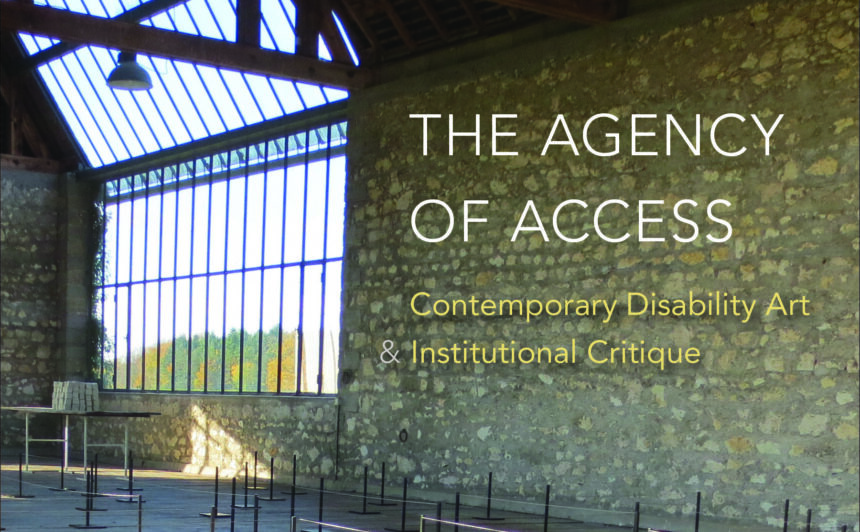
Book Review: The Agency of Access: Contemporary Disability Art & Institutional Critique by Amanda Cachia (Philadelphia: Temple University Press, 2025)
Jonah Gray
Amanda Cachia’s new book The Agency of Access: Contemporary Disability Art & Institutional Critique (2025) from Temple University Press is an ambitious survey of an activist strain of art that has consolidated in roughly the last fifteen years. Building on the work of a previous generation of disabled artists, who prioritized representing disabled bodies, Cachia argues that the artists she studies have instead focused on expanding the definition of art beyond the visual field to incorporate a broader sensorium to better reflect the lived experience of disability. Cachia turns away from the characterization of disability in terms of lack and towards a conception of disabled artists as experts in underrecognized sensory registers; hence the “agency” of the book’s title. In the introduction, Cachia pinpoints a key antecedent for the practices she studies in the 1990 protest by disabled activists, who crawled up the steps of the Capitol building in Washington, DC, to call attention to the slow legislative progress of the Americans with Disabilities Act. Whereas those activists – members of the grassroots group American Disabled for Attendant Programs Today (ADAPT) – used the spectacle of their action as part of a broader social agenda, the scope of the activism under discussion in this book is more tightly focused on the exhibitionary sphere of museums and galleries. The rapid rise of the tendency Cachia charts, and the prestigious venues where it has found a home, suggest that there has been a strong appetite within the institutional art world for work in this vein. Indeed, while the phrase “institutional critique” is included in the book’s title, less attention is paid to exclusionary practices, policies or spaces at museums and galleries, than the expanded definition of aesthetics exemplified by artists such as Carmen Papalia, Christine Sun Kim, Corban Walker and Park McArthur. Rather than supplanting the work of groups like ADAPT, Cachia argues that these artists’ aesthetic contributions complement broader movements for disability justice.[1]
“Access aesthetics” is the term Cachia coins to describe these artists’ shared tendencies.[2] A commonality between many of the works she discusses is a relative de-emphasis of vision as the dominant sense. Instead, artworks that activate multiple senses at once, mimic synesthesia, or involve unexpected translations from one sense to another rule the day. One prominent example is drawn from the oeuvre of the Vancouver-based Papalia – who describes himself as a non-visual learner and a social practice artist – and who becomes one of the book’s protagonists, his art and curatorial work reappearing across several chapters. See For Yourself (2015) was a project commissioned by Arts and Disability Ireland for an online exhibition that Cachia curated. Papalia commissioned others to write visual descriptions of significant historical artworks, which he then invited artist friends to reinterpret in a new visual form. Like an advanced game of telephone, each translation eventuated an entirely new interpretation, which Papalia embraced as a generative strategy within the project. This work appears in the first of the book’s five thematic chapters, each of which focuses on one of the key traits of access aesthetics that Cachia identifies in contemporary disability art: translation, ‘sensory aesthetics,’ movement, tactility, and exhibition design.
Cachia arrived at this book project by way of her curatorial practice, which developed in dialogue with many of the artists featured throughout. This familiarity with the artists, and personal experience with many of the artworks, including See For Yourself, is palpable in her writing. Often her theoretical arguments grow out of observations about certain artworks, and are informed by discussions with the artists themselves. This dialogic sensibility registers in the notion of “being with,” which Cachia deploys in support of her advocacy for access aesthetics.[3] Given how frequently she uses this phrase, it is surprising that she doesn’t go into its philosophical genealogy – most notably in the writing of Jean-Luc Nancy, who argues that being is never being alone but always being with or “being-in-common.”[4] Still, a working definition emerges through Cachia’s characterization of how access aesthetics enjoins its audiences – able and disabled – to consider and share experiences of the “complex embodiments” that typify life with a disability. Discussing the work of Walker and Shawanda Corbett, in the chapter on movement, Cachia explains:
the idea is that through [an] ambulatory political participation, some semblance of the disabled subject’s various complex embodiments will bridge any gap or distance between the so-called able-bodied and disabled and, instead, demonstrate a shared humanity in which we all partake differently.[5]
Later, in discussing a work by Wendy Jacobs in which participants lie on a vibrating platform, Cachia writes of bridging the “sensorial threshold” when “qualities of fixity are dashed” and thus how “in this indeterminacy of our bodies we find generative gaps that go beyond an ontological understanding of self; instead, they lead to a completely new rendering of the corpus.”[6] While it sometimes lacks theoretical precision (for example, how can being with go beyond ontology?), the argument that access aesthetics offers salutary new forms of shared experience is broadly persuasive.
Another key aspect of the book is its thorough contextualization of contemporary disability art in relation to the canon of 20th century art history. I was particularly drawn to this dimension of Cachia’s scholarship because she not only names a new group of significant practitioners but offers a substantial account of how historical artists and artworks fit into the narrative of contemporary disability art. In doing so, she also reconfigures historical artworks and movements in unexpected ways. For example, Marcel Duchamp’s installation Sixteen Miles of String in the First Papers of Surrealism exhibition of 1942 – for which he wrapped the gallery in a web of string, effectively blocking visitors from traversing the space – is discussed in relation to Walker’s installation, Short Minute Matter (2015), that involves wire and stanchions divvying up the gallery space in maze-like fashion. This comparison connects surrealist meta-interventions into the display of art to the tendency within access aesthetics to engage with the institutional architecture, display and crowd management apparatuses. It also helps historicize what Cachia terms the “antagonistic” impulse within much contemporary disability art.[7] The impulse to “crip” normative museum experience, she explains, parallels the generous and inclusive impulses of access aesthetics. The antagonistic drive, however, “is much more aggressive in that it aims to poke fun at and to put up barriers for the nondisabled audience in acts of revenge or to instill shock, discomfort and confusion.”[8] By evoking the Dada and Surrealist movements, Cachia grounds contemporary disability art’s antagonistic edge within the venerable legacy of vanguard cries to épater la bourgeoisie! Cachia’s analysis of Walker’s installation Please Adjust for the 2011 Venice Biennale compares Walker’s “Corban rule” to the idealized human proportions exemplified by Leonardo da Vinci’s Vitruvian Man (1487) and Le Corbusier’s Modulor (1943).[9] Walker’s rule is likewise an anthropometric scale of proportions, but derived from the artist’s own diminuitive height of four feet. The metal cube frames in the huge, precarious stack that composes Please Adjust take their individual dimensions from an application of the Corban rule. Although Cachia does not explicitly mention this other work by Duchamp, her frequent prompts to reconsider historical artworks recalled for me Duchamp’s 3 Standard Stoppages (1913–14). In that work, Duchamp devised an arbitrary system of measurement that anticipated the Corban rule by creating three rulers based on the chance contours formed when meter-long threads were dropped from a height.
The chapter on exhibition design is the one that most resonates with institutional critique as an art-historical phenomenon and a contemporary practice. McArthur’s Ramps exhibition from 2014 at Essex Street Gallery in New York, also approached the question of access head on. Laid out across the gallery’s floor were an array of ramps – from ad hoc plywood contraptions to purpose-built metal gangways finished with anti-slip tape – that had been created specifically for McArthur to drive up with her electric wheelchair. She borrowed each ramp from various institutions including galleries, residencies, schools and studios that she had visited between 2010 and 2013. The wide variety of ramps plainly revealed the lack of preparedness of many of these spaces to accommodate someone in a wheelchair. Over the duration of the exhibition, McArthur asked the lending institutions to post a notice on their main entrance announcing the temporary relocation of the ramps. Cachia compares Ramps to the Capitol Crawl action by ADAPT, arguing that McArthur’s reflection on the continued struggle of disabled people for basic accommodations strongly echoes that earlier performance. At the same time, it also emblematizes access aesthetics insofar as McArthur’s aim was not gaining entry to the literal seat of state power, but to meditate on the access challenges posed by sites for art production and exhibition and to advocate for their reform.
In her chapter on tactility, Cachia refers to Fiona Candlin’s study Art, Museums and Touch (2010), in which she establishes that “touching [in the nineteenth century] was actually a class-based activity because it was only the elite, wealthy classes that were not only given the privilege to touch objects in a museum, but were viewed by the museum staff as having the common sense to touch ‘rationally.’”[10] This observation led me to wonder how much this class-based exclusivity has changed within museums since the nineteenth century. In broader social and political discussions of access and agency – for example in relation to the healthcare system in the United States (such as it is) – the term access often obfuscates how agency can be circumscribed by class since the pure possibility of market access to care is irrelevant if the real possibility is denied by lack of economic means. Health care is an area in which class can thus have compounding effects on disability with the potential to deeply limit individual agency. While Cachia admirably examines the overlapping forms of oppression disabled people experience along the lines of gender, race and colonialism, her references to Candlin represent the most sustained consideration of class in The Agency of Access. Given the long history of class-based exclusion in museums and galleries, the nexus of contemporary disability art and social class presents an important avenue for future research. Given the nuance and care with which Cachia tackled the topics in this book, I would be eager to read her account of how economics intersects with disability, agency and access in contemporary art.
Jonah Gray is a Faculty Fellow at the NYU Program in Museum Studies. He completed his PhD at the University of California San Diego in Art History, Theory and Criticism. Specializing in contemporary art from Canada and the United States, his research foregrounds the aesthetic, political and economic entanglements of Indigenous and settler art. His dissertation, Troubling Settler Colonial Imaginaries in Contemporary Art, examines the socio-economic and cultural demands faced by Indigenous and settler artists to perform difference in order to satisfy emerging markets for artistic explorations of identity.
[1] Amanda Cachia, The Agency of Access: Contemporary Disability Art & Institutional Critique (Temple University Press, 2025), 9.
[2] Cachia, 8.
[3] “being with” is first mentioned on page 2 but is used frequently thereafter.
[4] Jean-Luc Nancy, Being Singular Plural, trans. Robert Richardson and Anne O’Byrne (Stanford University Press, 2000).
[5] Cachia, 107.
[6] Cachia, 176.
[7] Cachia, 16.
[8] Cachia, 16.
[9] Cachia, 110.
[10] Cachia, 147.