Political Art, Corporate Crime, and the Case of Daros Latinamerica
Guillermo Villamizar
The Political Landscape of Art and Violence
On January 18, 1990, Washington D.C. Mayor Marion Barry was arrested by the FBI for drug possession and the use of crack cocaine. In Colombia, the preceding year had already marked the escalation of political violence: on August 18, 1989, presidential candidate Luis Carlos Galán was assassinated by a convergence of drug traffickers, paramilitary groups, and state forces. The killings continued into 1990, with the murders of two other left-wing presidential candidates—Bernardo Jaramillo Ossa (Unión Patriótica) on March 22, and Carlos Pizarro Leongómez (AD-M19) on April 26.
In both countries, structural violence and state complicity were obscured under the language of “domestic security.” In the U.S., drug use was criminalized in poor Black communities, while in Colombia, political assassinations were folded into a broader narrative of national security and counterinsurgency.
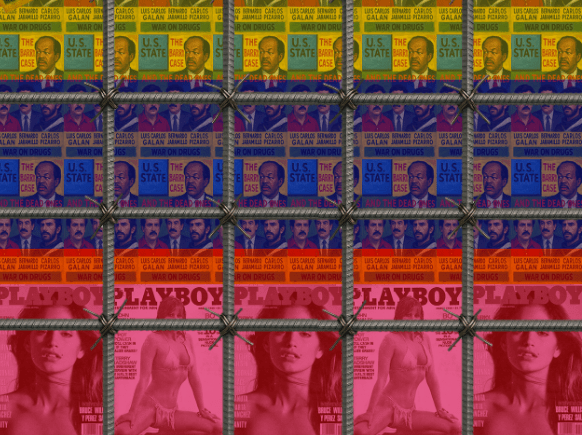
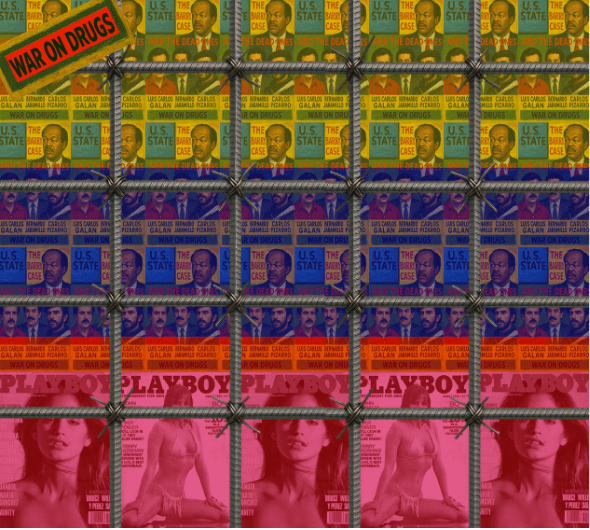
During this time, I created a series of works titled Bad Paintings. The Years of Pablo Escobar (1988–1992). One of these pieces links the figure of the D.C. mayor to the operations of the U.S. State Department—whose drug policy decisions contributed to a chain of violence and death in Colombia that seemed endless.
Throughout the 20th century, Latin America experienced repeated waves of violence triggered by decisions made in Washington. From the Bogotazo in Colombia in 1948, to the 1954 CIA-backed coup against Jacobo Árbenz in Guatemala, to the Cuban Revolution in 1959 and the failed Bay of Pigs invasion in 1961, U.S. influence shaped the region’s political landscape. These interventions continued with the 1964 military coup in Brazil, the 1965 invasion of the Dominican Republic, and the 1973 overthrow of Salvador Allende in Chile. While the Cold War may be over, its methods persist—now recast through narratives of security, economic stabilization, and soft diplomacy.
The U.S.-led War on Drugs must be understood as part of this broader historical continuum. It provided a new justification for intervention, internal repression, and the expansion of state power in fragile democracies—dynamics that remain active today. These cycles of violence—both military and ideological—have profoundly influenced Latin American artists. Many of them have turned to these histories as material for their work, giving rise to what we might call, for the sake of simplicity, political art: a category that is now as institutionalized as it is contested.
The last wave of violence sparked by drug trafficking in Colombia intensified the conflict between the State, paramilitary forces, and the former Marxist guerrilla group FARC, now demobilized. Artists like Doris Salcedo began to address these tensions in their work, constructing pieces that reflect collective mourning, trauma, and the silent weight of political loss through austere, site-responsive installations.
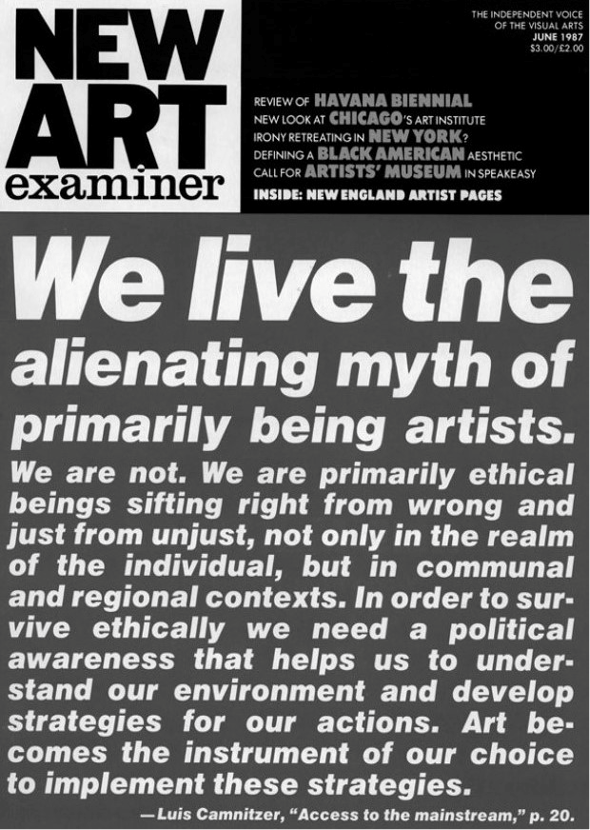
A longer arc of Latin American political art can be traced through figures like Uruguayan artist Luis Camnitzer, who argued that the dematerialization of art “became an expedient vehicle for political expression, useful because of its efficiency, accessibility, and low cost.”[1] His conceptual strategies often rely on language, irony, and pedagogy to challenge systems of power, particularly in contexts marked by censorship and repression.
Chilean artist Alfredo Jaar also exemplifies this critical lineage. His long-term Rwanda Project (1994–2010) investigates the global media’s silence during the Rwandan genocide, using photographic absence and architectural space to question the politics of visibility and the limits of representation.[2]
These artists often transform fieldwork, testimonies, and political research into artistic forms that circulate through the specialized circuits of Western art. Emerging from peripheral contexts, their work is shown in venues such as the Venice Biennale or Documenta, where it is frequently accompanied by critical texts from figures like Jacques Rancière—who has written extensively about Jaar’s practice.[3] Yet, as their work is exhibited and theorized within these spaces, it risks being detached from its original urgencies and recoded as cultural capital.
Schmidheiny, Eternit and the art of disguise
Stephan Ernst Schmidheiny was born in 1947 in Heerbrugg, in the Swiss canton of St. Gallen, into a wealthy industrial family. In 1975, at the age of 28, he became chairman of the Swiss Eternit Group (SEG), the family’s multinational asbestos-cement corporation with operations across Europe, Latin America, Africa, and the Middle East. For decades, SEG produced materials for the construction industry while facing growing evidence about the health risks of asbestos.
In the 1990s, Schmidheiny began to reshape his public image as a global philanthropist and cultural patron. He joined the Chairman’s Council of the Museum of Modern Art (MoMA) in New York (1995–2002),[4] supported environmental legal programs at Yale Law School, and contributed to the expansion of Tate Modern in London.[5] In 2000, together with his then-wife Ruth Schmidheiny, he co-founded the Daros Latinamerica Collection—one of the most significant private collections of contemporary Latin American art, with a focus on political and conceptual practices.
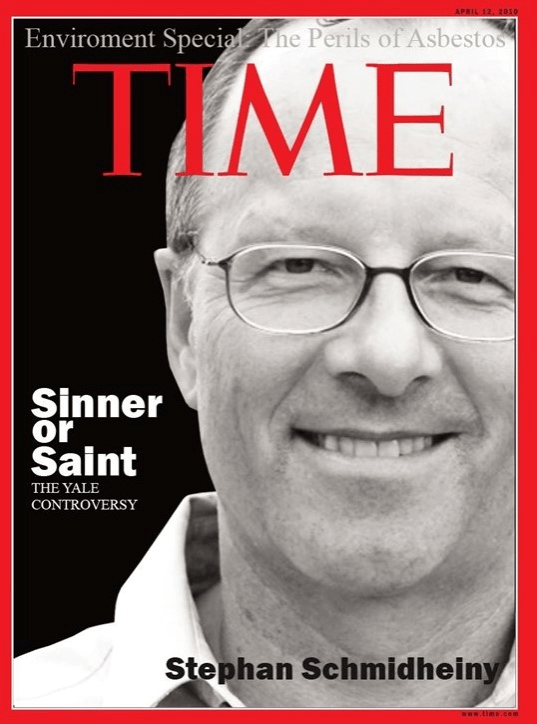
Ruth Schmidheiny played a key role in the formation and curatorial direction of the collection. Her vision and support were instrumental in shaping Daros as a platform for dialogue around memory, resistance, and social critique. She passed away in 2019, and with her departure, the collection ceased its public activity.[6] However, the collection still exists and is managed by Daros Latinamerica AG, based in Hurden, Switzerland.[7]
At its peak, Daros housed the largest institutional collection of Luis Camnitzer’s work and exhibited pieces by major Latin American artists such as Doris Salcedo and Alfredo Jaar. In March 2012, the National University of Colombia hosted a major retrospective of Camnitzer’s work in Bogotá.[8] One year later, the Schmidheiny family inaugurated Casa Daros in a restored 19th-century mansion in Rio de Janeiro.[9] With an investment of over $15 million, it became one of the most prominent private museums in the region—until its closure in late 2015.[10]
In mid-2012, during research at the Art Museum of the National University of Colombia, I encountered the Daros Latinamerica Collection and its frequent loans to the institution.[11] It was jarring to realize that this celebrated archive of politically engaged art was backed by Stephan Schmidheiny—the former owner of Eternit, a multinational asbestos corporation with a long history of health and environmental violations.
Judicial Truth and Manufactured Uncertainty
Just months earlier, on February 13, 2012, an Italian court had sentenced Schmidheiny to 16 years in prison for willful environmental disaster and criminal negligence in connection with the deaths and illnesses of nearly 3,000 people exposed to asbestos near Eternit’s Italian plants. The sentence was extended to 18 years on appeal, but in 2014, the Court of Cassation annulled the conviction on procedural grounds. A new trial was launched in 2015, this time for premeditated murder—a charge not subject to the statute of limitations.
The case has since evolved into multiple proceedings, with the most prominent—known as Eternit Bis—focusing on 392 deaths in Casale Monferrato. In 2023, Schmidheiny was found guilty of aggravated manslaughter and sentenced to 12 years. Both the prosecution and the defense have appealed, and as of early 2025, hearings continue before the Turin Court of Appeals.
Prosecutors Sara Panelli and Rosalba Altopiedi have presented extensive documentation tracing Schmidheiny’s direct involvement: from his leadership during Eternit’s operation, to his role in the company’s bankruptcy, and the subsequent efforts to obscure accountability.[12] They highlight the 1976 Neuss Conference as a key piece of evidence, where Schmidheiny acknowledged full awareness of asbestos-related risks—yet instructed his managers to avoid alarming the public or workers.[13]
Inhaling asbestos fibers causes deadly diseases such as asbestosis, lung cancer, and mesothelioma. The World Health Organization classifies asbestos in all its forms as a Group 1 carcinogen—meaning it is proven to cause cancer in humans.[14] More than 60 countries have banned it, including the European Union, Australia, Argentina, Canada, Japan, and, as of January 1, 2021, Colombia. The United States still lacks a federal ban.
The asbestos industry has faced three major crises across the 20th century: the identification of asbestosis in the 1930s, asbestos-related lung cancer in the 1940s, and the definitive link to mesothelioma in the 1960s. Each time, the industry responded not by adapting or withdrawing, but by learning how to protect itself—chiefly through the control of knowledge. It mastered the manipulation of professional associations, the suppression of data, and the hiring of experts to cast doubt on consensus.[15] As David Michaels explains, uncertainty is an inherent problem in science, but intentionally manufacturing uncertainty is a completely different matter.[16]
The “safe use of chrysotile”, a narrative promoted by industry-backed scientists, claimed that asbestos could be used responsibly with proper regulation. In countries like Colombia, this idea became public policy for more than thirty years. Discovering how deeply this fiction had infiltrated institutions was unsettling. Even more so was realizing that similar mechanisms operated in the art world—a field presumed to be critical and emancipatory, yet often complicit with the same economic forces it claims to resist. That Latin American art, celebrated for its imagery of resistance, could be funded by capital linked to industrial harm was a paradox I could not ignore.
Both science and art generate systems of representation—frameworks that help us understand reality. But when these frameworks serve the interests of power, they risk becoming tools of concealment. In “The Decay of Lying” (1889), Oscar Wilde wrote: “The final revelation is that lying, the telling of beautiful untrue things, is the proper aim of Art.”[17] But what happens when the lie is no longer beautiful, or voluntary, but structural—and deadly?
Social Practice and the Question of the Artist
When I began to explore the world of asbestos, I was struck by the sheer volume of fiction embedded in the scientific literature surrounding it. At the same time, I found myself in a paradoxical position as an artist: using tools from critical theory and cultural studies to analyze the Daros Collection, while also attempting to render the interdisciplinary complexity of the asbestos issue through forms of representation. It was a search for objectivity, conducted within a terrain shaped by concealment and symbolic capital.
In 2012, I published “Daros Latinamerica: Memories Behind a Dangerous Legacy”, a critical essay that traced the links between the Daros Collection and the legacy of Eternit.[18] The piece provoked a response from Luis Camnitzer, published in Esfera Pública, where he reflected on the entanglement between social mobility and criminal structures in Latin America: “Metaphorically speaking, today’s drug traffickers will become tomorrow’s aristocracy, and today’s aristocracy emerged from yesterday’s drug dealers.”[19] His observation echoed the stigma we often feel when presenting a Colombian passport at any border: the burden of systemic association.
Two elements are particularly helpful in understanding the contradictions of Latin American political art: the dynamics of the art market and the internal tensions within artistic discourse itself. Both intersect in ways that complicate claims of resistance or ethical commitment.
In 2012, I learned that artist Doris Salcedo had sold Untitled (C) III through the Alexander and Bonin Gallery (New York) to the Museo del Banco de la República (Colombia’s central bank, which operates with public funds) in 2006, for a total of USD $350,000. To put this figure in context: in 2013, the Ministry of Culture’s total budget for visual arts grants in Colombia was USD $375,000. While modest by international standards, that sale reflects a structural imbalance—one in which symbolic gestures of mourning and resistance are absorbed by a system that monetizes cultural trauma within an economy of prestige.
At the time, I was trying to understand how artistic gestures—especially those that signal structural violence—circulate within a broader economy of prestige. On one hand, public institutions legitimize specific narratives by incorporating them into the cultural canon. On the other, private institutions extract value from these symbolic acts, using them to rehabilitate compromised reputations. This was precisely the case with Stephan Schmidheiny, whose cultural investments in Daros Latinamerica coincided with his mounting legal troubles in Italy.
While preparing a series of lectures on asbestos in Colombia, I invited a Chilean anthropologist with expertise in public health and toxic industries. I was particularly interested in Alfredo Jaar’s opinion on the contradiction embodied by Casa Daros: a museum of political art financed by a figure on trial for one of Europe’s largest environmental crimes. We agreed to write to Jaar and ask for his views on the Turin trial against Schmidheiny.
Jaar’s response echoed the same narrative used by Schmidheiny’s legal team: he claimed ignorance about the dangers of asbestos, insisted that he had closed his factories upon learning the truth, and praised the Daros Collection as one of the most important in Latin America. In doing so, he effectively legitimized what can only be described as an artwashing operation. What struck me most was the silence of other Latin American artists: none seemed to question the financial history of Daros. And if anyone did, they chose not to speak.
Years later, I discovered a similar configuration in Bogotá. NC-Arte, one of the city’s most prominent contemporary art spaces, is linked to Fundación Neme—an entity financed by Nayib Neme, a leading figure in Colombia’s asbestos-based friction sector (pads and clutches for vehicles). His wife, Claudia Hakim, served as director of the Museum of Modern Art of Bogotá from 2016 until 2024. In 2018, Luis Camnitzer exhibited at NC-Arte. According to the curators, “In recent years, Camnitzer’s practice has focused on rethinking the role of art and education, and how both inevitably involve ethical and political positions.”[20] The irony was difficult to ignore.
These juxtapositions led me to ask: how do the fictions produced by artists—often framed as critiques of dominant systems—intersect with the carefully constructed narratives of the asbestos industry? Is there a point where both forms of storytelling converge? And if so, what does that convergence reveal about the limits of political art?
Amid this labyrinth of reflections, it seemed to me that Latin American political art had become enmeshed—perhaps naively, perhaps cynically—in the same mechanisms that shield the industrial public relations machine currently on trial in Turin.
Artistic representation often appropriates images that have already been shaped by structures of power—such as the War on Drugs—turning them into cultural capital through a process of aesthetic repackaging. That capital is then distributed across three interlocking axes, each articulated by the museum: the artwashing of private patronage, the illusion of critical discovery for the viewer-consumer, and the prospect of economic recognition for the artist-producer. In this system, art produces the complaint—and capital pays for it—as a kind of cultural vaccine, absorbing conflict in symbolic form to prevent it from becoming structural change.
This dynamic has produced what might be called an immunological cultural field—a space capable of metabolizing critique and neutralizing its political force through the apparatus of symbolic recognition. It is difficul —but not impossible—to imagine forms of art that break with this logic. The challenge is to produce gestures that do not simply reinforce the system’s symbolic economy but confront it directly. Only then might we begin to reduce the complicity gap between political art, and the power structures it claims to critique.
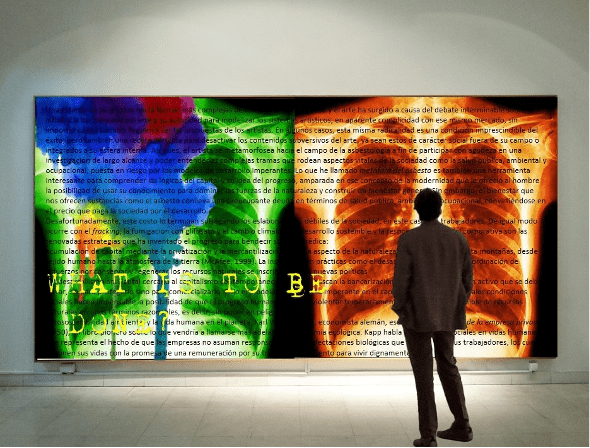
This realization was not abstract. It led me to seek out spaces where those gestures could take shape—not as representations, but as direct forms of engagement.
My first public presentation on the asbestos issue took place in February 2014, at the National University of Colombia, during the International Conference on Environmental and Occupational Health, organized by the university’s Institute of Public Health. I presented research I had compiled with a medical colleague, Dr. Jairo Ernesto Luna, focused on the history and impact of asbestos in Colombia.
The presentation traced the industrial development of asbestos in the country, beginning with mining and factory operations since 1942, through to patterns of annual consumption. We analyzed the public response to the material, the weak enforcement of occupational and environmental health regulations, and the glaring absence of epidemiological data in official records. This silence—particularly from sectors of public health—underscored the need to expose the socio-political roots of the crisis, not just its medical consequences.
That conference made visible the complex entanglement of science, economics, politics, and law—and how these domains converge in defense of industrial interests. To counter the dominant narratives promoted by the asbestos industry, I had to delve deeper. This led me to build an international network of experts, including leading voices in public health, occupational medicine, and environmental policy. I read extensively, translating scientific articles and court documents into Spanish, and then brought this knowledge into the Colombian public sphere through lectures, publications, and media interventions.
At that point, I began to ask myself: where does art fit into this web of entangled interests? Among all disciplines, social practice art stood out as uniquely suited to move across boundaries. It is a field flexible enough to engage with science, law, and policy without needing to claim full expertise—but bold enough to intervene, to pose questions, to insist on the presence of the real. Unlike traditional academic disciplines, it does not hesitate when confronted with ambiguity. On the contrary, it thrives on it.
Collage, Absence, and the Crisis of Representation
In her essay In the Name of Picasso, Rosalind Krauss reflects on the structural logic of collage. She writes: “The structural condition of absence is essential to the operations of the sign within Picasso’s collage. The extraordinary contribution of collage is that it is the first instance within the pictorial arts of anything like a systematic exploration of the conditions of representability entailed by the sign—thus achieving a metalanguage of the visual that is based on an absent origin. And this system is inaugurated with the loss of an origin that can never be objectified, but only represented.”[21]
Krauss’s reading of collage as a system built on absence—on what cannot be directly accessed—became central to how I understood the limits of representation in my own work. In drawing, representation unfolds through the continuity of the line—the world is traced without interruption. In collage, however, the fracture is explicit. The landscape does not precede the image; rather, the image is assembled from cuts that point toward a landscape that cannot be fully grasped. In the case of asbestos, there was no preexisting visual framework to rely on — no established referent for the violence it represented. The collage became the only way to make sense of that fragmented reality — a landscape we remember in parts, but can never see whole.
The only way to approach this fragmented reality is through partial traces — cuts that suggest a structure without ever revealing it in full. In that sense, representation becomes an act of social collage: not to reproduce a unified image, but to trace the contours of a scattered landscape. Through fieldwork and situated interventions, social practice art reclaims the right to construct meaning from what lies beyond immediate visibility.
As I began to engage with the complexity of the asbestos issue, I found that conventional models of visual representation were no longer sufficient. The contradictions within and between institutions—both inside and outside the art world—revealed a structural isomorphism that limited the field’s ability to respond critically. These overlapping dynamics led me to seek new frameworks for mapping and articulating forms of representation that could confront the public, environmental, and occupational health threats posed by asbestos.
This led me to consider new ways of identifying and representing the objects, practices, and relations embedded in social life—not just as aesthetic forms, but as complex systems shaped by multiple disciplines. The challenge was to create representations capable of holding together knowledge from fields as diverse as law, science, public health, economics, and activism, even at a basic level. Such representations could no longer fit within the narrow confines of what the art world traditionally considers “valid.” Art, as it has often been practiced, remains constrained by a monofocal aesthetic that limits its capacity to engage with complex realities.
The small spotlight that art directs toward the world often leaves vast areas of cultural and material life in darkness. A rich eco-geography of social relations, institutions, and invisible infrastructures rarely appears in our images—not because it is unimportant, but because our aesthetic tools have not been designed to account for it.
As a result, I began to rethink the relationship between the artist and the institution. Rather than using the institution as a space for validation, I saw it as a strategic device—one that could help displace the site of artistic production to other contexts entirely. My practice moved away from the creation of objects toward the development of actions: gestures rooted in daily life, structured as rituals that unfold not in galleries or museums, but in public and communal spaces embedded in the social fabric.
Confronting the asbestos crisis in Colombia forced me to acknowledge that the issue could not be addressed through traditional artistic tools alone. Its representation exceeded the visual, demanding a transdisciplinary approach capable of navigating a dense and often invisible web of institutional and material forces.
The asbestos problem is entangled with legal codes, scientific controversies, political negotiations, environmental degradation, and working-class struggles. It involves physics and chemistry as much as labor law, journalism, public health, and environmental justice. In this sense, the terrain I was trying to represent was not just artistic — it was systemic. As Henri Lefebvre suggested, social space is not only where goods are produced, but also where knowledge, ideologies, and artworks are made and contested.[22] This is the space where my practice began to unfold — not within the white cube, the camera frame, or the gallery, but in the expanded field of the social, where artistic gestures emerge from lived situations and intervene directly in public life.
Understanding a problem requires building a representation of it. One of the first questions I faced was: how could science speak so differently about the same substance? Was it truly possible to use asbestos under “safe” conditions — or was that notion itself a product of political and economic interests? What began as a scientific inquiry quickly expanded into a broader investigation. I realized that any attempt to isolate a single variable led to ripple effects across multiple domains: law, policy, corporate influence, academic research. Establishing those connections required me to move across disciplinary boundaries, many of them unfamiliar, but all necessary to grasp the structure behind the narrative of safety.
I soon realized that it would be difficult to communicate my findings through visual representation alone. The complexity of the asbestos crisis—and the institutional structures that sustained it—required a different mode of engagement. This led me to develop a practice I now refer to as everyday political performance: a form of artistic action rooted in real-world encounters, designed to intervene in public spaces directly related to the issue at hand.
These actions do not seek aesthetic spectacle. They emerge from the rhythms of daily life and are shaped by the demands of ongoing research. Sometimes they occur in meetings with journalists, public officials, or medical professionals. Other times they unfold as silent gestures within bureaucratic systems. Their temporality is fragmented and discontinuous, but they accumulate over time into a sustained line of action. Even when they go unnoticed, they can resonate—especially when amplified by media or community networks. By “everyday political performance”, I do not mean a stylized reenactment of daily gestures. I refer instead to interventions born from the subject’s own position in the social world. These are actions that do not imitate life—they are life, shaped by context, urgency, and an ethics of presence.
My first formal engagement with the asbestos issue began in September 2012, when I encountered online reports about the Eternit trial in Italy. These searches led me to the International Ban Asbestos Secretariat (IBAS) and its director, Laurie Kazan-Allen, whose work helped me grasp the global dimensions of the problem. A key resource was Defending the Indefensible: The Global Asbestos Industry and its Fight for Survival, by Jock McCulloch and Geoffrey Tweedale— abook that offered both a historical overview and a detailed account of the industry’s tactics.[23]
Since the 1970s, researchers and advocates such as Paul Brodeur and Barry Castleman have documented the ways in which the asbestos industry suppressed evidence, influenced regulatory agencies, and delayed public recognition of the harm caused by exposure.[24][25] The extent of that denial—and the industry’s ability to marginalize dissenting science—became a central concern in my work. Few still attempt to justify such actions, except those whose opinions are shaped by financial interest.
Faced with this growing body of evidence, I began to operate as a transdisciplinary agent—moving across academic, legal, scientific, and media fields in search of points of articulation. My goal was to activate nodes of influence that could build pressure toward change: whether through policy, public awareness, or institutional accountability. In the process, I discovered a significant tension: the way knowledge circulates within the academy is very different from how it must be defended in political arenas. In the classroom or seminar, theoretical clarity is often enough. But in the public sphere—especially when confronting entrenched interests—that same knowledge must be operational, strategic, and resilient.
In Representing Capital, Frederic Jameson reflects on a dilemma that runs through his entire work: capitalism both demands representation and resists it.[26] As Max Haiven notes, this contradiction haunts any attempt to visualize or narrate the totality of capitalism.[27] For Jameson, that totality is ultimately unrepresentable—a force so vast and multidimensional that it escapes containment in any single frame or language.
And yet, when confronting the social landscape of asbestos, I felt compelled to try. My goal was not to capture it all, but to trace its contours—to build a representation that could hold together its fragmented and heterogeneous manifestations. I knew that any image would be partial. But I also knew that the refusal to represent allowed violence to remain invisible.
I organized five thematic trunks—science, law, politics, economics, and art—and approached them as compositional elements in a collage-based methodology: not to illustrate reality, but to interrogate it through precise and purposeful cuts. These became the materials of my practice: not to illustrate reality, but to interrogate and recompose it through partial but purposeful cuts. At that point, the artist was no longer a producer of images, but a forensic interpreter—tracing what power had buried, assembling partial clues, and reconstructing the scene of an ongoing crime. This logic of invisibility was not confined to the symbolic field. It extended into concrete structures of ownership, territory, and production across Latin America.
This same strategy of filantrocapitalism extended well beyond the realm of art. Through Grupo Nueva and its subsidiaries, the Schmidheiny network also expanded into sectors like forestry, infrastructure, and housing across Latin America. In Chile, for example, Masisa—a company within the Grupo Nueva conglomerate—played a key role in the industrial expansion of forestry into Mapuche territory. The rhetoric of care thus served as a veil for extractive violence, echoing the symbolic operations of Daros: conflict rendered invisible through the language of responsibility.
This expansion, framed as “sustainable development,” occurred in the wake of Pinochet’s dictatorship, which dismantled collective land rights and forced many Indigenous communities to sell their ancestral territories.[28] By the early 2000s, Masisa (via Forestal Millalemu and the holding company Terranova) had acquired over 120,000 hectares in southern Chile and amassed additional forestry assets across Latin America and the United States—becoming the region’s largest wood panel producer.
Social Praxis, Public Health, and the Limits of Representation
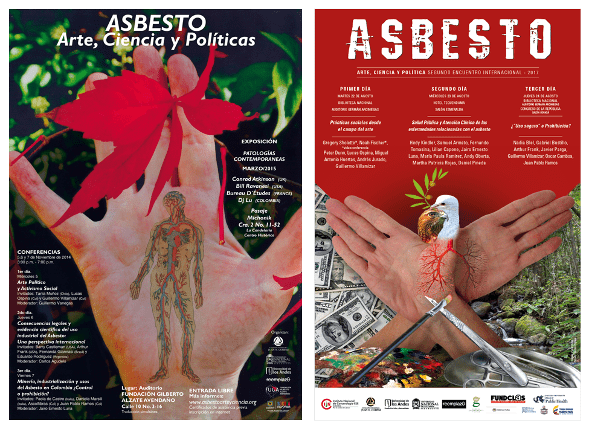
Through the director of IBAS, I was introduced to the work of British artist Conrad Atkinson, whose 1978 exhibition ASBESTOS: The Lungs of Capitalism at the Serpentine Gallery remains one of the earliest artistic critiques of the asbestos industry. It was a revelation. Another key figure I met through Atkinson was Peter Dunn, a pioneer of community-based political art in the UK. Both artists generously contributed poster images for the conferences I organized in Bogotá in 2014 and 2017, titled ASBESTOS: Art, Science, and Politics. These events became important platforms for building a critical mass within civil society and the media — one that would later prove essential for public awareness and legal reform.
In 2016, to counter industry claims that asbestos had caused no harm, we launched a research project in collaboration with Dr. Arthur L. Frank of Drexel University in Philadelphia. With support from the union of a company in Colombia’s friction sector, we examined 148 workers selected by convenience sampling. Each participant completed exposure history questionnaires and underwent physical exams, chest X-rays, and lung function tests. Nineteen radiographs showed abnormalities consistent with previous asbestos exposure, most of them parenchymal. Lung function remained normal in most cases. These results were published in Annals of Global Health in January 2020, contributing empirical evidence to a debate long shaped by denial and misinformation.[29]
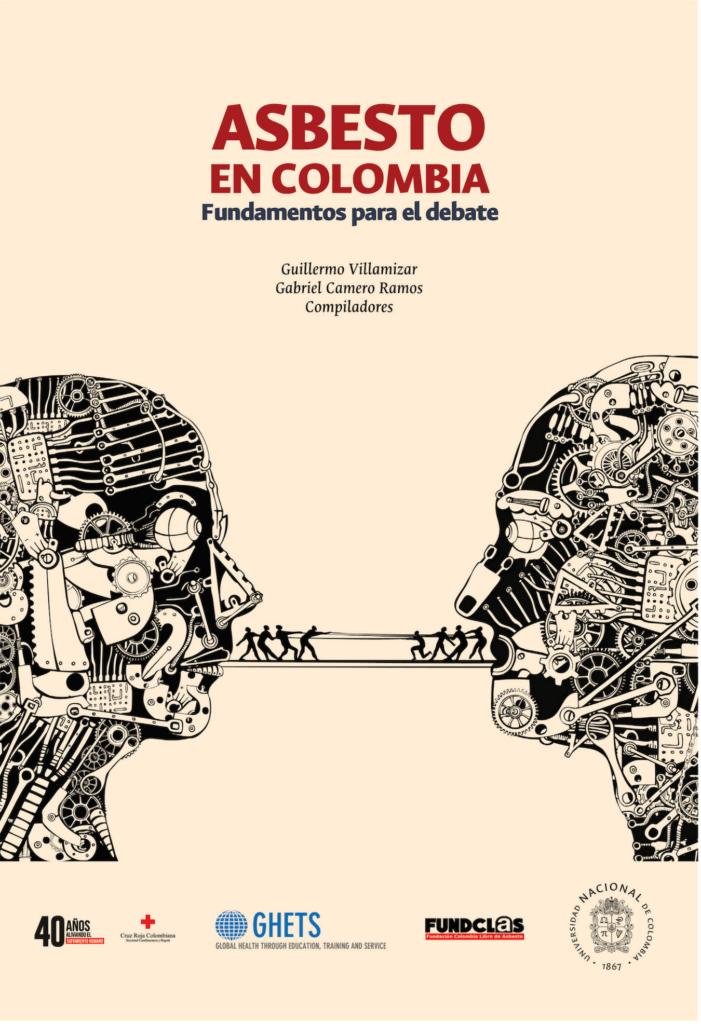
Another important milestone was the publication, in March 2019, of the book Asbesto en Colombia: Fundamentos para el debate.[30] This work became a key tool for opening up public and technical discussion on the impacts of asbestos in the country. In parallel, various individuals and organizations contributed from their respective fields to building the critical mass that would eventually push the political process leading to the national ban.
Among those who played a decisive role in that broader process were Professor Juan Pablo Ramos (Universidad de los Andes), whose scientific research and media outreach were instrumental; Ana Cecilia Niño and Daniel Niño, whose activism—amplified by Ana Cecilia’s death from mesothelioma—gained national attention; the environmental organization Greenpeace, which brought the issue into the viral sphere; and the Observatory of Networks and Collective Action at Universidad del Rosario, led by Juan Carlos Guerrero. Political support came from Senator Nadia Blel and Representative Mauricio Toro. Victims’ organizations, labor unions, and journalists also played key roles. Together, this constellation of efforts led to the official ban on asbestos in Colombia on June 11, 2019—a landmark moment in Latin American environmental health policy.
After the law passed, several fellow artists congratulated me—and then asked: “So, what’s next?” But they misunderstood the nature of this work. What we had done was not a project with a beginning and an end; it was the opening of a long-term struggle. When you intervene in the political structure of the State, the work never ends. It becomes a full-time, lifelong commitment. Representation, in this case, is not the resolution of the problem—it is only the surface of a conflict that continues to unfold in real time. As the president of the Colombian Medical College warned me at the time: “Be vigilant. Laws can be passed, but they can also be undone in the fine print of regulation.” Since the ban, I have seen firsthand how that warning plays out.
In collaboration with the Australian Embassy in Colombia and the Asbestos Safety and Eradication Agency (ASEA), we developed a practical guide for the safe management of asbestos. The goal was to provide clear, accessible information for the general population, especially given the widespread lack of public knowledge about the health risks associated with improper handling of asbestos-containing materials—both in industrial settings and at home. This guide became a crucial tool for post-ban implementation, bridging the gap between legislation and everyday practice.
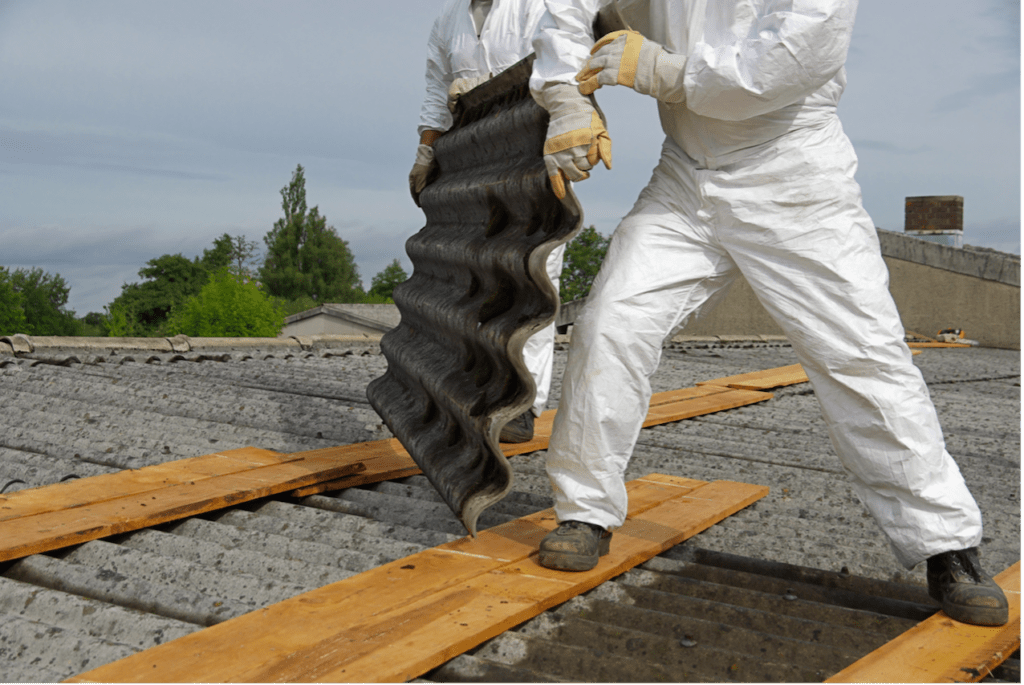
Seen from above, Colombia appears roofed in asbestos cement. The most common asbestos-containing materials in the country are classified as “non-friable —meaning that the fibers are embedded in other substances, making them less likely to be released under normal conditions.
However, three factors significantly increase the risk of fiber release: human intervention (such as cutting or drilling), the natural degradation of materials over their life cycle, and long-term exposure to weather conditions like rain, wind, heat, and temperature fluctuations. While these risks are well-documented, they are often downplayed by industry and echoed by state agencies—a continuity of the same rhetoric that delayed action for decades.
Only recently, and after sustained efforts by the Colombia Asbestos-Free Foundation, did the Colombian government formally acknowledge these risks. On January 18, 2024, through Resolution No. 063, it officially declared that all asbestos waste—whether friable or non-friable—constitutes hazardous material. This legal recognition marked a turning point, yet the asbestos industry in Colombia continues to defend the narrative that non-friable materials are harmless—a discourse that, for decades, was echoed by public agencies and institutional silence. To challenge this position with evidence, we conducted a pilot study in an attic space located between the asbestos cement roofing and the ceiling of a home. A surface dust sample collected from a single square foot revealed more than 1.43 billion asbestos fibers. That number was not an estimate—it was a measured count.
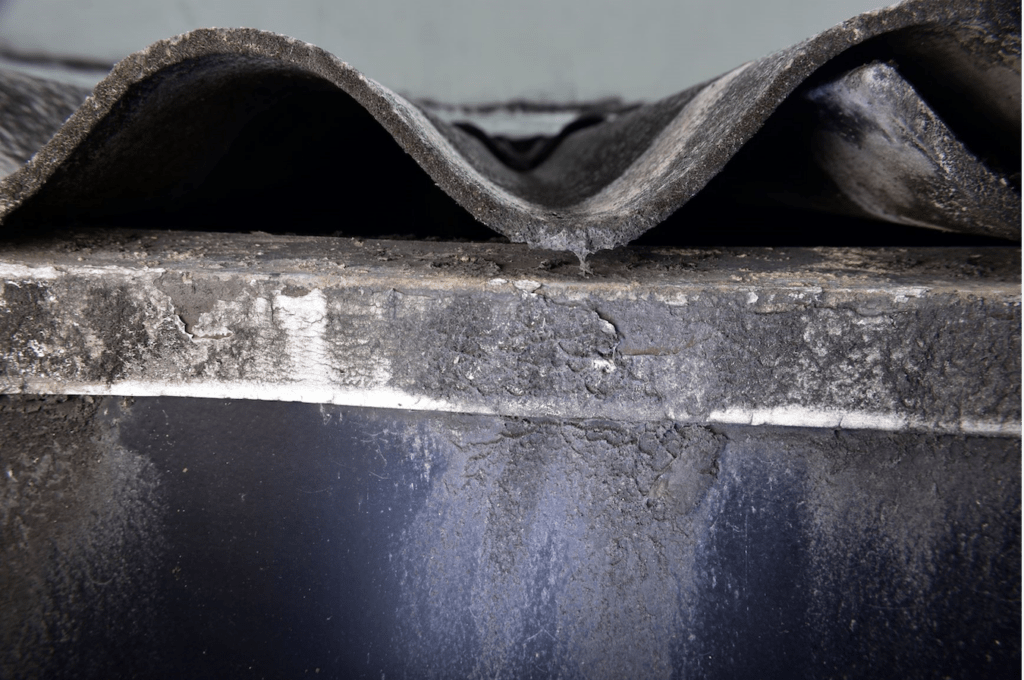
According to ASTM standards in the United States, specific risk thresholds are established based on the concentration of asbestos fibers per volume. While our sample came from a single site and more data is needed for broader conclusions, the sheer number of fibers found—over 1.43 billion—already signals a serious risk. The 2024 resolution represents a long-overdue step forward in acknowledging the health and environmental impacts of asbestos. However, the persistence of industry rhetoric and its influence on public perception show that this is not simply a technical matter—it remains a political maneuver designed to protect industrial interests under the guise of scientific objectivity.
A Cultural Economy of Immunity
We live in a time of symbolic excess—and art, far from being immune, is often its precursor. The public sphere has become a hotbed of curated fictions, aestheticized suffering, and carefully crafted narratives. Our cultural heroes depict global tragedies while waiting for the spontaneous emancipation of the spectator—all the while securing their prestige through institutions funded by the same economic elites that drive ecological collapse. Meanwhile, the industries that poison the planet repeat—ad nauseam—that there is nothing to worry about. The temperature rises. The air thickens. Politics trades in deception as its most valuable currency. And hunger, dispossession, genocide, and injustice gallop forward, unbothered by the beauty of the images we continue to produce.
Andrea Fraser reminds us that the gains of the art world are frequently built on the very conditions that deepen inequality and systemic harm elsewhere.[31] That contradiction is no longer theoretical. It is embodied, material, and urgent—visible in collections like Daros Latinamérica, where artists committed to memory and resistance coexist silently with fortunes built on industrial violence. In the end, the art world functions as a cultural immune system—one that absorbs dissent, processes it like an antigen, and neutralizes its force through symbolic acclaim. It digests critique, converting it into institutional prestige; turns resistance into aesthetic currency; and recodes opposition as style. Within this apparatus, protest circulates as discourse, and rupture is rehearsed without ever crossing the threshold. For spectators in the Global North, all that remains is the comfort of observation—a passing sympathy, safely detached from consequence. A beautiful trap. A mirror that reflects conflict—but refuses to crack.
Bogotá, Colombia
April 13, 2025
Guillermo Villamizar is an artist, art critic, and director of the Colombia Asbestos-Free Foundation
Notes
[1] Luis Camnitzer, Conceptualism in Latin American Art: Didactics of Liberation (Austin: University of Texas Press, 2007), p. 29.
[2] Alfredo Jaar, The Rwanda Project, 1994–2010. Available at: https://alfredojaar.net/projects/1994/the-rwanda-project/ [Accessed 5 May 2024].
[3] Jacques Rancière, The Emancipated Spectator (London: Verso, 2009).
[4] “Board of Trustees,” Museum of Modern Art, https://www.forbes.com/global/1999/0705/0213074a [Accessed 12 April 2025].
[5] How to raise £166 million for the Tate: “Money follows energy”,
https://www.theartnewspaper.com/1999/11/01/how-to-raise-pound166-million-for-the-tate-money-follows-energy [Accessed 3 May 2024].
[6] “Obituary: Ruth Schmidheiny (1949–2019),” Daros Latinamerica Foundation Archive (internal document, 2019). https://www.hommages.ch/fr/avis-de-deces/ruth-schmidheiny/pdf/231964 [Accessed 4 May 2024].
[7] Daros Latinamerica AG, “About Us,” https://www.daros-latinamerica.net/en [Accessed 9 May 2024].
[8] Luis Camnitzer, Exhibition Catalogue (Bogotá: Museo de Arte de la Universidad Nacional de Colombia, 2012). [Accessed 12 April 2025]
https://patrimoniocultural.bogota.unal.edu.co/publicaciones/
[9] Cantos Cuentos Colombianos, Exhibition Catalogue (Rio de Janeiro: Casa Daros, 2013).
[10] “Casa Daros to Close in 2015,” The Art Newspaper,
https://www.theartnewspaper.com/2015/06/16/time-running-out-for-casa-daros-in-rio [Accessed 4 May 2024].
[11] Guillermo Villamizar, “A University Art Museum Between Tradition and the Urgencies of Contemporaneity,” Esfera Pública, 18 February 2020. Available at:
https://esferapublica.org/un-museo-de-arte-universitario-entre-la-tradicion-y-las-urgencias-de-la-contemporaneidad/ [Accessed 7 May 2024].
[12] Rosalba Altopiedi and Sara Panelli, The Great Trial, Asbestos Disease Awareness Organization, 2016. Available at: https://www.asbestosdiseaseawareness.org/wp-content/uploads/2016/02/The-Great-Trial.pdf [Accessed 7 May 2024].
[13] “The Eternit Trial,” International Ban Asbestos Secretariat (IBAS), http://ibasecretariat.org/eternit-great-asbestos-trial-toc.htm [Accessed 6 May 2024].
[14] International Agency for Research on Cancer (IARC), Asbestos (Chrysotile, Amosite, Crocidolite, Tremolite, Actinolite and Anthophyllite), Monographs on the Evaluation of Carcinogenic Risks to Humans, Vol. 100C (Lyon: WHO/IARC, 2012).
[15] Jock McCulloch and Geoffrey Tweedale, Defending the Indefensible: The Global Asbestos Industry and its Fight for Survival (Oxford: Oxford University Press, 2008).
[16] David Michaels, Doubt Is Their Product: How Industry’s Assault on Science Threatens Your Health (Oxford: Oxford University Press, 2008).
[17] Oscar Wilde, “The Decay of Lying,” Intentions, (1891), 21.
[18] Guillermo Villamizar, “Daros Latinamerica: Memories of a Dangerous Legacy,” Esfera Pública, October 20, 2021. Available at: https://esferapublica.org/daros-latinamerica-memorias-de-un-legado-peligroso/ [Accessed 7 May 2024].
[19] Luis Camnitzer, “Ethics and Conscience,” Esfera Pública, 3 April 2020. Available at: https://esferapublica.org/etica-y-conciencia/ [Accessed 7 May 2024].
[20] Falto de palabra, NC-Arte, February–April 2018. Available at: https://nc-arte.com/falto-de-palabra/ [Accessed 7 May 2024].
[21] Rosalind Krauss, “In the Name of Picasso,” October, vol. 16 (1981), pp. 5–22.
[22] Henri Lefebvre, “The Production of Space,” Papers: Revista de Sociologia, no. 3 (1974), pp. 219–232. Available at: https://raco.cat/index.php/Papers/article/view/52729 [Accessed 7 May 2024].
[23] McCulloch and Tweedale, Defending the Indefensible.
[24] Paul Brodeur, Outrageous Misconduct: The Asbestos Industry on Trial (New York: Pantheon Books, 1985).
[25] Barry Castleman, Asbestos: Medical and Legal Aspects (Austin: Aspen Law & Business, 2005).
[26] Frederic Jameson, Representing Capital: A Commentary on Volume One (London: Verso, 2011), p. 6.
[27] Max Haiven, Art After Money, Money After Art: Creative Strategies Against Financialization (London: Pluto Press, 2018), pp. 31–32.
[28] Dany Jaimovich and Felipe Jordán, Indigenous Property and Economic Development under Pinochet Dictatorship, 2024. Available at: https://www.researchgate.net/publication/384468000_Indigenous_property_and_economic_development_under_Pinochet_Dictatorship [Accessed 8 May 2024].
[29] Guillermo Villamizar et al., “Asbestos Exposure and Chest Radiographic Findings in Colombian Workers from the Friction Products Sector,” Annals of Global Health, vol. 86, no. 1 (2020), pp. 1–6. https://annalsofglobalhealth.org/articles/10.5334/aogh.2634
[30] Guillermo Villamizar (ed.), Asbesto en Colombia: Fundamentos para el debate (Bogotá: Universidad Nacional de Colombia, 2019).
[31] Andrea Fraser, “L’1%, c’est moi,” in Texte zur Kunst, vol. 83 (2011).