Imagination Boosters against Hyper-politics—Socially and Politically Engaged Art in Germany in 2025
Karen van den Berg
Since my last report in the FIELD Journal, the world has changed. Techno-epistemic upheavals, man-made climate change, wars in Europe and Gaza, and the rise of right-wing extremist movements are reinforcing each other to create a planetary polycrisis (Adam Tooze).[1] Hardly any cultural institution worldwide remains unaffected by this. In Germany, this also means that the cross-party consensus on a bourgeois-liberal cultural policy of the post-war period has come to an end. These upheavals are accompanied by new patterns of action and structures in the politically engaged cultural sector: 1. Firstly, widespread boycotts; 2. new forms of protest; and 3. the growth of non-government infrastructures.
I. Since the beginning of the 2020s, a hardening of positions, a performative “cancel culture” and “boycottism”[2] have dominated the climate in the German cultural sector. 17 May 2019 marked the end of a long-standing understanding of culture, because on that day, the German Bundestag passed narrowly a resolution classifying the anti-Israel boycott, divestment and sanctions movement (BDS), founded in 2005, as anti-Semitic and thus withdrawing state funding from individuals and institutions associated with BDS. This was followed in 2020 by the first spectacular disinvitation of postcolonial theorist Achille Mbembe, who had been invited to speak at the Ruhrtriennale. Shortly afterwards, the heads of Germany’s most important cultural institutions joined forces to found the GG 5.3 Weltoffenheit initiative–including the Federal Cultural Foundation, the Goethe-Institut, the association of German stage directors and the directors of research institutions such as the Wissenschaftskolleg zu Berlin–to oppose this in the name of the Basic Law and freedom of art.[3] Even the plea by a group of renowned international scholars, who in 2020 drafted a paper on the definition of anti-Semitism entitled Yerusalem Declaration, which classified BDS as decidedly non-anti-Semitic, did not change the decision.[4] The boycott of the boycott remained in place. Event cancellations, disinvitations and closures of alternative cultural institutions were the result of a new form of soft power censorship–not to mention the documenta scandal and self-righteousness of the German government. This climate was somehow new. This was, in turn, met with third-order boycotts, such as the “Strike Germany” movement launched in 2024.[5] In addition, activist artists who opposed the boycott demonstrated a similar self-righteous attitude. For example, Tania Bruguera invited pro-Palestinian activists to her 100-hour Hannah Arendt reading at the Hamburger Bahnhof, who shouted down the event with slogans such as “Israel is not real” and “Fuck this racist Nazi country”.[6] One does not have to be particularly perceptive to recognize the shortcomings in the ability to engage in dialogue and to see the logic of hashtag activism at work. Political scientist Anton Jäger coined the term “hyper-politics” for this style of politics, describing the phenomenon of heated politicization without political consequences.[7] The term “hyper-politics” seems to describe the current political style better than simply labelling the Federal Republic of Germany as an illiberal democracy, as some prominent cultural figures have recently done.[8]
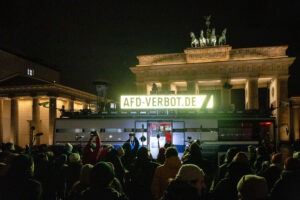
II. In any case, activist art in Germany currently seems to be intervening more explicitly–and mostly with impunity. Many projects, such as “Omas gegen Rechts” (Grannies Against the Right), are primarily directed against the far-right AfD party, while others stand for empowerment or focus on conquering living spaces. One important example remains the Centre for Political Beauty (ZPS), which in the summer of 2025 drowned out a television appearance by Alice Weidel, a leading politician of the far-right AfD, to such an extent that the live broadcast, from the terrace of the Bundestag, was close to being interrupted. The program was drowned out for 10 minutes from the other side of the Spree with a sacred-sounding yodelling choir singing “Scheiß AfD, scheiß AfD…”(Bloody AfD) on a continuous loop.[9] Significantly, the ZPS used a converted prison bus equipped with pressure chamber loudspeakers for this interventionist show of force. The singing came from an activist-empowering FLINTA* choir, the “Corner Chor” from Augsburg.[10] Such actions no longer seek symbolic detours, but rather rely on an emphatically cultivated demonstration of counter-presence that comes across as official and state-supporting and addresses the aesthetic mainstream very directly.
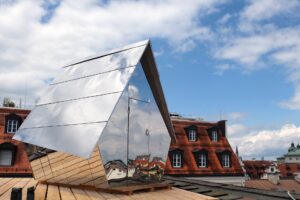
Activist interventions that use a “parasitic aesthetic“ to occupy spaces in times of housing shortages, such as Jakob Wirth’s projects, also take on a similarly official guise. The artist offered an illegal tiny house on unused roof spaces as a penthouse on real estate platforms and advertised public spaces on Airbnb as places to stay overnight.[11]
However, the continuing general boom in activist art has now also led to activist empowerment workshops becoming a business. One example of this is the group “Radikale Töchter” (Radical Daughters), which tours Germany offering feminist courage-building workshops.[12]
III. In the media shadow of boycotts and activism, however, a third development is emerging: non-governmental socially engaged projects are forming increasingly sustainable infrastructures, and philanthropists are taking on projects that were previously run by the state. For example, the private SPORE initiative, a place dedicated to promoting “biocultural diversity” [13] and indigenous knowledge, hosted the event on multidirectional memory culture with Candice Breitz and Michael Rothberg, which had been cancelled by the Federal Agency for Civic Education. The founder behind this initiative also provides large-scale funding for press freedom, shelters persecuted journalists from all over the world in a large building in Berlin with workspaces and recording studios. The work of such foundations, which call for more courage and democracy, shows that there is definitely a functioning civil society in Germany and that there are art patrons who use their money for purposes other than erecting monuments to themselves. However, this trend also testifies to the fact that the relationship between political art and the state has changed significantly. This has not least to do with the fact that artists and cultural organizations have directly engaged with political issues and promoted post-autonomous art. In return, art has been used more and more directly by the state as an instrument of soft power diplomacy–and sometimes, like in the case of the de-colonial sociocultural art space Oyoun, de-funded when it is no longer suitable for this purpose.[14]
So, once again: in Germany, the anti-BDS resolution represented a genuine break with the hegemonic concept of post-war bourgeois-liberal culture, in which direct scrutiny of artists’ political convictions was avoided. In the former understanding of culture, tolerance and the ability to endure resistance–especially against the backdrop of the Nazi dictatorship–were considered hallmarks of the victorious democratic “West”. Left-wing critical art was en vogue in conservative circles. The autonomy and freedom of art were a kind of fetish–an arrangement that had the advantage of always keeping criticism well contained in an artistically symbolic form. Herbert Marcuse called this “affirmative culture”.[15]
Today, however, even politicians from left-wing parties in Germany are promoting the concept of “reason of state” as a new principle of cultural order. With the end of this bourgeois-liberal cultural-political arrangement, major private sponsors and philanthropists are now stepping in to take over events that until recently the state wanted to organize. Until now, this phenomenon was only known from the Soros Foundation in Eastern Europe and in the post-Soviet countries. This should make us sit up and take notice.
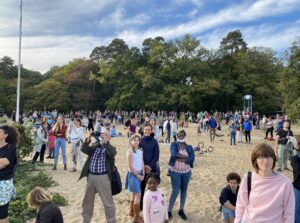
In addition to this shift, another development is emerging: existing socially and politically engaged art initiatives are becoming increasingly sustainable and expanding into larger infrastructures. A prominent example of this is the Tegelsee lido, which developed during the pandemic from an association of artists, refugees and volunteers, looking for outdoor meeting spaces.[16] The group around artist Marina Naprushkina cultivates radical forms of self-governance, collaboration and mutual learning. They ended up leasing a beach resort that had been abandoned by the city of Berlin due to unprofitability. In order to create a place for concerts, dance events, writing workshops, feminist empowerment events and artistic workshops for children in addition to seasonal bathing operations they signed a 40-years leasing contract–all financed entirely by private donations.
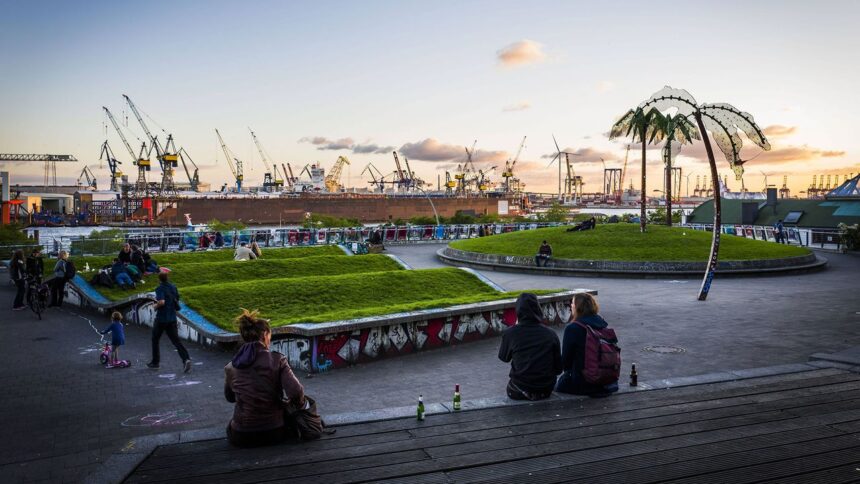
Park Fiction in Hamburg is also undergoing a similarly large expansion. The public park, now internationally renowned for its collaborative planning process, is currently being expanded by 160 per cent directly beyond the protective wall on the banks of the Elbe.[17]
Places that focus on new forms of collaborative micro-political action have also been emerging in rural areas recently.[18] It would be an error to dismiss these solely as neoliberal projects through which the public sector shirks its responsibility and shifts social work onto volunteers. For these playful and experimental projects remain counter-hegemonic–yet do not invite confrontation. They explore a new understanding of democracy that seeks to connect singularities and society in new ways through the power of reinforcing imagination. These projects are encouraging, but at present they remain dependent on the existence of boisterous, interventionist activism alongside them.
Karen van den Berg is Professor of Art Theory & Curating at Zeppelin University in Friedrichshafen Germay since 2003 and since 2006 she is academic head of the university’s arts program. She studied Art History, Classical Archaeology and Nordic Philology in Saarbrucken and Basel. Teaching and guest residencies have taken her to the University of Witten/Herdecke, the Chinati Foundation in Texas, Stanford University and Bauhaus University Weimar, among others. Van den Berg’s research focuses on art and politics, socially engaged art, the theory and history of exhibiting, and studio research. Between 2021 and 2025, van den Berg was training coordinator of the EU-funded innovative training program, FEINART (The Future of European Independent Art Spaces in a Period of Socially Engaged Art).
Notes
[1] See https://adamtooze.substack.com/p/chartbook-130-defining-polycrisis.
[2] Hito Steyerl used these terms in a panel discussion in March 2024. Hito Steyerl: in: Studio Bonn, A mensch is a mensch. Art & Culture after October 7 (Part 2), https://www.youtube.com/watch?v=ZeQqoiR2TfU&t=963s. min.19:19-19:30.
[3] See https://www.humboldtforum.org/wp-content/uploads/2020/12/201210_PlaedoyerFuerWeltoffenheit.pdf.
[4] https://jerusalemdeclaration.org/.
[5] However, the website https://strikegermany.org has since been taken down again.
[6] Jens Winter: “Ihr performt doch nur.”(You’re just performing) In taz (February 12, 2024), https://taz.de/Palaestina-Protest-bei-Kunstaktion/!5991553.
[7] See Anton Jäger: „From Post-Politics to Hyper-Politics.“ In Jacobin (February 14 2022), https://jacobin.com/2022/02/from-post-politics-to-hyper-politics.
[8] See “Der grosse Kanton: Rise & Fall of the BRD” (https://www.zhdk.ch/en/event/59826).
[9] See https://soundcloud.com/corner-chor.
[10] See https://www.tagesschau.de/video/video-1488156.html, here from minute 15:30.
[11] See Jakob Wirth: “Call for a Parasitic Aesthetic.” In Kunstforum (January-February 2024), pp. 127-135.
[12] https://radikaletoechter.de/en/workshops/.
[13] https://spore-initiative.org/en/.
[14] https://oyoun.de/en/.
[15] Herbert Marcuse, “The Affirmative Character of Culture.” In Art and Liberation: Collected Papers of Herbert Marcuse, vol. 4, (London: Routledge, 2007), 82-112.
[16] https://seeee.de/about.
[17] https://park-fiction.net/park-fiction-landet-am-elbufer/.
[18] See https://dueschenhof.de/.