
Editorial | Winter 2026
Welcome to FIELD’s Winter 2026 issue. Here in the U.S. we continue to suffer through the ongoing expansion of an authoritarian regime that seems intent on destroying what little remains of the Constitutional mechanisms of democratic governance: protections against “unreasonable search and seizure” (the Fourth Amendment) and free speech (the First Amendment), the right to habeas corpus, free and independent elections, freedom of the press and much more have all been dramatically eroded over the past year, with the open complicity of one of the country’s two major political parties. At the same time, the White House, under Stephen Miller, has created a de facto secret police force that answers only to Trump. In addition to the murder of peaceful observers in Minneapolis we see repeated attempts to undermine election integrity, impose racist gerrymandering to disempower voters, the destruction of long cherished international alliances, threats to invade friendly sovereign nations on a whim, open efforts to conspire with other dictatorial regimes around the world, and the obscene enrichment of the corrupt billionaire class who have bankrolled Donald Trump’s rise to power. In the realm of culture, the authoritarian onslaught has included the ludicrous re-naming of the Kennedy Center for the Performing Arts as the “Trump-Kennedy Center,” followed by its indefinite closure (after numerous artists refused to appear there in protest against the Trump regime), the destruction of a historical wing of the White House, the open censorship of American history, and especially the historical contributions of African Americans and the history of slavery, in national museums, and a proposal to erect a grotesque “triumphal arch” to Trump’s ego in the center of Washington D.C., overlooking the Potomac River[1] As I’m writing this, The Washington Post just laid off over a third of its editorial staff, including key offices dealing with Silicon Valley, Ukraine and the Middle East, along with its dedicated Amazon beat reporter, with the justification that the newspaper is facing cash shortfalls. The Post is owned, of course, by Jeff Bezos, the Amazon mogul and billionaire, who recently spent $75 million dollars creating a vanity film devoted to Melania Trump that is so unpopular that Republican-aligned groups have resorted to buying up large blocks of tickets and giving them away to boost its perceived success, bought a $500 million dollar yacht and spent $55 million on his wedding.
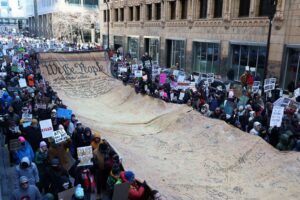
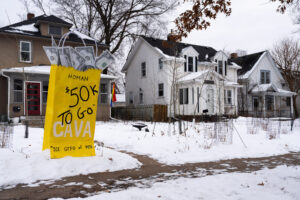
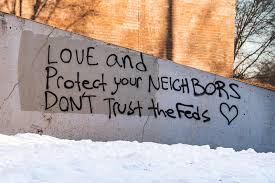
Even in the midst of this horror, resistance not only continues, but has grown exponentially. Hundreds of thousands of protestors have demonstrated in the streets of Minneapolis and many other American cities, often in below zero weather. Where ICE and the Department of Justice rely on an insidious AI surveillance platform created by Palantir, co-founded by far-right ideologue Peter Thiel, the citizens of Minneapolis have cobbled together a remarkably effective system of counter surveillance, observation and documentation of ICE actions, involving thousands of volunteers, maps, whistles, encrypted messaging apps and cameras. The culture of vernacular protest in Minneapolis has been equally vibrant, most recently including a large demonstration where protestors carried a massive reproduction of the U.S. Constitution through the streets of the city. Even routine celebrations have become opportunities for creative dissent. The annual Art Sled Rally at Powderhorn Park featured numerous custom-built sleds carrying anti-ICE messages, and just last week the Minnesota Orchestra changed its programming for a set of concerts to memorialize Alex Pretti and Renee Good, peaceful observers who were both shot down by ICE agents. The city is dotted with improvisational interventions, from anti-ICE graffiti, stickers and posters to elaborate hand-built sculptures. We hope to provide coverage of the protests in a forthcoming issue.
Over the past decade, FIELD has remained committed to providing independent critical analysis of activist and engaged and art practices, filling a significant void in contemporary art criticism. This is an absence that has only become more conspicuous in recent years, given the broad rise of neo-authoritarianism both in the U.S. and globally. Only two years ago a New York Times art critic named Jason Fargo, lamenting the ostensibly politicized work he encountered at the last Venice Biennale, wrote: “We cannot imagine an exit from the museum and the art market,” while at the same time contending, “we engage in perpetual protest but seem unable to channel it into anything concrete”.[2] Moreover, he continued, curatorial pressures to address social and political issues have become a blight on “talented artists,” whose complex works are being “sanded down to slogans and lessons”. Of course, the decisive elision here centers on the pronoun “we”. Artists have been imagining an “exit” from the art world and art market for the past four decades or more, and have been aligned with movements that have generated any number of “concrete” changes. Not by themselves, of course, but as part of a broader network of resistant practices. In this troubling context, we want to take the opportunity to celebrate the recent arrival of Labor Art Review, a new journal devoted to activist art practices associated with labor.[3] Labor Art Review was co-founded by FIELD Editorial Board member Greg Sholette, Noah Fischer, Barrie Cline and Keith Christensen, and edited by FIELD’s own Laura Thompson.
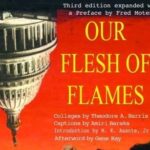
For our Winter 2026 issue we are pleased to feature John Heon’s timely essay on the important work of Theodore Harris, which explores issues of racism and political domination in the U.S. both historically and in the present moment, Ana Nolasco’s detailed investigation of issues of collaboration and institutionalization in the projects of Portuguese artist Rigo 23, and Guillermo Villamizar’s analysis of the complex cultural politics of the Daros collection of Latin American art, assembled by billionaire industrialist Stephan Ernst Schmidheiny and his then-wife Ruth Schmidheiny. Schmidheiny would become notorious for his role the illness and death of 3000 people living near one of his asbestos plants in Italy. We are also excited to publish two additional reports in our ongoing series on artistic and cultural responses to the global rise of authoritarianism. This issues’ reports come from Red Conceptualismos Del Sur, a collective consisting of activists, artists and researchers working in, and on, Latin America, Kuba Szreder, writing on events in Poland, and Karen van den Berg, providing an update from Germany. We want to express our sincere gratitude to Greg Sholette for his role in introducing and curating these reports over the last several issues. Greg will be stepping down from this role, but we hope to identify another editor to carry this important tradition forward; a tradition which, sadly, only seems more relevant today than when we first launched it. Finally, this issue features reviews of two recent books, Biennial Boom: Making Contemporary Art Global, by FIELD alumnus Paloma Checa-Gismero, reviewed by Carlos Garrido Castellano, and Jonah Gray’s review of The Agency of Access: Contemporary Disability Art & Institutional Critique, by Amanda Cachia.
FIELD is available at: www.field-journal.com
Grant Kester



- “On October 15, 2025, Trump showed reporters in the Oval Office a model sitting on his desk of a proposed arch that he wished to build. CBS reporter Ed O’Keefe asked him: ‘Who is it for?’. Trump replied: ‘Me. It’s going to be beautiful.’ O’Keefe asked if it would be called ‘The Arc de Trump’, a nickname that was immediately adopted by the media. See: https://en.wikipedia.org/wiki/Memorial_Circle_arch ↑
- Jason Farago, “The Venice Biennale and the Art of Turning Backward,” New York Times (Online), April 24, 2024.https://www.nytimes.com/2024/04/24/arts/design/venice-biennale-review-art-israel.html ↑
- https://laborartreview.net/ ↑