Theodore Harris: How to Make Art under a Dictatorship
John Heon
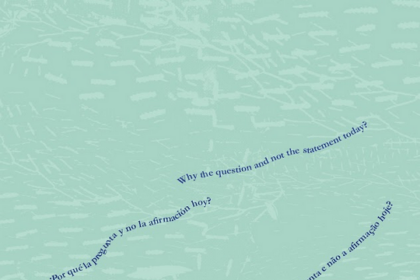
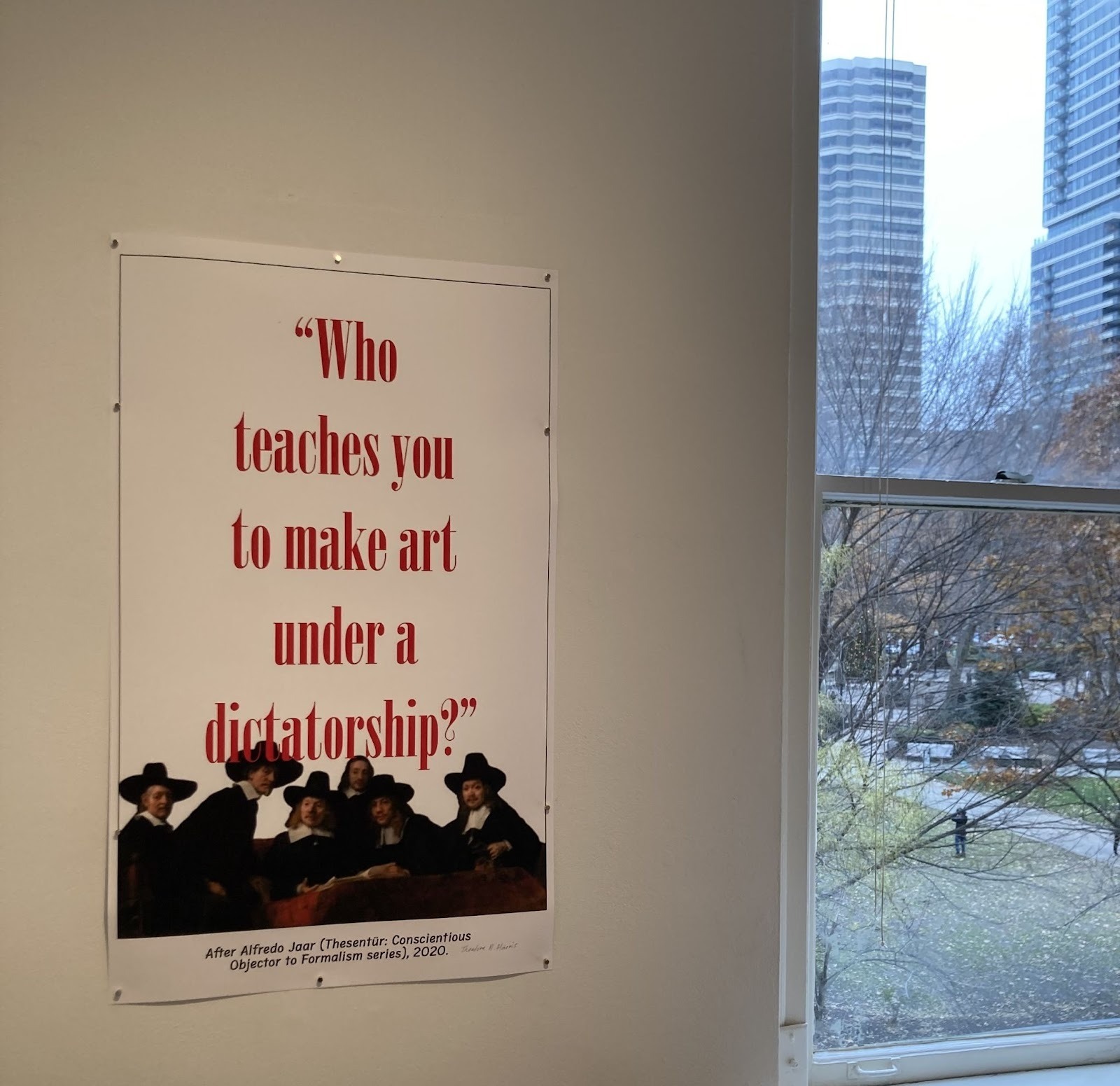
“Who teaches you to make art under a dictatorship?”
After Alfredo Jaar (2020), Theodore Harris
“There’s Nazis here.”
“What’s That Who Is This in Them Old Nazi Clothes? Nazi’s Dead” (2013),
Amiri Baraka.
What’s as big as a mountain
And grows bigger every day
‘Til it’s taller than the sky?
It’s a monster, a monster,
A monster lie.
“Monster” (1964), Nina Simone
A month after the 2024 presidential election, I was in the Center for Emerging Visual Artists on Rittenhouse Square in Philadelphia listening to Taji Ra’oof Nahl, a multi-media artist/performer and Guggenheim Fellow, present a spoken-word piece with musician Walter Gershon entitled, “Hearing Justice: A Sonic Response in Solidarity with a Colonial Critique.” In a whispered baritone accompanied by synthesizer and saxophone, Nahl said: “Just like Nina told you. No fear. Don’t be scared of the monsters.”
A moment later, as I contemplated those words in relation to our monstrous national political situation, I noticed one of Theodore Harris’s text pieces (After Alfredo Jaar, 2020) on the wall behind Nahl:
“Who teaches you to make art under a dictatorship?”
One answer to that all-too-timely question is Theodore Harris. Through jujitsu juxtapostions of texts and images, Harris’s work inverts expectations, surprises and enlightens, revealing how the forces of greed, racism, and political oppression have shaped history and our lives.
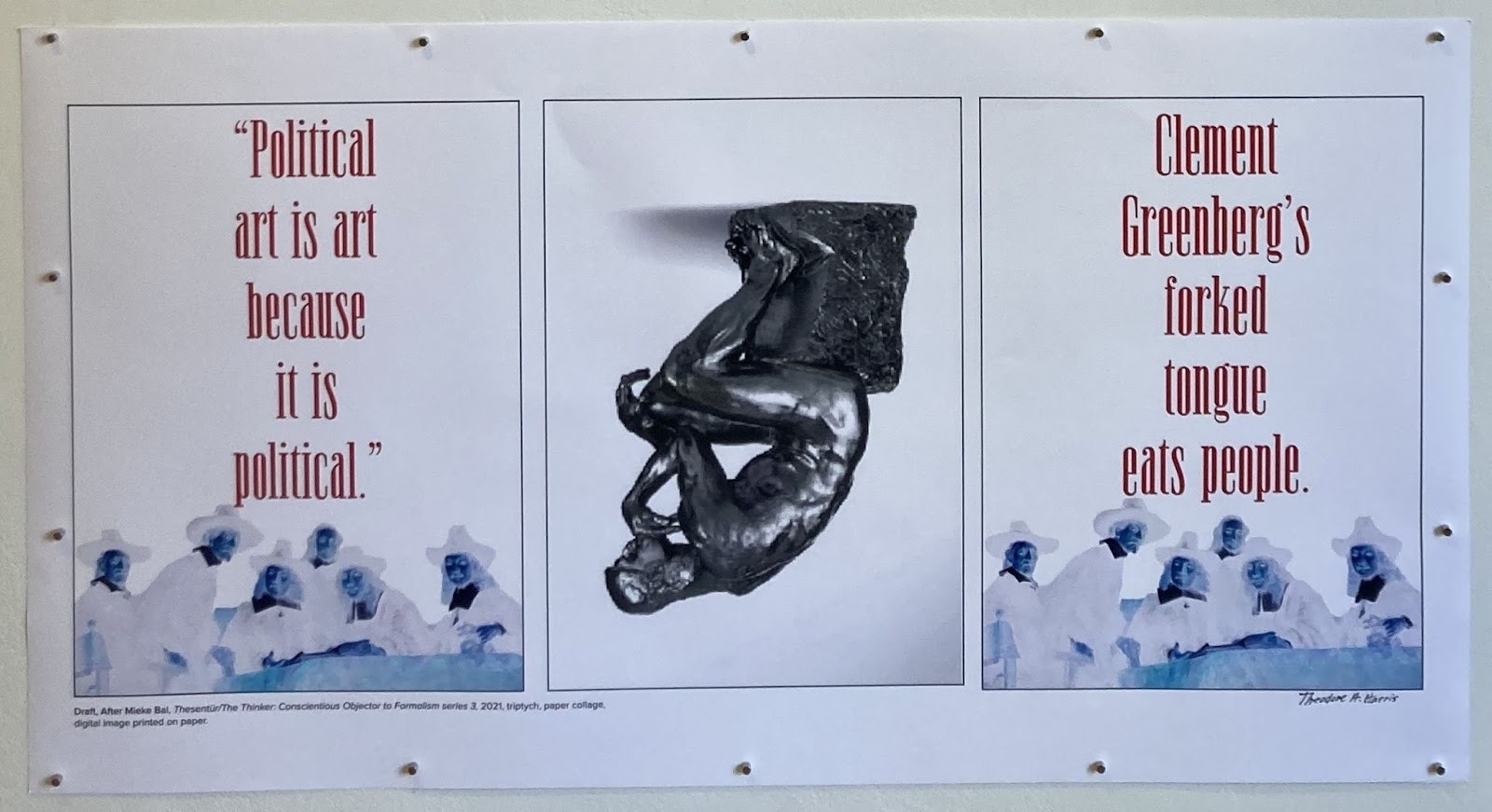
As Harris notes in another text-based piece, Draft After Mieke Bal (2021), “Political art is art because it’s political.” He has been teaching that lesson for years, but it is particularly apt today, as the Elon Musk-Donald J. Trump co-presidency of white-supremacist oligarchs has recently shown its true nature even more clearly. They have attacked not only diversity, equity, and inclusion but also knowledge itself by ordering the dismantling of the Department of Education. This nefarious task is being handled by one of Trump’s cabinet “apprentices,” former World Wrestling Entertainment executive Linda McMahon, now Secretary of Education McMahon. McMahon learned her new chain-sawing trade under the tutelage of the ubiquitous Mr. Musk, the driverless DOGE driver of the Trump evil-clown car. And, yes, Musk is still that driverless driver. After a brief, theatrical break during which he strong-armed a trillion-dollar pay package from Tesla, he is back on the White House stage, partying with Trump and Saudi Crown Prince Mohammed bin Salman, helping to grease the rails for real estate and crypto deals between the Trump family and the Saudi royal family, and writing big checks for MAGA midterm candidates, all while continuing to orchestrate the defunding of our students and teachers.[1]
Harris teaches us precisely what this budding dictatorship, with its War on Education, doesn’t want us to learn. He demonstrates how art just might help prevent it from becoming a full-blown dictatorship—even as the would-be dictators also slash funding of the National Endowment for the Arts. Harris is particularly adept at unmasking the hidden histories that authoritarians seek to conceal, which is perhaps more imperative today than ever before. After Trump’s 2025 executive order to purge American history instruction and research of anything deemed “negative” (e.g., slavery, racism, sexism, colonialism), David Blight, President of the Organization of American Historians, wrote in The New York Times: “Big lies move like viruses in the culture, and though we do have evidence, facts, and ethics on our side, there are no vaccines. The crude intent of this order is to further break institutions and to silence historians.”[2] Fortunately, artists of history like Harris will never be silenced. In fact, his work speaks more loudly than ever, especially about the history that those currently in power are attempting to censor.
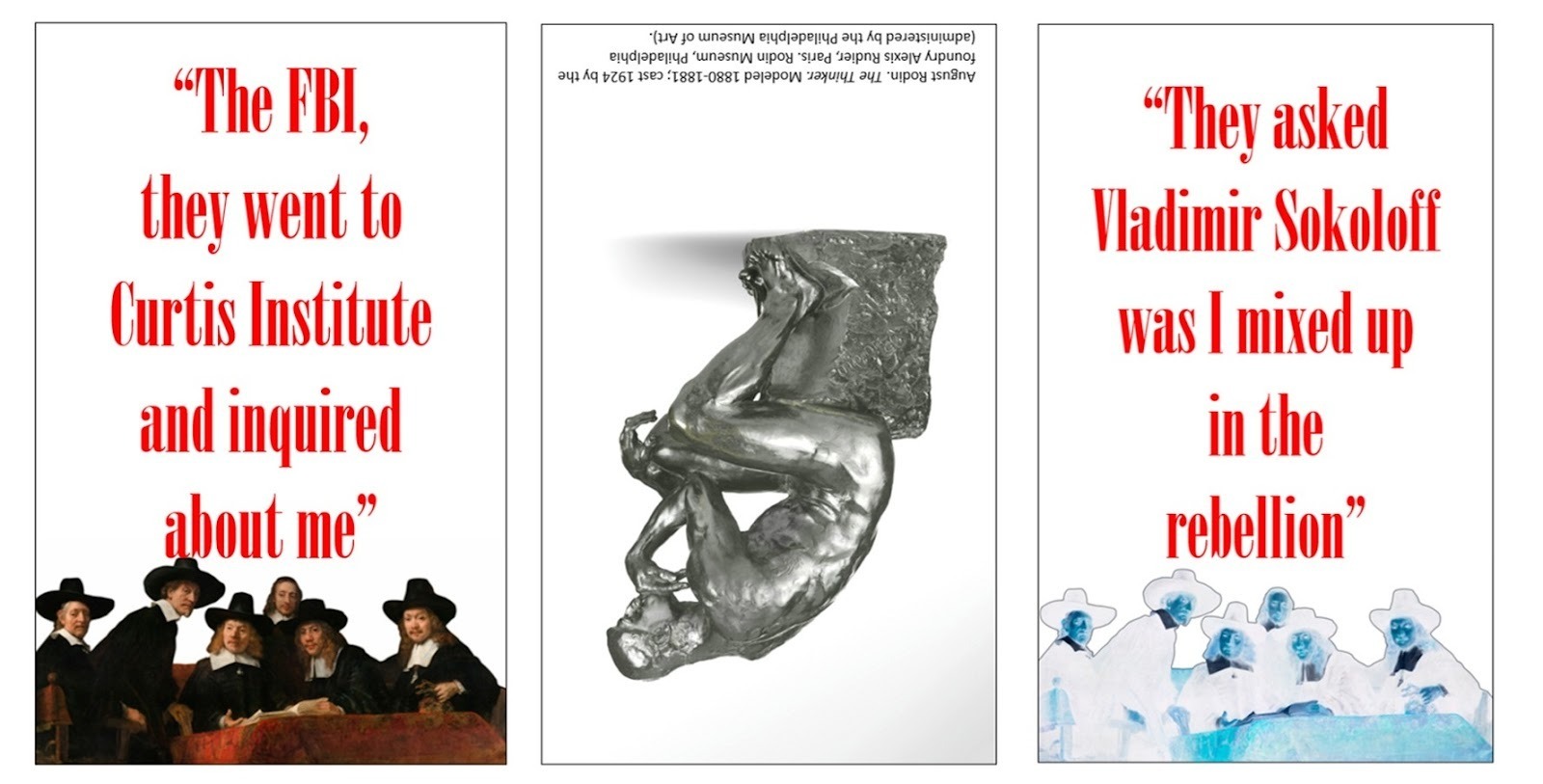
Harris has a knack for being uncannily relevant, as do the artists and thinkers who inspire him. His recent CFEVA fellowship exhibition, “Thesentür/The Thinker: Nina Simone and the Politics of Music,” provided further evidence of this. The exhibition brought together a range of his works, including those centered on the FBI investigation of Simone when she applied to study at the Curtis Institute of Music, one of the most prestigious centers for classical music education in the world—and which happens to be just a block from the CFEVA exhibition space on Rittenhouse Square. At the time, Simone was the only Black student seeking admission to Curtis, and was viewed by the FBI as dangerously subversive, suspected of Marxist and Black Power affiliations (yes, “Un-American activities”). In the exhibition, Harris guides us through the hidden history of Simone’s political persecution, in part by quoting her in his text-based pieces: “The FBI, they went to the Curtis Institute and inquired about me,” and “They asked Vladimir Sokoloff was I mixed up in the rebellion” (After Nina Simone 1, half here/half gone, 2022).
That was then, but it is also now. That was Nina Simone, but that is also us. It doesn’t take much imagination to see the parallels between Hoover’s witch hunts targeting communists and Black activists and Trump FBI Director Kash Patel’s “list of enemies,” which includes anyone who has dared to oppose Trump and call attention to his many illegal and often unconstitutional actions since the 2016 election, from the assault on the Capitol to the recent arrests and deportations of student activists, financial threats to universities, and blanket pardon of the January 6th “patriots.”[3]
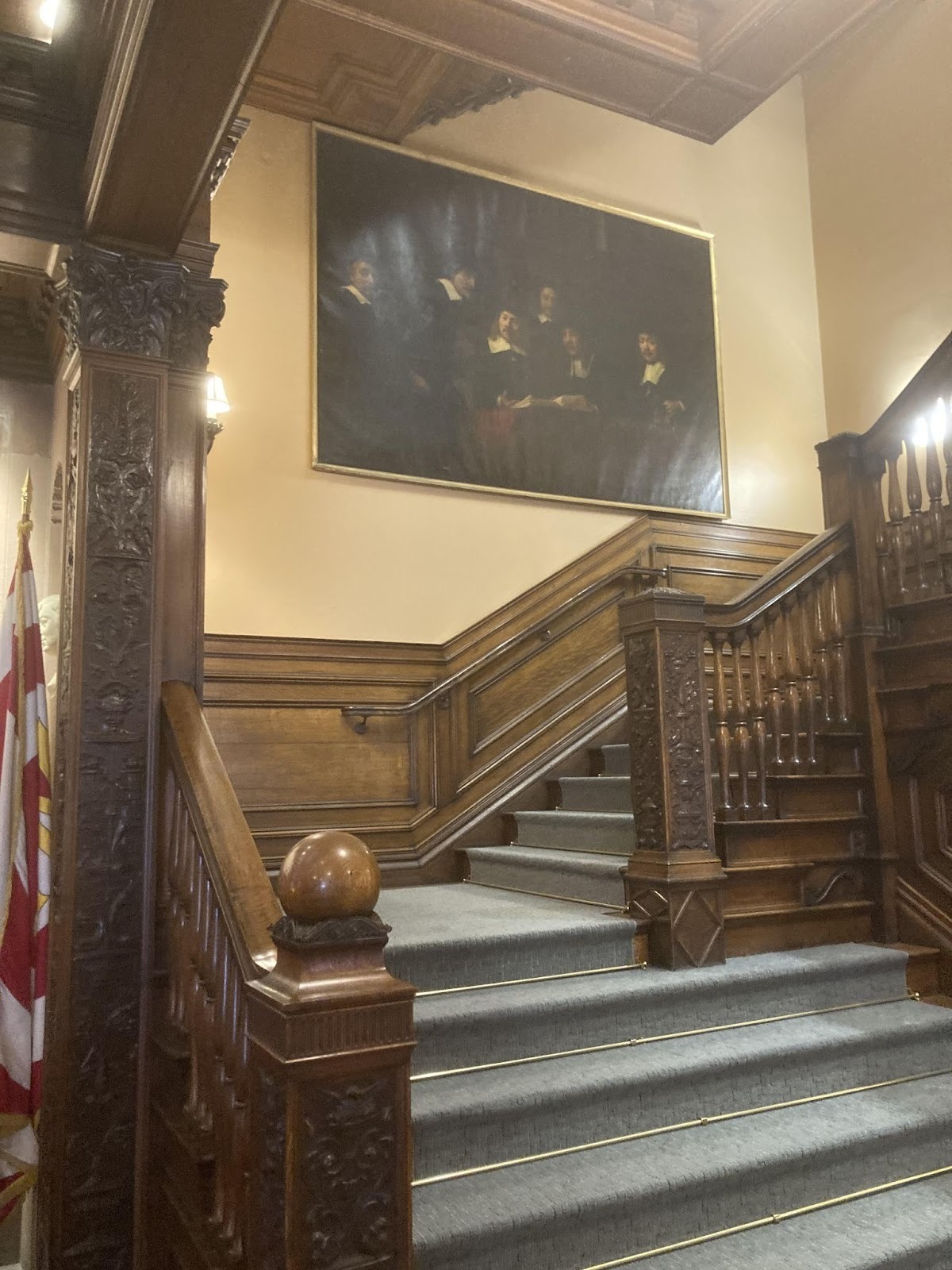
Interestingly, as Harris points out, when Simone applied to Curtis there was (and still is) a reproduction of Rembrandt’s famous painting The Syndics of the Drapers’ Guild, also known as The Sampling Officials (1662), hanging above the main lobby stairway landing. For Harris, who uses modified versions of the “Dutch Masters” figures depicted on Dutch Masters cigar boxes as a recurring motif to call attention to the colonialist funding behind Rembrandt’s work and that of many other canonical artists, the discovery of the reproduction was remarkable, yet not entirely surprising.
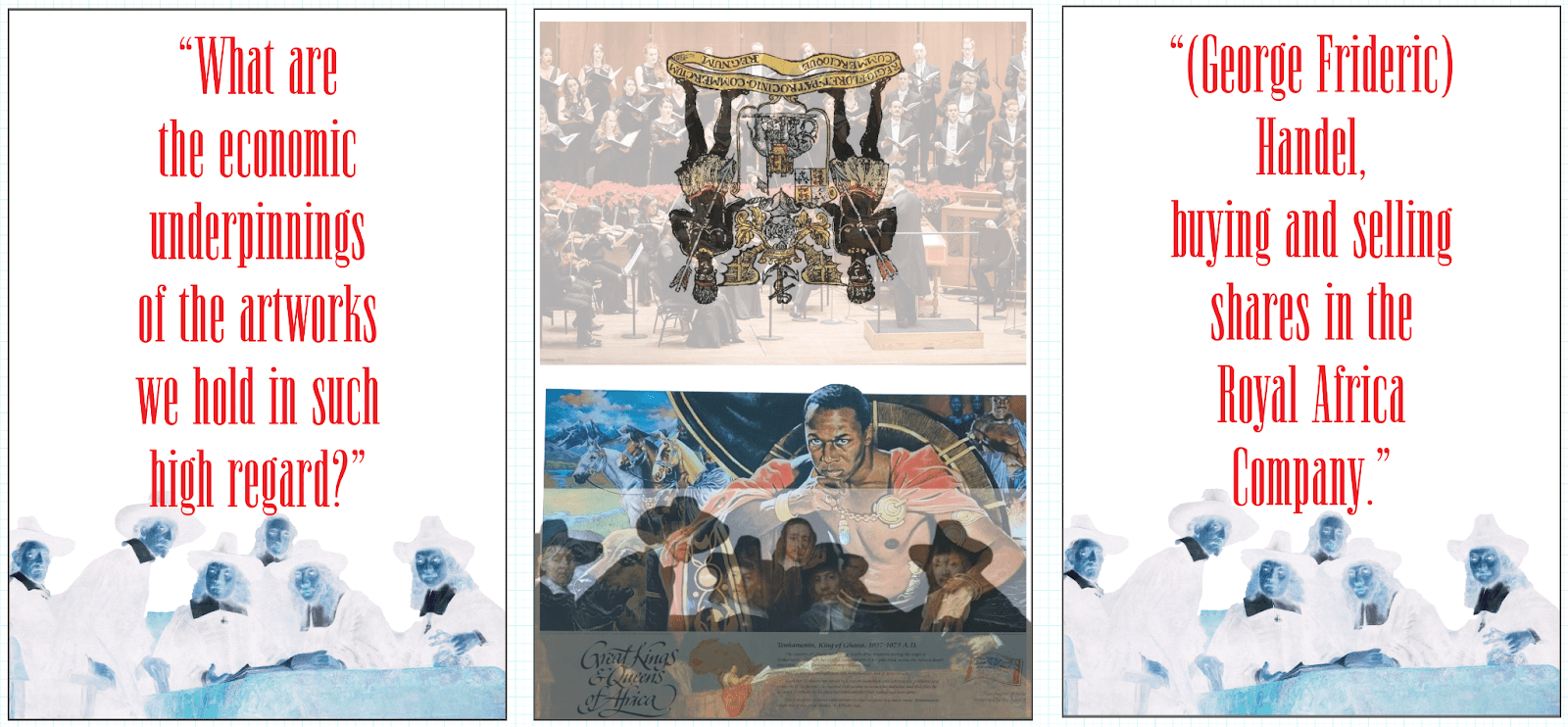
The majority of Rembrandt’s works were commissioned by Dutch oligarchs who made their fortunes from slave labor on sugar-cane, tobacco, and cotton plantations—a fact that was recognized in the Rijksmuseum’s 2022 Rembrandt exhibition, “Slavery: Ten True Stories.”[4] Harris poses one of the overarching questions of the exhibition and his entire oeuvre in another piece in the show, using the words of musicologist David Hunter: “What are the economic underpinnings of the artworks we hold in such high regard?” (After David Hunter, Ghosts 1, 2022).
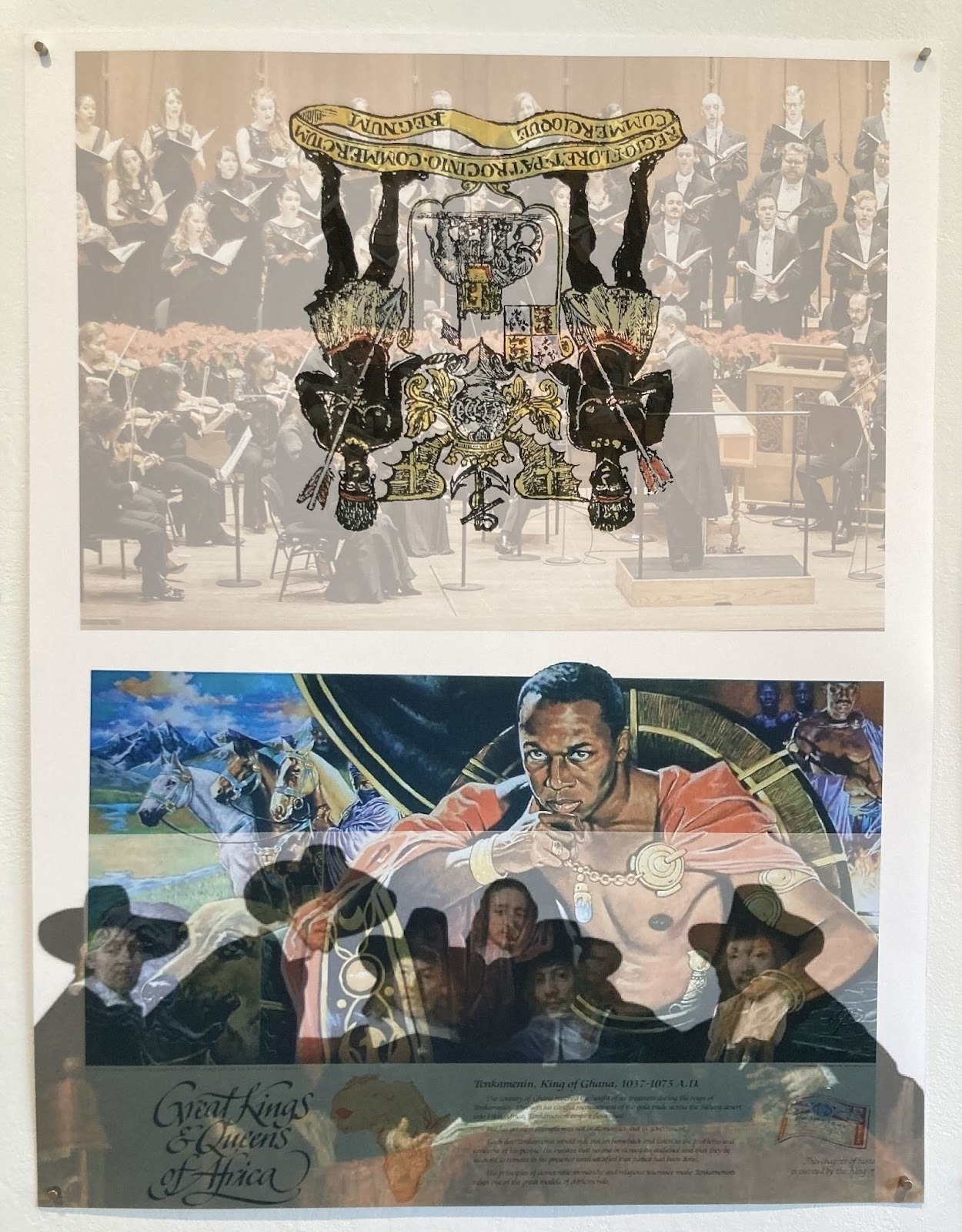
In an adjacent panel of the triptych, Harris presents us with another pertinent but virtually unknown historical fact from Hunter that answers this question regarding one of classical music’s most famous composers: “Handel, buying and selling shares in the Royal Africa Company.” In this work, Harris calls attention to the simple truth that, like Old Masters painting, much canonical “old masters” music also had direct financial links to slavery (c.f. Harris’s piece, SURGEON GENERAL’S WARNING: ‘This Work Is Brought To You In Part by The History Of the Slave Trade’).
The Royal Africa Company, founded in 1660 by the English crown and a group of influential London merchants, derived most of its profits from the African slave trade and was one of the largest slave-trading companies in the world.[5] These facts, coupled with Harris’s ironic presentation of an inverted image of the seal of the Royal Africa Company above images and text from the Budweiser ad campaign from the 1970s, “Great Kings and Queens of Africa,” illustrate just how pervasive the exploitation of Africa has been across history, from the three-hundred-year crime of slavery to the blaxploitation of beer ads. Harris’s underlying message in these and many of his other works is that if you want to understand why things are the way they are, just follow the money—back a few years, decades, or centuries.
What’s New and Not? Neo-Neo-Colonialism, with a Genocidal Twist
Colonialism and genocide, today? Lest this sound like liberal-snowflake paranoia, consider a few facts that demonstrate just how relevant Harris’s work is to our current political moment. In Harris’s and Amiri Baraka’s words, “What is The Thinker thinking about colonialism?,” and, by extension, what should any thinking person be thinking about colonialism now? One answer to these questions is that under the current regime we are witnessing the resurgence of colonial power structures and white-supremacist, techno-fascist oligarchy. Two wealthy white men, one of them obscenely wealthy, both with well-documented, deeply rooted white-nationalist beliefs, are in the process of systematically undermining not only American education but environmental protection, racial equality policies, financial regulations (especially crypto currency), AI oversight, judiciary independence, and democracy itself—with the support of a compliant Republican-controlled House and Senate dominated by wealthy white males (21st-century Syndics). It should surprise no one that almost all of these actions also serve to deregulate and lower taxes on the industries in which they make their profits.
As noted above, one of the lessons Harris teaches us about making art under a dictatorship is to “follow the money.” Although Nixon’s crimes during Watergate now seem almost quaint by comparison, following the money still reveals profound truths about the nature of power. So, when you gaze upon the words “Handel, Buying and Selling Shares in the Royal Africa Company,” you can’t help but ask, “Who is buying and selling shares in the Tesla Company today?” (If it’s university endowments—let’s hope they’re only selling). We might never know the exact answer, but we do know that in response to Tesla’s plummeting stock value in March 2025, there was an extended Tesla car commercial starring Trump and Musk, broadcast live, in front of the White House.[6] Curiously, this unique advertising opportunity materialized immediately after Musk promised to contribute another $100 million to Trump’s political action committee (PAC), on top of the $300 million he had already poured into the misinformation campaign that was indispensable to Trump’s re-election.[7] It’s the same old story, bought and sold. You are what you invest in. Don’t listen to their words; watch where their cash flows. Follow the money.

Once again, Harris’s historical sleuthing shows just how real this neo-neo-colonialism truly is. Consider Harris’s statements in two other works featured in the CFEVA show, which draw on Fred Moten’s words in the triptych After Fred Moten and Robin D.G. Kelley, half here/half gone (2020), “Settlers always think they’re defending themselves; that’s why they build forts on other people’s land,” and “Settlers always think they’re defending themselves and then they freak out over the fact that they are surrounded.”
Case in point, South Africa: not just two or three centuries ago, but today. If you think that apartheid is all a thing of the distant past and that any current concern with it is just a “woke” fever-dream, consider a few recent developments and their historical-economic underpinnings. In early February 2025, Ezra Klein, political columnist for The New York Times, made some insightful observations about settler mentality regarding South Africa and the recent rise of white nationalism, revealing how truth emerges when you follow the money on politics and racism: “Musk is South African. Peter Thiel spent much of his childhood in South Africa. David Sacks is South African. …it seems relevant and interesting that Thiel, Musk, and Sacks, who are three of the most significant figures in Silicon Valley’s embrace of Trump, have this very distinctive political experience of watching South Africa’s white minority move from being in control of the country to a frightened minority in the country.”[8] William Shoki, a South African journalist, explored Musk’s apartheid roots: “He is a white South African, part of a demographic that for centuries sat atop a racial hierarchy maintained by violent colonial rule. That history matters.”[9] Shoki adds that Musk’s “worldview is inseparable from his rearing in apartheid South Africa” and that “Mr. Musk represents an unresolved question: What happens when settler rule fails but settlers remain?…. History, unlike Mars, is not his to colonize.”[10] These “sons of apartheid,” whose ancestors built forts on other people’s land and then stole the entire land and the freedom of its Indigenous people, are now crying foul, proclaiming racism against wealthy whites (“We’re surrounded!”) to be the real problem in South Africa and are implementing lethally vengeful policies against poor Black South Africans.
What, exactly, have Musk and Trump done in South Africa to “defend” wealthy white settlers? Attack the poor Black majority. In recent months, Trump, under the direction of Musk, revoked all humanitarian aid funds to South Africa because, as Trump and Musk claim, “white landowners” are an oppressed minority and “genocide” is being committed against them.[11] These cuts are primarily directed toward programs for the prevention of malnutrition, dysentery, malaria, and AIDS, and they will virtually guarantee that thousands of Black people in South Africa, especially children living in deep poverty, will die. Call that Musk-Trump white-settler policy what it is: Genocide by defunding. And it is not just happening in South Africa. The United Nations’ World Food Program said ending these programs, especially USAID, “could amount to a death sentence for millions of people facing extreme hunger and starvation.”[12] If there could be any doubt about the enormity of Musk’s crimes, Bill Gates dispelled it in an interview with The Financial Times in early May 2025. Speaking of Musk’s dismantling of USAID, Gates stated flatly: “The picture of the world’s richest man killing the world’s poorest children is not a pretty one.”[13]
It is fair to say that there are very few people with more authority to speak those words. Gates, an expert in humanitarian aid who has donated tens of billions of dollars over the past two decades to help the poorest of the poor, has just pledged the remaining $200 billions of his fortune to continue this work at an accelerated pace.[14] The phrase “genocide by defunding” is not hyperbole.
It is beyond bitterly ironic that Musk, the white South-African American and former immigrant, who gleefully chainsawed USAID and threw it “into the wood chipper,” as he put it on Twitter/X,[15] has received billions in U.S. government subsidies, tax breaks, and loan guarantees over the years to help his often struggling car company, Tesla, avoid bankruptcy—and that much of this aid was granted by Barack Obama.[16] In fact, since 2008, Musk and his companies have received over $38 billions of US government aid in the form of subsidies, loans, tax credits, and government contracts.[17] Yes, Elon Musk is a white corporate welfare recipient. When he was down and out, he received a handout from the first Black president, an idealistic man who wanted to believe that Musk was as devoted to the environment as he then claimed to be. Follow the money—and see the hypocrisy. There is nothing truly new about neo-neo-colonialism.
The Big Lie
In 1964, Nina Simone, the presiding spirit of Harris’s CFEVA exhibition, released a new song, “Monster,” in which she sang:
What’s as big as a mountain
And grows bigger every day
‘Til it’s taller than the sky?
It’s a monster, a monster
A monster lie.
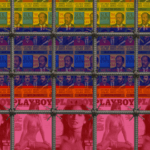
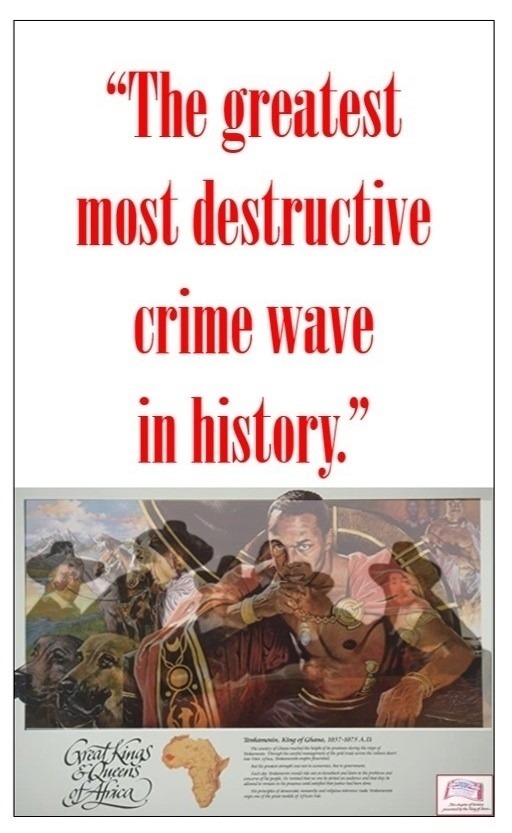
A central element of Harris’s work has been exposing the lies that have attempted to conceal history, especially “The greatest, most destructive crime wave in the history of the world,” settler colonialism and slavery. One of his works that exemplifies this is a grouping of nine image-and-text panels arranged in three stacked, printed triptychs. At its center is “The greatest, most destructive crime wave in history,” featuring those words by Robin D.G. Kelley above an image of Rembrandt’s “Syndics,” with a superimposed image from the “Great Kings and Queens of Africa” Budweiser advertising campaign. This is one of Harris’s most humorous and meaningful juxtapositions: Dutch colonialist masters of slaves used to sell cheap cigars; glamorized African kings used to sell cheap beer. The Thinker upside down, the inverted thinker, teaching us to think again about what we think we know, to think about what we don’t know but should. To think about the Musk-Trump doublethink, the absurd inversion of logic and fact necessary to claim that genocide against white South Africans is actually occurring.
As Harris shows, colonialism is a crime wave that has not ended. Given recent developments, it is fair to say it is on the rise again under the cover of somewhat different but still very big lies, amplified most shamelessly by the techno-fascist propaganda machine of Musk’s X/Twitter, which reinstated Trump’s account shortly after Musk bought the company in 2022, and the account of Nick Fuentes, perhaps the most notorious and vocal neo-Nazi Trump supporter in America today, in 2024.[18] Understanding how those in power have used big lies to gain power and maintain control is central to Harris’s artistic mission. The phrase “the big lie” has a notably ignominious history. As the European Center for Populism Studies explains: “The big lie is the name of a propaganda technique, originally coined by Adolf Hitler in Mein Kampf, who says ‘The great masses of the people… will more easily fall victim to a big lie than to a small one,’ and denotes where a known falsehood is stated and repeated and treated as if it is self-evidently true, in hopes of swaying the course of an argument in a direction that takes the big lie for granted rather than critically questioning it or ignoring it.”[19]
But Hitler’s Germany was just an isolated incident—a black swan event—utterly unrelated to anything truly significant in U.S. history, right?
“There’s Nazis Here.” Still and More than Ever (“Heil Tesla!”)
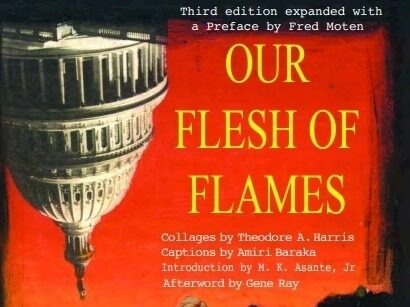
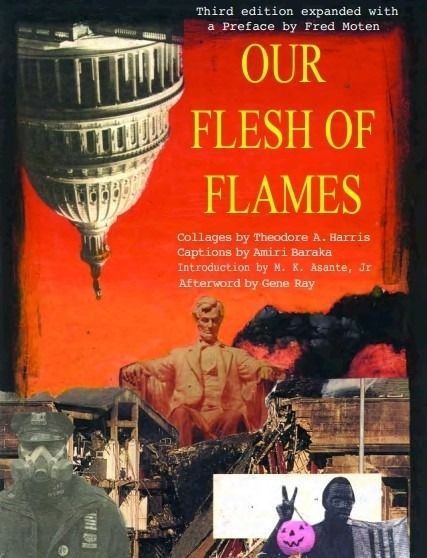
We’ll let a poet answer that question. A few years ago, while perusing Harris’s text-image collaboration with Amiri Baraka, Our Flesh of Flames, I read one of Baraka’s most disturbing and prophetic lines, written in 2013, shortly before his death: “I thought they said all of them Nazis was out of here permanent… I feel Nazis. There’s Nazis here.”[20] Five years later, on October 27, 2018, an American white nationalist armed with an assault rifle walked into the Tree of Life Synagogue in Pittsburgh and killed eleven members of the congregation. Tragically, this was not an isolated incident of antisemitic violence. The firebombing of Pennsylvania Governor Josh Shapiro’s residence on the first night of Passover, 2025, while he and his family were asleep inside, is one of the more recent ones.
Yes, as Baraka wrote in 2013, “There’s Nazis here,” and if that sounds alarmist, consider a few more salient historical facts. Musk has been enthusiastically supporting white nationalists in the US, UK, and Germany. In fact, his financial backing of neo-Nazis in Germany has been sustained and very substantial, despite objections by the German government and people that he is interfering in their national political process. Over the past two years, Musk has poured tens of millions into the campaigns of extreme right-wing politicians in Germany, primarily in the white-nationalist party, Alternativ für Deutschland (AfD). He has also expressed his unequivocal support of them on X/Twitter, his fully owned and controlled social-media propaganda platform, which he acquired through a hostile takeover to disseminate his big lies without interference. And Musk’s big-lie media empire is expanding: in November of 2025, Cornell researchers found that Grokipedia, Musk’s recently launched alternative to Wikipedia, routinely cites neo-Nazi publications as reliable sources, including the largest neo-Nazi website in the world, Stormfront, which Grokipedia cites 42 times, and the white-nationalist website Vdare, which it cites 107 times.[21] Goebbels would have been green with envy. Perhaps Musk’s and Trump’s alma mater, the Wharton School of Business (which, along with its parent institution, the University of Pennsylvania, is still under threat of being sued if it reveals Trump’s grades[22]), can do the math for them: Trump + Musk = Hitler + Goebbels. Some might try to dismiss this equation as hysterical left-wing rhetoric, but the very well-informed opinions of top German journalists and high-ranking American generals support it.
Shortly after Musk’s infamous Nazi salute given during his speech at an official Trump inauguration event in January of 2025, one of Germany’s leading newspapers, Die Zeit, published an article by its editorial board that directly confronted Musk for his support of Neo-Nazis in Germany and around the world. The editorial, appropriately alluding to the famous line by Jewish-American writer Gertrude Stein, “a rose is a rose is a rose,” stated, “A Hitler salute is a Hitler salute is a Hitler salute.”[23] Die Zeit added, “What is happening now is predictable… Neo-Nazis and right-wing radicals can interpret the stretched right arm as a gesture of fraternization and empowerment.”[24] Katrin Bennhold presented the German perspective: “In Germany, gestures like the one Mr. Musk made are illegal, along with other symbols and slogans from the Nazi era.”[25] Shortly after the Musk’s infamous gesture, anti-Musk protesters projected a photo of him delivering his picture-perfect Nazi salute accompanied by the words “Heil Tesla” onto the front of the Tesla Factory in Berlin. Bennhold, who is herself a life-long German citizen, also explained Musk’s choice to use this particular gesture to this particular audience: “Mr. Musk is now courting far-right parties in several European countries. His audience in Washington on Inauguration Day included Tino Chrupalla, a co-leader of Germany’s Alternative for Germany party; Giorgia Meloni, the prime minister of Italy, whose party is descended from the post-Fascist movement; Nigel Farage of Britain’s Reform Party; and Eric Zemmour of France, who is to the right even of the French National Rally’s Marine Le Pen.”[26] It is perhaps necessary to mention that although Gravity’s Rainbow does explore the war crimes of apartheid South Africa and Nazi rocket scientists during WW II, Pynchon did not dream up the following Musk family homage to Nazi Germany: Musk’s father, Errol Musk, was inspired to choose the name “Elon” for his son after having learned of a science-fiction novel written by none other than Nazi rocket scientist and SS major Wernher von Braun, Project Mars, which is set in a “colony on the planet run by an executive known as ‘the Elon.’”[27] This is not postmodern humor noir historical-fiction but verified historical fact published in Walter Isaacson’s 2023 biography, Elon Musk.
To connect the neo-Nazi dots a bit further and to prevent other pertinent facts from disappearing into what political comedian Harry Shearer refers to on Le Show as “the memory hole,” keep in mind that General Mark Milley, former Joint Chief of Staff under Trump, said to The Washington Post in November of 2024, “No one has ever been as dangerous to this country as Donald Trump… he’s a total fascist… fascist to the core.”[28] These words were not screamed by a wild-eyed, vegan radical at a protest but spoken publicly by a four-star general, hand-picked by Trump, and who worked closely with him for longer than any other joint chief. General John Kelly (Trump’s Chief of Staff 2017-2019), reported that Trump said to him more than once: “You know, Hitler did some good things, too.”[29] Regarding the swastika-wearing white nationalist mob in Charlottesville bearing torches and chanting “Jews will not replace us” in 2017, Trump said, “There are very good people on both sides.” It is little surprise that Trump was enthusiastically supported by former KKK Grand Wizard David Duke in all three presidential elections. You don’t need Wharton to help you do the math: Trump + Musk = Hitler + Goebbels. Take it from Amiri Baraka, Theodore Harris, Trump’s closest military advisors, and Die Zeit, “There’s Nazis here.”
“Zeit” means “time” in German, and Harris, Baraka, and Die Zeit know what time it is: a time of white-nationalist, techno-fascist resurgence. Yes, “there’s Nazis here,” in American and Europe, and they are all getting a big, unifying lift of funding and propaganda from the current occupants of the “Whitest House,” Musk and Trump. Musk put the cherry on the sundae of his fascist, genocidal credentials when he tweeted/X’d on March 14, 2025, that Hitler was not responsible for the deaths of millions of people.[30] The big lie has to be constantly repeated and amplified, because, as Harris’s work shows, it has to cover up “The greatest, most destructive crime wave in the history of the world.”
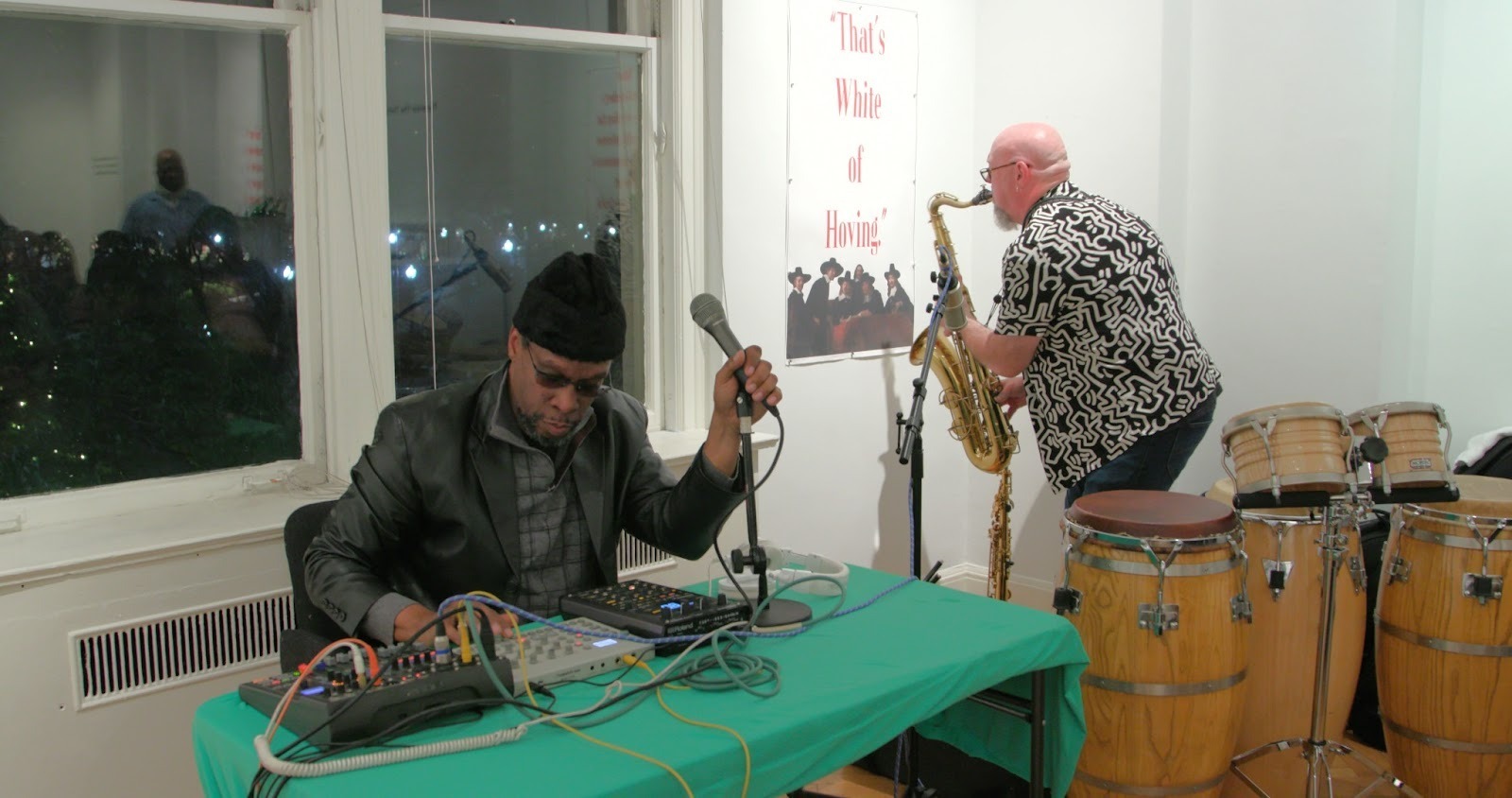
During the same performance at the opening of Hearing Justice: A Sonic Response in Solidarity with a Colonial Critique, Taji Ra’oof Nahl, also spoke these words: “When the monster approaches you. And it will approach you. Just offer him some cornbread. Monsters love cornbread.”
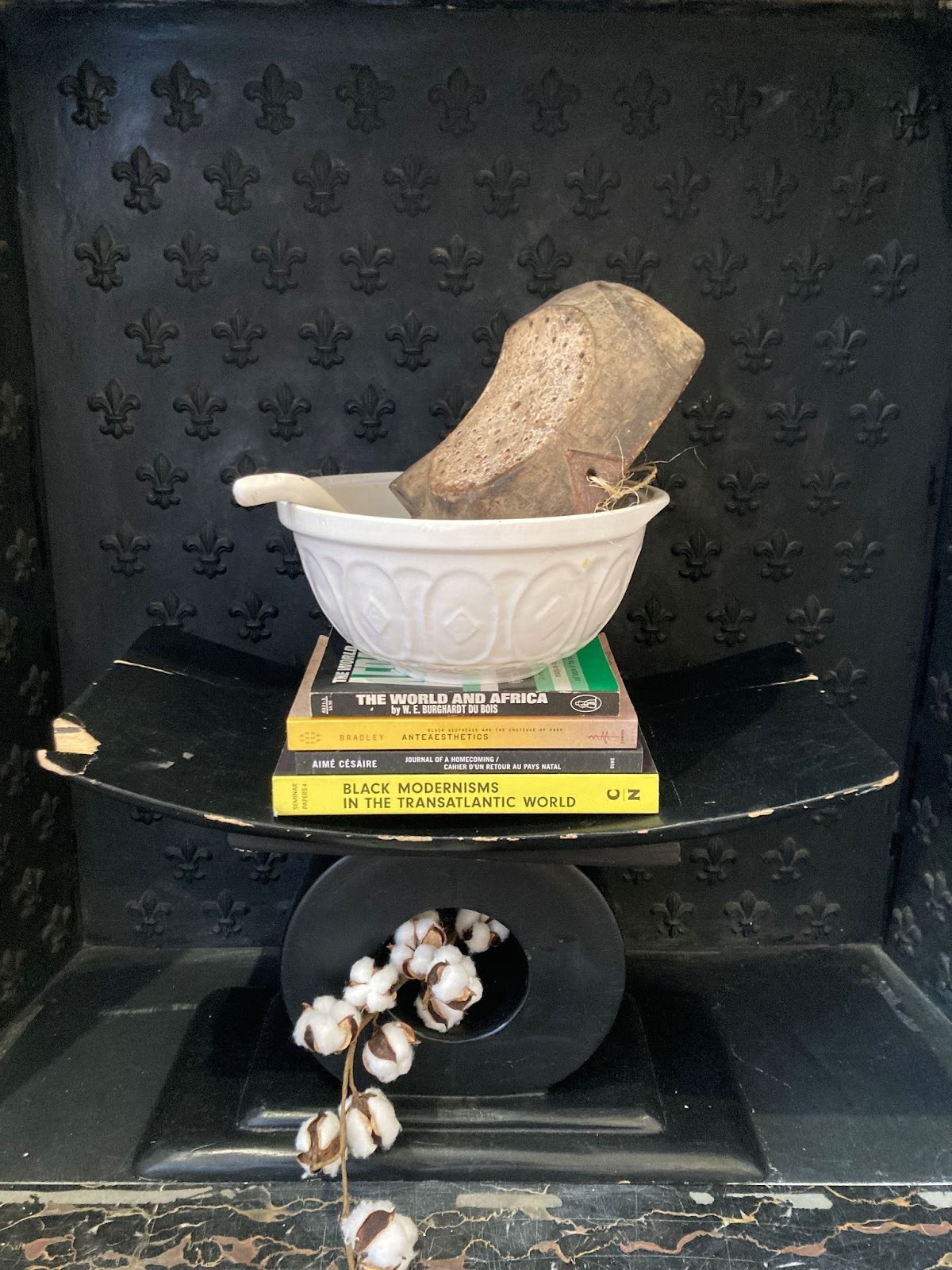
As Harris’s works, and the works of those artists and thinkers who have inspired him prove, the two-headed monster of Musk-Trump is the predictable product of centuries of colonialism. One of the ways to slay this beast is through gaining and spreading knowledge, particularly knowledge of history. And there is a piece in the exhibition, After Aimé Césaire, that extends the invitation to hidden historical knowledge quite directly; it is a sculptural installation in a fireplace that has four books ranging from African colonial history (Césaire’s Journal on a Homecoming) to Black modernism, with an African mask resting on top of them and a branch with cotton bolls below. Trump is currently taking the money from the defunding of the NEA (National Endowment for the Arts) which he wants to kill (just like the Department of Education, the National Endowment for the Humanities, and the EPA), and using it to bankroll his “National Garden of American Heroes” project, a planned collection of 250 sculptures of “heroic” Americans, whose rules for commission dictate that “all would be depicted in a ‘realistic fashion, with no abstract or modernist sculpture allowed.”[31] It’s another propaganda project that Hitler and Goebbels would have smiled upon, one that simultaneously purges the nation of Entartete Kunst (a Nazi term, which translates as “degenerate art”) and promotes “patriotism.” I’m glad to say that Theodore Harris’s work could never make the cut.
Slaying the two-headed beast that is slouching toward democracy and freedom will not be easy, but this beast is, in Joseph Conrad’s words in Heart of Darkness describing the Belgian colonial forces in Congo, just another manifestation of the “flabby, pretending, weak-eyed devil of a rapacious and pitiless folly.”[32] And clear-sighted strength, with swift, relentless gut-punches of historical fact, can take it down. Like Nina said: “No fear. Don’t be afraid of the monsters.” If there’s one thing that Theodore Harris teaches us, it’s that only the big historical truth, told passionately and eloquently, again and again, can kill the big historical lie.
Additional images (installation view) that accompany the essay: https://theodoreharris.weebly.com/images–field-journal-2026.html
John Heon, Co-Director of the Philadelphia Avant-Garde Studies Consortium, specializes in the politics and psychology of humor in modern/postmodern literature and art. He has written about Theodore Harris’s work in ASAP/Review, and his “Twisted Witz: Experiments in Psychopathology and Humor by Dr. Faustroll and His ‘Pataphysical Progeny,” is the opening chapter of Pataphysics Unrolled (Penn State UP). He has analyzed the relationship between racial politics and humor in Pynchon’s fiction in “Crossing the Punch-Line” (Peter Lang), and his book-in-progress is, Articulate Art: Language, Literature, and Humor in the Works of Bruce Nauman. John holds a doctorate in English from the University of Pennsylvania, where he received the Dean’s Award for Distinguished Teaching and the Dean’s Scholar Award.
Notes
- New York Times, “Who Attended the Dinner for the Saudi Crown Prince?” The New York Times, Nov. 18, 2025. https://www.nytimes.com/2025/11/18/us/politics/trump-saudi-dinner-guests.html ↑
- David Blight, “Trump Cannot Win His War on History,” New York Times, Mar. 31, 2025, https://www.nytimes.com/2025/03/31/opinion/trump-war-history.html. ↑
- US Senate Committee on the Judiciary, “Radical Extremist Kash Patel Would Weaponize the FBI to Target Enemies of Trump, Not Enemies of America,” US Senate Committee on the Judiciary Minority Press, Jan. 30, 2025. https://www.judiciary.senate.gov/press/dem/releases/radical-extremists-kash-patel-would-weaponize-the-fbi-to-target-enemies-of-trump-not-enemies-of-america ↑
- Rijksmeum, “Slavery: Ten True Stories.,” exhibition, Rijksmuseum, Amsterdam, 2022. https://www.artandmuseum.com/en/museums/rijksmuseum-amsterdam-slavery-ten-true-stories ↑
- William Pettigrew, Freedom’s Debt: The Royal African Company and the Politics of the African Slave Trade, U of North Carolina P, 2013. ↑
- Theodore Schleifer and Maggie Haberman, “Musk Seeks to Put $100 Million Directly into Trump Political Operation,” New York Times, Mar. 11, 2025. https://www.nytimes.com/2025/03/11/us/politics/elon-musk-trump-donation.html ↑
- Schleifer and Haberman, “Musk Seeks to Put $100 Million Directly into Trump Operation,” New York Times, Mar. 11, 2025. https://www.nytimes.com/2025/03/11/us/politics/elon-musk-trump-donation.html ↑
- Ezra Klein, “What Elon Musk Wants,” New York Times, Feb 7, 2025. https://www.nytimes.com/2025/02/07/opinion/ezra-klein-podcast-kara-swisher.html ↑
- William Shoki, “Musk is South African: We Shouldn’t’ Forget It,” New York Times, Feb. 28, 2025. https://www.nytimes.com/2025/02/28/opinion/elon-musk-south-africa.html ↑
- Shoki. ↑
- Michael D. Shear and John Eligon, “Trump Halts All Aid to South Africa, Claiming Mistreatment of White Landowners,” New York Times, Feb 7, 2025. https://www.nytimes.com/live/2025/02/07/us/trump-administration-updates#trump-biden-security-clearances ↑
- Karoun Demirjian and Edward Wong, “US Slashes Many of the Aid Programs It Had Promised to Keep.” The New York Times, Apr. 25, 2025. https://www.nytimes.com/2025/04/09/us/politics/usaid-cuts.html ↑
- Jennifer Rigby, “Gates to Give Away $200 Billion by 2045, Says Musk is ‘Killing’ World’s Poorest Children,” Reuters, May 8, 2025. https://www.reuters.com/business/bill-gates-give-away-fortune-by-2045-200bn-worlds-poorest-2025-05-08/ ↑
- Rigby. ↑
- Taylor Giorno, “‘We Are Terrified’: Musk Puts USAID Through ‘Wood Chipper,’” The Hill, February 3, 2025. https://thehill.com/policy/technology/5122676-usaid-shutdown-elon-musk-doge/ ↑
- Jim Motavalli, “US Technology Loans for Ford, Nissan, and Tesla,” New York Times, June 23, 2009. https://archive.nytimes.com/wheels.blogs.nytimes.com/2009/06/23/us-technology-loans-for-ford-nissan-and-tesla/ ↑
- Desmond Butler, “Musk’s Business Empire Is Built on $38 Billion in Government Funding,” Washington Post, Feb. 26, 2025. https://www.congress.gov/119/meeting/house/117956/documents/HMKP-119-JU00-20250226-SD003.pdf ↑
- Robert Draper. “Nick Fuentes: A White Nationalist Problem for the Right.” New York Times, Sept. 9, 2025. https://www.nytimes.com/2025/09/09/us/politics/nick-fuentes-trump.html ↑
- European Center for Populism Studies. “Big Lie.” (website article) https://www.populismstudies.org/Vocabulary/big-lie/ ↑
- Amiri Baraka, “What’s That Who Is This in Them Old Nazi Clothes? Nazi’s Dead” (poem), SOS: Poems 1961 to 2013, Grove Press, 2015. ↑
- David Ingram, “Elon Musk’s Grokipedia Cites a Neo-Nazi Website 42 Times.” NBC News Artificial Intelligence, Nov. 20, 2025. https://www.nbcnews.com/tech/elon-musk/elon-musk-grokipedia-wikipedia-neo-nazi-grok-42-encyclopedia-rcna244749 ↑
- Christopher Rim, “Here’s Why Donald Trump Doesn’t Want Anyone to Know His Grades or SAT Scores,” Forbes, Feb. 28, 2019. https://www.forbes.com/sites/christopherrim/2019/02/28/heres-why-donald-trump-doesnt-want-anyone-to-know-his-grades-or-sat-scores/ ↑
- Die Zeit, quoted in Bennhold, Katrin. “What Elon Musk’s Salute Was All About.” New York Times, Jan 24, 2025 https://www.nytimes.com/2025/01/24/world/europe/elon-musk-roman-salute-nazi.html ↑
- Die Zeit, quoted in Bennhold, Katrin. ↑
- Bennhold, Katrin. “What Elon Musk’s Salute Was All About.” New York Times, Jan. 24, 2025.https://www.nytimes.com/2025/01/24/world/europe/elon-musk-roman-salute-nazi.html ↑
- Bennhold. ↑
- Walter Isaacson, Elon Musk, Simon & Schuster, 2023, p. 16. ↑
- Jamelle Bouie. “There Is No Precedent for Something Like This in American History.” New York Times, Oct. 10, 2025. https://www.nytimes.com/2024/10/18/opinion/trump-woodward-milley- mass-deportation.html ↑
- Dan Mercia, “Trump Said ‘Hitler did some good things’ and Wanted Generals like the Nazis’, former Chief of Staff Kelly Claims,” PBS News, Oct 23, 2024.https://www.pbs.org/newshour/politics/trump-said-hitler-did-some-good-things-and-wanted-generals-like-the-nazis-former-chief-of-staff-kelly-claims ↑
- Kate Conger. “Elon Musk Shared, Then Removed Post Absolving Dictators of Genocide,” New York Times, Mar. 14, 2025. https://www.nytimes.com/2025/03/14/technology/elon-musk-x-post-hitler- stalin-mao.html ↑
- Jennifer Schleussler, “Canceled Humanities Grants to Help Pay for Trump’s ‘Garden of Heroes,’” New York Times, April 10, 2025. https://www.nytimes.com/2025/04/10/arts/trump-garden-heroes- humanities.html ↑
- Joseph Conrad, Heart of Darkness (1899), Norton, 2nd edition, 1971, p. 17. ↑